It will be my pleasure to participate in my fourth Cornerstone Festival this July 4-8 in Bushnell, IL. This year I am privileged to present seminars in two tracks, including Cornerstone You and the Imaginarium. Both sets of presentations look at differing issues from the perspective of intercultural studies. My series in the Cornerstone You venue looks cross-culturally at the rage directed at the West by the Majority World:
“The West and the Rest: Where Does Their Rage Come From?”
Americans scratch their heads at the constant protests and expressions of hatred against our country around the world. In reality, our lack of cultural appreciation and perspective causes us to misunderstand other cultures and their rage, but also to misunderstand the Scriptures and the Christian faith.
This year’s Imaginarium will be looking at various Day of the Dead celebrations in differing cultural contexts, and analyzing it from differing cultural expressions. My contribution to this fascinating topic is the following seminar series:
"Incarnation Means Becoming Human: Body, Soul & Imagination"
Image, myth, symbol and ceremony are the bread and butter of the Imaginarium, a fare people respond to as if they'd been starved. Often, they have been - by a Modern culture that prizes abstraction over incarnation. Missionaries worry about syncretism - mixing with non-Christian cultural forms - but have rarely scrutinized Modernity's conquest of the faith. Yet recent developments in missiology parallel the Imaginarium's journey in seeking a more sophisticated approach to culture. This seminar surveys those overlapping trails, and serves as the theoretical counterpart to our evening series: "Death Takes a Holiday: Celebrations of All Saints, Souls, & Bodies."
I am really looking forward to the perspective I will contribute to these topics and many of the other seminars as well. This may be the best overall year for the Imaginarium yet.
Most intriguing is a seminar series by Gretchen Passantino Coburn. I was fortunate to meet Gretchen, and her late husband Bob, during a previous Cornerstone event. We developed a relationship that continues to this day. During the course of our discussions I discovered a similar perspective on many issues of theology, apologetics, and missional approaches. Gretchen will also be speaking in the same venues as I am, and one of her sessions in Cornerstone You will be a joint Q&A between the two of us. Gretchen’s series in this venue captures the direction she has been moving in her thinking over the last few years:
“Why Doesn't Apologetics Work?”
Even seasoned apologists like Gretchen Passantino Coburn agree that most people adopt false beliefs and join aberrant groups for reasons other than intellectual, yet a wide spectrum of Christian leaders continue to focus on education and knowledge as the keys to right belief and practice. How do we resolve this paradox?
I know that Gretchen has been rethinking apologetics, theology, and mission in recent years. It will be interesting to hear her presentations and to see where her thinking is at the present time. Perhaps this veteran apologist and past co-worker with the late Walter Martin has moved to the incarnational mission side of the coin alongside this blogger.
If you can attend this year's C'Stone Fest, I wholeheartedly recommend it. And if you attend one of my seminars stop on by and say "hello."
Sunday, April 30, 2006


Tuesday, April 25, 2006
Diverse Faiths in our Neighborhoods: What Does the Lord Require of Us?
 In a Yahoo discussion group Amos Yong of Regent College stimulated my thinking about an aspect of the encounter between evangelicals and adherents of other religions. He touched on implications from Jesus’ teachings from the parable of the Good Samaritan, as well Matt. 25 where Jesus states that how we respond to those in need reflect our reception (or denial) of him. Yong wondered how our treatment of the “religious other” might also be included in this passage of Scripture.
I found this perspective of great interest. Evangelicals spend a lot of time considering the soteriological destiny of those in other religions, defining orthodoxy in relation to heresy, and formulating evangelistic and mission strategies in this regard. But we spend little time reflecting on what God is doing in the Christian as they interact with those of other faiths. We are rightly concerned about a number of issues in the interfaith encounter, but we may be neglecting one of the most important issues in the process.
As I continue to consider the importance of this issue I was fortunate recently to come across an organization called Faith to Faith in the United Kingdom. An Internet search turned up this Christian consultancy which addresses the issue raised above as it also attempts to formulate a balanced Christian perspective in light of religious pluralism in the U.K., an approach similar to that of my own Neighboring Faiths Project in the U.S.
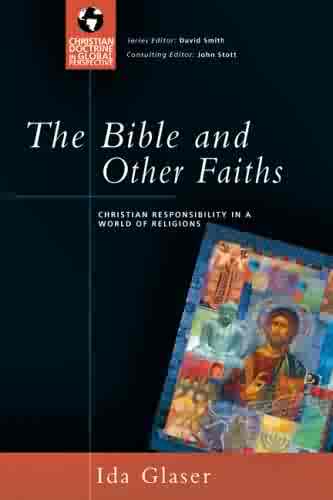
Faith to Faith was directed in the past by Ida Glaser, who is now senior teaching and research fellow for the Edinburgh Centre for Muslim-Christian Studies. She is the author of a wonderful book I am now reading (one of several!) titled The Bible and Other Faiths: Christian Responsibility in a World of Religions (IVP, 2005). The book is part of a series on Christian Doctrine in Global Perspective, with John Stott serving as the Consulting Editor. This book is extremely helpful in that it not only provides a global perspective on the question of religious pluralism, but also moves beyond traditional Christian approaches to the topic in order for Christians to reflect on what the Lord requires of us in the interreligious encounter. A brief excerpt from the first chapter provides a hint of the treat this book provides:
In August 2001 I led a seminar for teachers from theological colleges in Uganda. We were thinking about how and why they taught Islam. The key question, I suggested to them, is “How should we as Christians live in relation to Muslims? What does God want of us?” We looked at the Sermon on the Mount, at the great commandment of Matthew 22:39 and at the Great Commission of Matthew 28:18-20. Then we read Micah 6:8: “He has showed you, O human being, what is good. And what does the Lord require of you? To act justly and to love mercy and to walk humbly with your God” (author’s translation).Glasser’s book brings a helpful perspective for Christians living amidst America’s increasing religious diversity and who are concerned not only with sharing the faith across religious cultures, but also with the process of transformation through the Spirit that comes with our yielding to a life of service and love for those from the world’s religions (and new religions) that we live with in our neighborhoods.
Then I asked, “How are we getting along? Are we living like that in relation to Muslims? What stops us?”
The answers came immediately: “Muslims say that Jesus is not the Son of God. They criticize the Bible. They won’t let us preach. They are setting up lots of new mosques. They want to take over our town. They are persecuting Christians in Sudan. They won’t eat our food. They are trying to marry our daughters …”
I repeated what they had said, and they got the point. Even if all those things are true, is there anything in Muslims that Christians can blame for their own lack of obedience to God? Nothing in Muslims, Hindus, Sikhs, Buddhists, atheist or even other Christians can stop us from doing what God requires. Only what is in us can do that.
Thursday, April 13, 2006
Sacramento, California Trip Summary and Words of Clarification
My family and I are nearing the completion of our trip to Sacramento in the northern California area. Tomorrow is the last day as we have a few more meetings, luncheons, and time with friends.
The ministry experiences here have been encouraging. I presented Bridges to a combined group from two churches, RiverCity Calvary Chapel of South Sacramento, and LifeSong of Elk Grove. The presentation was well received, and several people expressed appreciation for a missional and relational approach to understanding Mormonism and sharing the gospel with Mormon friends.
This trip to California also included meetings with large churches in the greater Sacramento area. Several of them are considering hosting a Bridges presentation, along with the new Grounded program for teens developed by Salt Lake Theological Seminary. We are well on our way to developing an alternative evangelical approach to the LDS temple opening this summer.
In addition, I was able to touch bases with supporting churches, including First Baptist Church of Elk Grove, and Fair Oaks Presbyterian Church, where I gave a summary of our Utah ministry at the monthly missions potluck. We are thankful for the partnerships with these churches and many of their members who's prayers and financial support literally make our ministry possible.
During this visit I also had an opportunity to meet with a ministry colleague who shared concerns about the missional direction that I have taken. Similar concerns were shared with colleagues of mine in Utah while I was away. I'd like to use the opportunity presented by these concerns to clarify issues and provide further food for thought.
1. Missional paradigm. My colleague shared his concerns that the missional paradigm I am involved in was too academic, it could not be understood, and that he was against it. Several thoughts come to mind in response to this concern.
First, what is the missional model to new religions that I and colleagues from around the world are presenting? Very simply, we are suggesting that the cross-cultural missions approaches that are articulated in the New Testament, and continue into the history of Christian missions overseas, should be applied to the new religious movements in the U.S. and the West. This means viewing Mormonism, for example, as a culture rather than as a "cult," and engaging this culture holistically, drawing not only upon apologetic argument, but also cross-cultural missions.
Second, our missional paradigm has been developed academically, and our book, Encountering New Religious Movements (Kregel Academic & Professional, 2004), was designed as a textbook for Christian university students, Bible college students, missiologists, and other Christian scholars, but this does not mean the book should be dismissed by those who do not feel they are academically inclined. We hope to develop these ideas for the "lay" Christian reader in the near future, but I would encourage those who are tempted to dismiss the articulation of our missional thesis in the academy not to return to the anti-intellectualism that marks Christian fundamentalism.
Third, if someone cannot understand our missional paradigm then it cannot be dismissed as inappropriate. Recall the maxim of the necessity to be able to say "I understand" before you can say "I disagree." If countercult personalities do not understand the cross-cultural missions paradigm we are articulating then they have a responsibility to ask questions and to seek clarification and understanding before leveling criticism.
Fourth, we might consider the possibility that the reason why the missional paradigm has been reacted to so negatively by many in the countercult is not because the the thesis has not merit, but because it involves a paradigm shift. Shifting from heresy contrast and refutation to cross-cultural missions is not easy, and the heresy refutation filter for countercultists likely results in a skewed interpretation of the missional paradigm.
2. Critique of countercult philosophy and methodology. My colleague also shared his concerns about my critique of countercult theory and praxis. He feels that it is inappropriate to state that a given methodology is problematic and should not be engaged in, even when it comes to the "street preachers" in Utah. Two thoughts come to mind in response to this concern.
First, the cross-cultural missions paradigm to new religions contains within it an implicit critique of countercult approaches. While my vocal critique of the countercult paradigm has no doubt added fuel to the fire for those who disagree with me, eventually the deep differences between the two approaches would have been evident and would have to be dealt with.
Second, why can't criticism be leveled against different paradigms in the free marketplace of ideas, including the arena of ministry? Theologians and missiologists routinely engage each other and critique each other's work and few cry "foul" in these contexts. I also find it curious that a few countercult critics have recently refused to label even the most extreme street preachers in Utah as inappropriate and out of bounds, and yet these same critics feel comfortable leveling criticism against those of us developing a missional model. It seems that those of us who are arguing for a missional model that takes culture and Scripture seriously are more problematic for the countercult than those who hold up derogatory signs and wipe their buttocks with Mormon temple undergarments.
I would ask the critics of the missional model to give this approach a fair consideration. If you don't understand something, ask one of the proponents and we'll do our best to help you understand. Also keep in mind that our thesis was presented in a book that won a Christianity Today Book of the Year Award in the category of missions/global affairs, and the book and its ideas have been favorably reviewed by missiological journals in the U.S. and the U.K. Other academic periodicals have begun to consider the thesis as well, and in the recent issue of Bibliotheca Sacra our book was favorably reviewed. Beyond this, our paradigm has received the support of the Lausanne Committee for World Evangelization, and leading theologians and missiologists as well. There is something credible and exciting here.
But at the end of the day it may be that representatives of our conflicting paradigms must part company. Recall Paul's parting of the ways with Barnabas. One of the great challenges for Christians has always been balancing our diversity with our unity. As the granddaddy of the countercult used to say, let's try to exercise the maturity necessary to "agree to disagree agreeably" even as we wish each other godspeed and pursue our differing pathways.
Thursday, April 06, 2006
Off Next Week to California
My family and I leave tomorrow (Friday) for northern California and the Sacramento area. I will be presenting the Bridges training program to the combined churches of RiverCity Calvary Chapel and LifeSong Church. I will also be speaking on the challenge of Western culture and misisonal church to the college group of Fair Oaks Presbyterian Church Sunday night, and return Tuesday evening to update the church on my missions work in Utah at their monthly missions potluck. Beyond that I will be touching bases with various supporters, both individuals and churches, and I will be touching bases with key churches in order to pursue an Evangelical-LDS dialogue and Bridges training as an alternative to the distribution of literature during the opening of the LDS temple this summer in Rancho Cordova.
Given my travels in California I will not be posting on this blog next week. This means that those who enjoy reflecting on my posts will have to wait for a week, and my critics will have a week off as well which will allow their blood pressure and stress level to lower for a while.
I wish all my readers a wonderful Palm Sunday and Easter celebration.
Monday, April 03, 2006
Mormons as Enemies of God?: Reflections on LDS General Conference
 Last Saturday and Sunday the Church of Jesus Christ of Latter-day Saints held its General Conference in Salt Lake City. I had the privilege of participating in Operation Loving Kindness sponsored by the ministry of Standing Together in connection with the conference on Saturday. The purpose of Operation Loving Kindness is for traditional Christians from a variety of area churches to share their love and support with Latter-day Saints as they enter and leave from their participation in General Conference. As the throngs of Mormons walked by we stood near the conference center and wished Mormons a good morning, and shared our love and support for them as individuals and as a people.
One of the fascinating aspects of participation in this event was the variety of responses from Mormons as well as the notorious "street preachers."
The response of Latter-day Saints was varied as one might expect, with some expressing an understandable hesitancy and concern over non-Mormons standing near the facility associated with General Conference. But the vast majority received us warmly and expressed their appreciation for our presence and expressions of kindness. A handful even went so far as to approach us, offer us a handshake, and thank us for our efforts and sentiments.
While the reactions of Latter-day Saints was of interest, the reaction of the street preachers was even more interesting. The handful of preachers were scattered up and down the main street that led to the conference, signs with scripture verses and derogatory slogans held high. They alternated between preaching messages of denunciation at Mormon passers by, and when LDS crowds thinned, they took aim at those of us affiliated with Standing Together, even going so far as to denounce us as heretics and unbelievers. (As an aside, the street preachers assumed they were presenting the gospel that was being rejected by heretics, when in fact no contextualized communication was taking place across the subcultures of evangelicalism and Latter-day Saints. Their sermons amounted to little more than a harangue that had no positive appeal and represented poor communication skills, even for evangelicals who might share aspects of their worldview.) During these dismissive sermons I was able to feel for just a moment some of the rejection and judgmentalism that Latter-day Saints must feel when they are the target of this aggressive form of "evangelism."
My experiences at General Conference came during a week when I also received a few emails from a critic of my blog on the topic of Mormonism. He began our brief exchange by asking whether I believed Mormons were rightly viewed as "enemies of God" which included his citation of Romans 11:25 which refers to ethnic Israel's becoming the enemy of God for the grafting in of the Gentiles into the Kingdom of God. As our exchanges continued it become increasingly evident that this person was looking for any kind of biblical justification for regarding Mormons as enemies of God, and presumably of evangelicals.
I believe the attitudes and behaviors of the street preachers and my email inquirer share a common thread, and that is a tendency to view the Mormon people (and not merely Mormonism) as an evil worthy of our denunciation and condemnation, but precious little else. While Christ surely engaged in moments of condemnation, a quick review of these instances in the New Testament reveals that he reserved such judgments for the religious leaders, not for the common people of various stripes, whether Jew or Samaritan (whom the Jews presumably thought were the enemies of God as well). Perhaps if Christ were to have made his first appearance in our time he would in like manner have given his most stern rebuke to corrupt Christian leaders while extending his mercy and invitation to the Kingdom to those some evangelicals perceive as enemies of God.
At any rate, I find it interesting that when evangelicals engage in acts of kindness and love for Mormons and engage in ways of ministry that challenge the status quo of confrontation, the attack quickly shifts to an expanded collection of targets that also includes fellow evangelicals. While there are certainly divergences of opinions and methodologies among the countercult community (to a limited degree), my experiences with both the countercult and the street preachers leads me to wonder whether they do not inhabit the same spectrum of ministry separated by degrees rather than by kind.
Thursday, March 30, 2006
Kent Bean Doctoral Dissertation on Manti Miracle Pageant
Through my ongoing research on anthropology of pilgrimage as it relates to LDS temple openings and the Manti Miracle Pageant, I was referred to Professor Kent Bean at Snow College in Ephraim, Utah. Dr. Bean wrote his doctoral dissertation, "Policing the Borders of Identity at The Mormon Miracle Pageant," for the Graduate College of Bowling Green State University. Dr. Bean touches on several areas I have discussed in previous posts, including the issues of identity and boundary maintenance, which Bean sees as key activities of engagement among the social actors attending Manti, including Mormons, members of the True and Living Church of Jesus Christ of Saints of the Last Days, and evangelicals. Several aspects of Bean's dissertation are worth highlighting.
Bean's discussion of the social aspects of the Manti pageant are significant. Bean discusses the Manti pageant as "material aspects of public display" which sends a "meta-message" as thousands of Mormons gather to reaffirm their faith and sense of identity. Bean references Mircea Eliade's writing in The Sacred and the Profane (1962) where he asserts "that a people can become what they display." The identification of individuals and of a whole religious community through the act of public display takes on additional signficance when we consider that the presence of others from other religious communities is interpreted as an affront to the boundaries of the Mormon community. Indeed, Bean notes that the presence of members of each religious group serves as a threat to the boundaries of each group:
In one section of his dissertation, Bean discusses the issue of identity formation and the importance of having an Other against which one can define oneself. He quotes John R. Lewis who notes that societies need enemies, and working against a perceived enemy provides a sense of greater unity for a community. Bean notes that it might be too harsh to conceive of evangelicals and Mormons as enemies, nevertheless, he writes, "Actually, I should not be too hasty in saying they do not consider each other enemies, for certainly some members of each group consider members of the other group to be, quite literally, enemies of righteousness. But the important point is that in the defining of someone as an enemy - indeed, in the manufacture of some Other as an enemy, which is arguably what is happening in instances of counter-Mormon activity and Mormon response - there is group cohesion."
On the issue of the evangelical portrait of Mormonism, Bean writes:
There are many other highlights and insights in Dr. Bean's dissertation that make it a worthwhile read. He has done us a service in providing another interpretive lens through which to understand the Manti Miracle Pageant. His thinking should be considered before evangelicals put together this summer's short-term "mission trip" to Manti. Are such trips really the result of sound missiological thinking, or are they subconsciously an opportunity to defend evangelical identity against a perceived religious enemy in order to claim their sacred turf as our own?
Bean's discussion of the social aspects of the Manti pageant are significant. Bean discusses the Manti pageant as "material aspects of public display" which sends a "meta-message" as thousands of Mormons gather to reaffirm their faith and sense of identity. Bean references Mircea Eliade's writing in The Sacred and the Profane (1962) where he asserts "that a people can become what they display." The identification of individuals and of a whole religious community through the act of public display takes on additional signficance when we consider that the presence of others from other religious communities is interpreted as an affront to the boundaries of the Mormon community. Indeed, Bean notes that the presence of members of each religious group serves as a threat to the boundaries of each group:
"Pageants have become one 'battleground' where issues of naming can be discussed and tussled over. Identity claims can be staked out by all those involved: 'I am this; you are that.' 'No, I am this; you are that.' Boundaries are explored in the process and territory is claimed."
In one section of his dissertation, Bean discusses the issue of identity formation and the importance of having an Other against which one can define oneself. He quotes John R. Lewis who notes that societies need enemies, and working against a perceived enemy provides a sense of greater unity for a community. Bean notes that it might be too harsh to conceive of evangelicals and Mormons as enemies, nevertheless, he writes, "Actually, I should not be too hasty in saying they do not consider each other enemies, for certainly some members of each group consider members of the other group to be, quite literally, enemies of righteousness. But the important point is that in the defining of someone as an enemy - indeed, in the manufacture of some Other as an enemy, which is arguably what is happening in instances of counter-Mormon activity and Mormon response - there is group cohesion."
On the issue of the evangelical portrait of Mormonism, Bean writes:
"..Evangelicals read Mormon Scripture mostly, if not completely, divorced from the context of Mormon culture, which gives Mormon Scripture a fuller structure. Evangelicals arrive at the pageant with a textual construction of Mormonism, made from the fabric of sundry Mormon texts (many of which the average Mormon does not read or would only pull down from the shelf as a reference book), and they proclaim it Mormonism. Mormons, living their day-to-day lives, often uneventful but filled with the simple, repetitive joys of family, job, and weekly church attendance, are baffled by the strange thing presented to them by the Evangelicals, and their first instinct is to charge dishonesty."
There are many other highlights and insights in Dr. Bean's dissertation that make it a worthwhile read. He has done us a service in providing another interpretive lens through which to understand the Manti Miracle Pageant. His thinking should be considered before evangelicals put together this summer's short-term "mission trip" to Manti. Are such trips really the result of sound missiological thinking, or are they subconsciously an opportunity to defend evangelical identity against a perceived religious enemy in order to claim their sacred turf as our own?
Wednesday, March 22, 2006
Amos Yong and the Interreligious Encounter
Amos Yong is Associate Professor of Theology at Regent University School of Divinity. He was born and raised in part in Malaysia, and has been a minister with the Assemblies of God since 1987. He is a promising and prolific young scholar who has been applying his academic gifts toward the development of a pneumatological theology of religions in books such as The Spirit Poured Out on All Flesh: Pentecostalism and the Possibility of Global Theology (Baker Academic, 2005), and Beyond the Impasse: Toward a Pneumatological Theology of Religions (Baker Academic, 2003.
Yong is featured in the March 2006 issue of Christianity Today in an article by Roger Olson titled "A Wind that Swirls Everwhere." The article includes a number of interesting statements, including Yong's view that "Dialogue and proclamation are not mutually exclusive but intrinsically connected." Olson puts his work in the category of a theologoumena, theological explorations of new ways of looking at old questions. The article also states that Yong regards the traditional categories of religious pluralism and inclusivism too static and as a result he is looking for an alternative. As the article nears its conclusion, Olson says that, "For Yong, the Spirit should not be limited to the supernatural, so even the porcess of discerning the Spirit's work can be enhanced by sociological and anthropological research."
In a recent exchange with Dr. Yong he made available a copy of an article that will be published in the future in Missiology titled "The Spirit of Hospitality: Pentecostal Perspectives toward a Performative Theology of Interreligious Encounter." The paper is the result of a presentation Yong gave at a meeting of the American Society of Missiology.
The article is worth a subscription to Missiology journal, not only for the merits of its overall thesis, but also the many gems contained within it. For a few examples, Yong states that there is a "need to cultivate a wider range of postures and approaches to the interreligious encounter more appropriate to the demands of a post-9/11 era." The author develops his pneumatological theology of interreligious encounter, and adds additional elements to it. Yong discusses the lessons we can learn about interreligious encounters from the church's expansion into Samaria and the Parable of the Good Samaritan and suggests that Jewish attitudes about the Samaritans parallel Christian attitudes about other religions. The article also discusses the significance of hospitality and table fellowship in a first-century context and suggests that this spirit of hospitality can be helpful for the Christian church in the interreligious encounter and dialogue with adherents of other faiths. At one point Yong states that the theological position he develops in this article "not only allows but also obliges us to cultivate different dispositions toward those in other faiths than those traditionally promoted; not only allows but also requires that we look for dialogical situations and opportunities involving religious others; not only allows but also necessitates our establishing friendships and opening our homes for table fellowship with those of other faiths."
In this blogger's opinion, Amos Yong represents one of the promising evangelical voices working to develop a theology of religions in a religiously plural, post-9/11 environment.
Saturday, March 18, 2006
Robertson, Graham, and Mohler: Islam and the Religions as Demonic
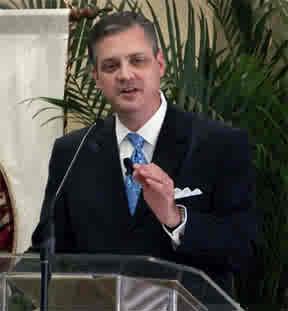
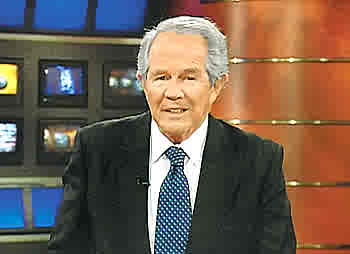 Last Friday evening on The O'Reilly Factor, Bill O'Reilly included a segment on recent statements on Islam by Pat Robertson and Franklin Graham. Both stated in so many words that Islam was a demonic and satanic religion. I expect these kinds of statements from Robertson, but I was a little surprised by Graham.
O'Reilly had Albert Mohler on the program during this segment to comment on the statements by Robertson and Graham. Mohler concurred with their assessment, and stated that it represented the Christian view for 2,000 years (but at least he did it with a broad evangelical smile).
The comments of these evangelical leaders are unfortunate for a variety of reasons. First, they have a view of Islam that fails to consider the complexity and diversity within the religion, such as the disagreement among Muslims over the meaning and place of jihad in Islam. James Beverley has referred to such diversity in Islam as the "two faces" of the religion, one emphasizing a more peaceful interpretation wherein jihad is understood as an inner struggle against evil, and the other interpretation endorsing violent acts against perceived enemies of Islam. This important nuancing is missing from Robertson, Graham, Mohler and other evangelical spokespersons.
Second, the idea that Islam is demonic and satanic represents the Christian view, not only of Islam but of all non-Christian religions, is also unfortunate. While many have dismissed the religions as demonic deceptions, and this may be the majority view among conservative evangelicals, it is not the only view. Other theological concepts have been put forward in developing a theology of religions, such as Justin Martyr's logos spermatikos, the "seed of reason" implanted in the human mind and heart by the Logos; sensus divinitatis, the natural awareness of divinity; and related to this, the imago Dei, a desire for experience with the Transcendent or Ultimate Immanent resulting from the human reflection of the divine nature.
In response to these statements by evangelical leaders I'd like to provide two closing thoughts. First, America's increasing religious pluralism, coupled with the continued culture clash through the war on terrorism, demonstrates the great need for the development of a sound theology of religions. As missiologist David Bosch stated, "the challenge of the religions..is even more important than that of secular ideologies... it is the theologia religionum which is the epitome of mission theology." A well developed theology of religions arrived at by fresh reflection on Scripture, cultures, and the religions is desperately needed if we are to move beyond the polarizing statements of popular evangelical spokespersons.
Second, evangelicals might consider the words of missiologist Henrik Kraemer before uttering their next public statements on Islam that are rebroadcast to an already fractured world where the West is perceived as anti-Islam and anti-Majority World. Kraemer stated that the only real point of contact between the missionary and the people was "the disposition and attitude of the missionary," and that "the way to live up to this rule is to have an untiring and genuine interest in the religion, the ideas, the sentiments, and the institutions" of a people and culture. We fall far short of Kraemer's ideal when we casually dismiss Islam and other religions as demonic.
Thursday, March 16, 2006
Sacramento LDS Temple Opening Summer 2006: Is Apologetic "Outreach" Really the Best Response?
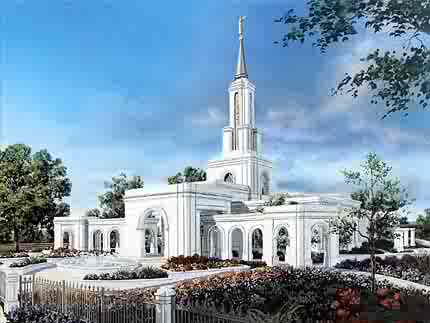 The First Presidency of the Church of Jesus Christ of Latter-day Saints recently announced the Open House and Dedication dates for the Sacramento, California Temple. An open house for hte general public will take place from July 29 through August 26, 2006, excluding Syndays, and a four session dedication will be held on September 3. A cultural celebration is scheduled for September 2.
It didn't take long once this announcement was made for evangelicals in the countercult community to set their plans in motion for an "outreach" during this event. I'd like to share a few thoughts about alternatives to evangelicals in general, and perhaps to a few evangelicals in the countercult community as well where I might still have some credibility.
1. Let's consider the place of the temple to LDS culture. After my experience at the Manti Miracle Pageant last summer, I have been conducting further research on the place of LDS temples within LDS culture from the perspective of anthropology of pilgrimage for a cultural hermenetics class at seminary. My ongoing research has confirmed my initial insights, namely, that visits to temples constitute a form of religious pilgrimage in Mormon culture parallelling religious pilgrimages in other religions, such as Islam, Hinduism, and Christianity. For individual Mormons, participation in such pilgrimages serve an important function, not only spirituallty, but also in terms of reinforcing their individual and collective identity as a part of the Mormon community and culture. With this insight in mind, the presence of evangelicals engaged in "outreach," no matter how well intentioned, is interpreted as an attack both on the sacred symbol of the temple, but also everything it represents, including the history and culture of Mormonism, and the individual Mormon him/herself.
With this insight in our minds, I think we would recognize that not many evangelicals would stand outside the Dome of the Rock to pass out tracts documenting the false nature of Islam in contrast with traditional Christianity. Neither would they stand outside of the Wailing Wall while holding up signs decrying the failure of the Jews to recognize Jesus as Messiah. In these instances evangelicals recognize that such activities are inappropriate in light of the symbolism of the structures and the needless friction with the culture that would result. And yet the cultural courtesies extended to religious groups like Islam and Judaism are curiously misisng in evangelical responses to Mormon sacred sites.
If evangelicals don't find this line of reasoning compelling, put yourself in the shoes of the Latter-day Saint, if only or a moment. How would you feel if you came out from the dedication of your new church or chapel building to find LDS standing on the streets outside your property passing out tracts on the satanic nature of your new building? Would this warm your heart to hear the message of your LDS neighbors? Of course not, you'd be offended, and rightly so, and this is same kind of reaction LDS experience in response to evangelicals at temple openings.
2. I was recently in a small group meeting with a a representative and a few others sympathetic to its approach to Mormonism. I shared my concern about evangelical responses at Manti and LDS temple openings, and that such approaches are needlessly counter-cultural and counter-productive to sound evangelism, and one of the participants in the meeting, Bill McKeever of Mormonism Outreach Ministry, told me that LDS temple openings are not conceived of as evangelistic outreaches, but are more aimed at informing evangelicals and the general public about differences between traditional Christianity and Mormonism. If this is the case, then a few questions arise. First, if the temple responses are more for educational purposes for evangelicals then why are they presented as evangelistic outreaches? Second, since the LDS people rightly bristle at such outreaches, why continue to alienate the very culture we say we want to reach? Why create additional stumbling blocks? And third, if the goal really is to educate evangelicals and the public, aren't there other ways, better ways in which this can be done?
I'd like to try to reason with my fellow evangelicals as the Sacramento temple opening nears. If that doesn't work, I'll try pleading with them. We've simply got to do something different in response to temple openings, both in Sacramento and throughout the United States. I suggest that traditional apologetic approaches must be abandoned, and in there place we must substitute educational events that accomplish the worthy goals we seek. I am working feverishly to create a new paradigm for evangelicals in response to temple openings, one that includes public evangelical-LDS dialogues modeling civility and understanding, followed by Bridges training to help evangelicals understand the Latter-day Saints as a culture rather than as a "cult." It would be wonderful to have evangelicals join me in the development of this new paradigm.
I realize that despite my passionate plea to my evangelical brethren the Sacramento temple "outreach" will likely press ahead as planned. The unfortunate result will be that the "outreach" participants will come away from the event satisfied that they have warned the church and defended the faith, and the Latter-day Saints in Sacramento will come away personally and corporately offended. Perhaps without planning to do so evangelicals will widen the divide between our two religious communities making understanding and real sharing of our spiritual concerns that much more difficult. Folks, let's move beyond our methodological dogmatism. There's a better way, one that is more in keeping with the Spirit and way of Jesus.
Wednesday, March 15, 2006
Dr. Douglas Cowan Interview Part 3: Conclusion

The conclusion of our three-part interview with Dr. Douglas Cowan of Renison College/University of Waterloo on the evangelical countercult movement.
MoreheadsMusings: How would you define propaganda?
Douglas Cowan: The definition that I developed then, and that I hold to now, is:
Propaganda is a systematic, ideologically driven, action-oriented manipulation and dissemination of information, which is intended for a specific target audience, and which is intended to intended to influence the beliefs and behaviour of that audience in manners consonant with the aims of the propagandist.
The particular value of this definition is that it does not rely on subjective characteristics such as “good” or “bad” propaganda, or that what “we” (the good guys) give out is “information” and what “they” (the bad guys) do is propaganda. My analysis is not dependent on whether or not one agrees with the information one is investigating. It also provides a more systematic way of looking at information and information management that is open to empirical investigation. For example, three of the most important components of this definition of propaganda are that it is systematic, that is, it not simply one pamphlet, one lecture, one whatever, but that the information can be tracked and investigated across a coherent body of data. Second, it is a manipulation of information. Some scholars have argued that all information is propaganda, but I disagree. I argue that there is an inherent manipulation in propagandistic discourse that shapes, moulds, and manages the information in ways that support the aims and intentions of the propagandists. To take a couple of simple examples, using the word “cult” to describe a religious movement when one knows the very negative connotations that word carries in our culture is a way of manipulating the information one disseminates. Or, simply inventing information about a group, lying about them, or, at best, only revealing partial truths. The third component that is important to note is that propaganda is not for everyone, it has a specific target audience. You could not use the vast majority of evangelical countercult material on adherents of new religions. The moment you call Mormons satanic, or say that all other religions than one’s own are from the Devil, you’ve pretty much stopped any reasonable chance at dialogue. In broad terms, the most successful propaganda is propaganda aimed at people who are most likely to be sympathetic to it already.
MoreheadsMusings: Evangelical readers who are not sociologists or trained in religious studies, may struggle to understand your argument. Are there any non-technical texts you could recommend for evangelicals to start with in grasping the sociological theories you draw on?
Douglas Cowan: Hmmm, that’s a tough one. Although it is a bit dated, one of the best is Peter Berger’s The Sacred Canopy. For a good introduction to the kind of propaganda analysis that I am talking about, though they take a slightly different approach, would be Edward Herman and Noam Chomsky, The Manufacture of Consent, a very well-known study.
MoreheadsMusings: A member of the countercult movement might casually dismiss the thesis and resulting criticism of the countercult movement in your book, but what positive insights might be gained through critical self-reflection on your book’s ideas?
Douglas Cowan: While the critique that I offer might sting a bit, I do think there are benefits. For example, I alluded earlier to the ease with many countercult arguments can be defeated or dismantled. And I wasn’t exaggerating. It really is a simple matter. By paying attention to some of the criticisms I make in the book, perhaps countercult apologists might come up with arguments that are not so easy to challenge. Also, to go back to what I suggested is the real motivation behind an awful lot of countercult apologetics—reality maintenance for people who already believe they have the only true interpretation of this, that, or the other thing—then I’m not sure they’ll really get much out of this. They are more likely to ignore the critique—which is exactly what has happened. On the other hand, if there are people who are genuinely interested in dialogue with members of new religions, and, to be honest, I’ve met far fewer of those, then the kind of arguments they make could be modified by the critiques I offer. What is important to recognize about that, though, is that dialogue is not monologue, and in countercult discourse the two are often used as though they are synonymous. Real dialogue only occurs when there is (a) an exchange of ideas that occurs on an equal footing, and (b) equal potential for each partner in the dialogue to be changed by the process. This doesn’t mean that an evangelical Christian would convert to Mormonism, for example, though I suppose that’s a possibility. What it means is that the evangelical is as open to changing his or her mind about the LDS church as, hopefully, the Latter-day Saint is to changing perceptions of evangelicalism. There have been some significant and well-reported events of this kind recently, though those have tended to draw trenchant criticism from much of the countercult, so I guess I don’t hold out much hope.
MoreheadsMusings: To the best of your knowledge, have there been any substantial interactions with your thesis by members of the countercult movement?
Douglas Cowan: Only from the good folk at Sacred Tribes. Most others go on and on about how “somebody really needs to take Cowan on,” but to date no one has stepped up. Various people have been huffing and blowing for a couple of years now about writing an in-depth review or refutation, but I haven’t seen anything yet.
MoreheadsMusings: What have been some of the reactions from members of the countercult?
Douglas Cowan: As I pointed out, there has been some huffing and blowing that someone should sit down and really take me to task for what I’ve written. But, to date, no one really has. Mostly, with the exception of the odd mention on email lists, my work has been pretty much ignored by the countercult. One of the more absurd reactions was from a couple of the people I discuss briefly who thought that because they were mentioned in the book I ought to be sending them free copies. Fortunately, that level of response was fairly limited.
MoreheadsMusings: In 2002 you were invited to make a presentation to the annual conference of Evangelical Ministries to New Religions. You wrote a paper after this experience that you presented to the Center for Studies on New Religions. What are your current thoughts on this encounter with the countercult community, and have there been any continuing reactions to your presentation?
Douglas Cowan: What’s interesting about the 2002 EMNR conference is that, though many of the participants dismiss the importance of my work, the presentation I made there was still being talked about three years later. I would be surprised if very many other presentations have that kind of shelf life. I had though that the EMNR might organize an author-meets-critics roundtable for one of their conferences—something I suspect would be quite a draw. I understand, though, that that suggestion was soundly rejected. Too bad, I’d certainly be willing to do it.
MoreheadsMusings: Some of the countercult characterizations of your thesis we have heard include the notion that all apologetic activity is propaganda, and that you are advocating some form of epistemic relativism. Would you consider these accurate representations of your thesis? If not, what do such characterizations indicate about the countercult understanding of your thesis?
Douglas Cowan: I’ve heard that, too. Also that I’m “postmodern,” which, in a very soft way, I suppose that I am, in that I reject overarching metanarratives as adequate explanations for human history, society, and behaviour. In terms of “epistemic relativism,” I don’t know that I’m advocating anything so much as (a) pointing out that epistemologies are relative; if they weren’t, there would be a much narrower range of beliefs available and evident, even within Christianity. (b) Rather than advocating a particular position, I also calling attention to the logical shortcomings of the apologetic system that currently characterizes much of the evangelical countercult movement, and asking how often very intelligent people can hold to epistemological positions that are so patently tenuous.
In terms of what this indicates about their understanding of my thesis, I feel a bit like one of the religious groups they target. There has been very little attempt to understand what I’ve written, but no shortage of commentary that what I’ve written is wrong, ill-informed, and so forth. Perhaps if a more affordable paperback is released, more people will be able to interact with the material, and some substantial responses will be offered.
Tuesday, March 14, 2006
Dr. Douglas Cowan Interview: Part 2
 Late last week I posted the first installment in a multi-part interview with Dr. Douglas Cowan. Following is the second installment.
MoreheadsMusings: Who is the primary or intended reading audience of your book?
Douglas Cowan: As a dissertation, a dissertation that was twice as long as the published book, by the way, Bearing False Witness? had a very specific purpose and a very limited audience. As a book, on the other hand, it was written primarily for academics in my field—sociologists of religion and religious studies scholars. And, it has been rather favourably reviewed in the American Journal of Sociology, which is nice. But, and this has been hard for some members of the countercult to understand, it was not written with them in mind as the audience. I have had to repeat over and over to many folks, “You are the group I wrote the book about; you’re not the group I wrote the book for.” When I presented some of the research at the 2002 EMNR conference, I found that a lot of people seemed to think that my task, or my goal, was to help them do their countercult work better—which is a fundamental misunderstanding of the work, and not a little characteristic of the ego-centricity of many countercult apologists. That is, if you don’t think like us, and we can’t use what you have, why should we care about what you think? A good example of this was when I wouldn’t disclose my religious beliefs at the conference. There was quite a bit of email traffic about this following the event, and my position was (and remains): if my criticisms have validity, then it shouldn’t matter what my personal religious beliefs are. If they have validity, and I obviously believe that they do, then you can’t use the fact that I’m not an evangelical Christian to dismiss them. I think that an awful lot of the countercult folks actually know this, they simply don’t want to admit it. While they’re very good at dishing out criticism, they’re very poor at receiving it. In fact, I would suggest that these are the two areas in which many members of the evangelical countercult show the least grace: the manner in which they exercise their witness to others, and the manner in which they respond to criticism of that witness.
Unfortunately, when BFW? came out, it came out in a very expensive edition, and I am contemplating a revised edition that would be much more affordable, and which would take into account changes in the countercult, such as the incarnational approach modeled by the folks at Sacred Tribes.
MoreheadsMusings: In your book you rely on a theory called “the sociology of knowledge.” Could you briefly explain the main premises of this view?
Douglas Cowan: Sure. A sociology of knowledge asks some fairly basic questions: how do we come to think the way we do about something? Why do we think particular ways and not others? And how do we keep thinking that way in the face of disconfirming evidence? It is not so much interested in “knowledge as objective Truth,” as it is in “what passes for ‘knowledge’,” to quote Peter Berger and Thomas Luckmann, in a given culture. For example, on what basis do countercult apologists make the claims they do? How do they support their particular vision on the religious traditions they target? What happens when they’re proven wrong about something, or challenged in some very fundamental way about what it is they believe? How do they resolve the “cognitive dissonance” that represents?
Sociologies of knowledge are predicated on the concept of social construction. That is, all knowledge is constructed knowledge, it’s manufactured by communities using the raw materials and conceptual tools those communities have available to them. Obviously, one of the tools for the countercult is the Bible. But, more than that, their often very particular and idiosyncratic interpretation of the Bible. The argument runs that their interpretation is more accurate, more valid, more faithful, and therefore more correct than an interpretation offered by, say, a Jehovah’s Witness or a Oneness Pentecostal. That’s why one of the very common things one finds in countercult literature is the concern to demonstrate facility with the Bible, and the necessary superiority of one’s own interpretation—which is most often done through challenging the interpretations offered by others. What they lose sight of, of course, is that their interpretations are also just that—interpretations—and have no more prima facie validity than those offered by anyone else.
For example, a number of popular countercult authors have come to the conclusion that there cannot be life on any other of the unimaginable number of planets in the universe. Why? Because the Bible doesn’t say that there is, and to paraphrase one such apologist, one would think that God would include such an important detail in the Bible if it were true. Not to put too fine a point on it, this is logically absurd, and monumentally arrogant—and easy to demonstrate in both cases.
However, rather than simply countering the argument, a sociology of knowledge asks, “OK, how did you come to this conclusion, as opposed to another? What is it about your understanding of the Bible that leads you here? And how do you support that conclusion in the face of challenge and disconfirmation?” For example, the Bible says nothing about the Internet, but countercult apologists have wasted no time making good use of it.
What this kind of analysis led me to relatively quickly is that the vast majority of material resources produced by the countercult is not meant for adherents of alternative religions. It is not intended, really, to convert anyone. Rather, by and large, it is meant for evangelical Christians who already share the basic worldview of the countercult apologists, and who want to be confirmed and reinforced in their beliefs. They’re hymn books produced for the choir, not for those they would like to join the choir.
Now, this is not to say that nothing is ever produced for adherents of other religions, or that literature is not designed to assist evangelicals in their interactions with these folks. Of course, there is. But, for the most part, countercult apologetics is about reality maintenance, maintaining and reinforcing the security and the superiority of one’s own evangelical Christian worldview.
MoreheadsMusings: Is the sociology of knowledge generally accepted as a valid approach by sociologists of religion?
Douglas Cowan: Absolutely. And the great thing about it is that there is no community to which its theoretical principles or methodological approaches cannot be applied.
MoreheadsMusings: Why did you decide to apply the sociology of knowledge approach to your analysis of countercult apologetics?
Douglas Cowan: For me, the sociology of knowledge approach addresses the most interesting and significant questions about a group—not so much how and when a group develops, but why it develops when it does and why it evolves in the way that is does. Since I am also interested in the role of the “movement intellectual,” those who claim to speak with a certain measure of authority for different groups and the effect those movement intellectuals have, this allowed me to investigate the ways in which evangelical countercult propaganda has shaped and influenced Christian perceptions of new religious movements. Though I was a member of a very liberal Protestant church in Canada, remember my reaction to reading The God Makers—not that Decker and Hunt were propagandists who should not be believed if their tongues came notarized, but that the religious group they were describing were actually as described. The printed word, especially the word that is published and sold commercially, is an especially powerful tool in our society. The sociology of knowledge allows me to investigate the effects these words have, which is why I chose to concentrate on publicly available works, and then locate them in the analytical framework of propaganda theory
Saturday, March 11, 2006
Interview with Dr. Douglas Cowan: Part 1
 Dr. Douglas Cowan is Assistant Professor of Religious Studies and Social Development Studies at Renison College/University of Waterloo, where he specializes in “cults,” sects, and new religious movements, as well as religion on the Internet and religion and film. He is a co-general editor of Religion Online: Finding Faith on the Internet (Routledge, 2004), and (with Jeffrey K. Hadden) Religion on the Internet: Research Prospects and Promises (JAI, 2000). He is the editor-in-chief of the Religious Movements Homepage Project, located at the University of Virginia. Dr. Cowan has also written several books including his most recent, Cyberhenge: Modern Pagans on the Internet (Routledge, 2005).
Perhaps his most controversial book, however, at least among a segment of the evangelical community known as the “countercult movement,” is Bearing False Witness? An Introduction to the Christian Countercult (Praeger, 2003). In the study of new religions and those who respond to them, scholars have examined the secular anticult movement, but few have distinguished between this and the evangelical countercult movement. I and my fellow co-editors of Sacred Tribes believe that Bearing False Witness? presents an important thesis, as well as criticisms of evangelical countercult methodologies worthy of careful consideration. For this reason we are pleased that Dr. Cowan has agreed to participate in this interview. Due to the length of the interview it will be posted here in installments, and the complete interview will be available in a future edition of Sacred Tribes journal.
MoreheadsMusings: Dr. Cowan, thank you for participating in this interview. As we begin, please share some of your background with us. What led you into religious studies from the perspective of sociology of religion?
Douglas Cowan: Thanks for the opportunity. I do appreciate it. As I tell my students, I am something of a mixed bag in terms of my training and experience in Religious Studies. If a colleague has a BA, MA, and PhD in History, for example, and that makes her a purebred, I’m a reasonably well-mannered junkyard dog. I have a Bachelor’s degree in English Literature, a Master of Divinity, for which I specialized in Church History—I wrote my thesis, which became my first book, on The Cloud of Unknowing, a fourteenth-century English mystical text—and I have a PhD in Religious Studies. The benefit of this kind of multidisciplinary preparation is that I tend not to see things through any one particular disciplinary lens. Though I tend to function now as a sociologist of religion, both professionally and intellectually, I still bring a multidisciplinary or interdisciplinary approach to everything that I do.
I am also an ordained minister in the United Church of Canada, and served congregations in southern Alberta for a number of years before going to grad school for my doctorate. I spent two years training as a spiritual director—which was not my calling at all, by the way. Those experiences, as much as anything else, gave me the impetus for grad school by providing me with a topic I was passionate about researching—the evangelical Christian countercult. Since then, as you noted in your introductory material, in addition to the countercult, I have published on conservative reactionary movements in mainline Protestantism, religion on the Internet, and I am currently working on my second book on contemporary Paganism. John, I know you are also particularly interested in another ongoing project: Sacred Terror: Religion and Horror on the Silver Screen. Since I bore easily, I tend to work on a lot of things at the same time.
MoreheadsMusings: How did the countercult community come to your attention as distinguished from the secular anticult movement, and why did you decide to research this movement?
Douglas Cowan: I really wasn’t aware of any of it until I was ordained and settled on my first pastoral charge. I mean, I grew up in the 1960s and 1970s and had been told that there were these dangerous, devious organizations called “cults” out there, but I had no real clue what that meant. Or even if it was true. Though I certainly wouldn’t consider them a “cult,” while I was an undergrad in Victoria, I did once get into a letter-writing campaign with a Jehovah’s Witness, the kind of tedious, minutiae-driven, micro-hair splitting debate you see in countercult apologetics all the time—“Is eimi in John 8:58 present tense or a past participle or a present progressive or whatever, and, more importantly, why what you believe about it makes you a heretic.” That sort of thing. I found it a completely unfulfilling experience, a rather sad chapter in my life, actually. We were speaking different languages, were not going to see eye-to-eye, and that became clear almost immediately. However, several years later, having survived seminary, I figured I’d had all my theological shots and felt relatively immune to whatever the real world had to offer.
In my denomination, new ordinands are “settled” on a pastoral charge. Though you have some input into the decision, the Church essentially decides where you will serve first. When I got the call from the settlement committee, I was at my parents’ home on Vancouver Island.
The chair of the settlement committee called up and said, “We’re thinking of Cardston and Magrath for you,” two small towns in southwestern Alberta, just north of the Montana border.
“OK,” I replied, “I know where it is on a map. Tell me about it.”
“Ummm, well, how do you feel about inter-faith dialogue?”
“Fine... why?”
“Well, there are some Mormons there.”
Cardston, you see, was settled in the late 1880s by Latter-day Saints who were leaving Utah after the passage of the Edmunds and Edmunds-Burke Acts—the anti-polygamy laws—and who were seeking a place where they could practice their religion free from state interference. In fact, the town of Cardston is named for one of Brigham Young’s sons-in-law, Charles Ora Card. In 1923, the Cardston saints dedicated the first LDS temple in Canada, the only one until the Toronto temple was dedicated in 1990. When I moved to Cardston, there were about five thousand people in the town, a little more than four thousand of whom were Latter-day Saints.
And I had the United Church. Since I knew very little about Latter-day Saints, I went to the Christian bookstore in my hometown and asked what they had on Mormonism. “Oh, we have the best book on the market,” the clerk replied, and handed me a copy of Ed Decker and Dave Hunt’s The God Makers. I took it home and read it that afternoon. About three-quarters of the way through, though, I looked up and said, “Mom, they’re sending me to Mars.”
What I discovered when I got to Cardston, of course, is that Latter-day Saints are pretty much like everyone else. In fact, over the years I was there, they were extremely gracious in offering their ward facilities—which were obviously the largest in town—when we had, for example, a funeral that our tiny church could not accommodate. When my first book came out, the one on The Cloud of Unknowing, the owner of the local LDS bookstore was quick to order ten copies—at a significant loss to him, I’m sure! When I left Cardston, the United Church had grown to the point where they were building a new church, and the Latter-day Saints pitched in on a number of occasions to help them do it.
Through all of this, I began to wonder about the disconnect—what as a sociologist of religion I would now call the “cognitive dissonance,” the difference between expectation and experience—between what I read in Decker and Hunt, and what I encountered living in the heart of Mormon Alberta for five years. At one point, I mentioned The God Makers to someone, and he replied, “Oh, that’s just Christian hate literature.”
And I realized he was right. I began looking deeper into the socio-literary iceberg of which The God Makers was only the tip and discovered this whole evangelical subculture dedicated to little more than countering the “cults.” I began to collect material, as much of the literature of the countercult as I could find, thinking it might make an interesting book someday. I collected backsets of Saints Alive in Jesus Newsletter, The Berean Call, Christian Research Journal, and so forth. I haunted used bookstores for anything and everything I could find—which amounted to quite a collection, as everyone who has helped move my library can attest!
When I moved to Calgary in 1994, the University of Calgary was just starting its regularized doctoral program. I approached Irving Hexham, at that time probably the most knowledgeable person in Canada on new religious movements, and asked if he would be willing to supervise my work. He was, and I was admitted in the first intake to the program. I am also the first graduate of that program.
I knew that in my doctoral work I wanted to write about the evangelical countercult, but at first, to put it crudely I was simply interested in “proving them wrong.” As one reviewer of BFW? noted, not infrequently, exposing the “soft underbelly” of countercult polemics is absurdly easy. I mean, so many of the arguments put forth by countercult apologists and polemicists are so obviously flawed, so logically inconsistent, and in not a few cases, so patently falsified, that in many cases it’s a wee bit like dynamiting trout. Interesting the first couple of times you do it, perhaps, but unfulfilling in the long run.
Irving pushed me to explore the topic more deeply, to understand the “why” of the countercult, not just the “what” and the “what’s wrong.” This is not an uncommon experience for beginning graduate students. They think they know what they want to do, until they realize there are so many more interesting questions to be asked. Which is why I moved to an analysis based on propaganda theory and a sociology of knowledge. I moved from trying to “get them” to trying to understand the motivations and the methods, the theological underpinnings and the sociological pressures that drive the countercult engine.
Tuesday, March 07, 2006
Concerns Over Evangelical-LDS Dialogue: Biblically Forbidden or Symptomatic of Evangelical Unpreparedness?
 For a few years now a handful of evangelicals have shared their concerns about public dialogues between Greg Johnson, an evangelical pastor of Standing Together, and Robert Millet, a professor at Brigham Young University. Last April I engaged a few colleagues on this topic through a Yahoo discussion group. I recently pulled the copies of our exchanges from my files and reviewed them in light of a renewed chorus of concerns shared by a few individuals a couple of weeks ago.
The responsive thoughts below are the result of my recent reflections and interactions with the helpful comments of my colleagues, Harold Taylor and Amos Yong. Harold served as a missionary for sixteen years in Papua New Guinea and the Solomon Islands, is emeritus vice-principal of the Bible College of Victoria, Australia, and serves on the board of directors for Global Apologetics and Mission. Amos previously served as associate professor of theology at Bethel College, and presently is associate research professor of systematic theology at Regent College. He is the author of a number of scholarly articles and books, including Beyond the Impasse: Toward a Pneumatological Theology of Religions (Baker Academic, 2003).
The reasoning behind evangelical criticism of public evangelical-LDS dialogue might be distilled to the following concerns:
1. False Prophet Motif. In a recent exchange with counter-cult individuals in Utah, they felt strongly that public dialogue is an inappropriate form of interaction with “false prophets.” With this concern certain theological assumptions are made about a biblical concept which is then applied to representatives of Mormonism in leadership roles.
2. Proclamation and Denunciation Over Dialogue. Related to the concern above, evangelicals seem far more comfortable with monological proclamation, confrontation, and denunciation, but have difficulties with two-way dialogue with Mormon representatives. “What is the point since we have the truth and they are cultists?,” seems to be the conscious or unconscious feeling underlying this concern.
3. Fear of Syncretism. Evangelicals frequently share concerns about syncretism in the increasingly pluralistic West. Those who advocate relationships and dialogue with religious others are of particular concern due to the possibility of their creating situations where spiritual confusion and contamination may occur.
4. Compromised Fellowship. Various websites express concern about evangelicals in ongoing relationships with Mormons that do not result in the short-term conversion of either participant. “How long does one maintain such a relationship if no change of heart or thinking takes place?” asks such evangelicals. It seems as if a small time frame is in mind, otherwise the endeavor cannot be justified in their thinking.
I would like to provide some additional considerations that may provide a broader framework for reassessing these concerns. My own thinking on interreligious dialogue has been shaped by theological and missiological reflection, and interaction with colleagues such as Taylor and Yong mentioned above, as well as by Terry Muck of Asbury Theological Seminary, who has also engaged in a lot of theological reflection on the topic, and has exemplified this in his Buddhist-Christian dialogues. While this has been done for world religions we have a lot of work ahead of us in applying this to Mormonism, other New Religious Movements, Paganism, and various alternative spiritualities in the West.
Harold Taylor suggests that the best way to relate in interreligious dialogue is not as “religious other,” which immediately focuses on the differences between “us and them,” which are defined in doctrinal terms, and then become the basis for any ongoing relationship. Starting out with the differences easily leads to confrontation, and in this type of situation, dialogue is both misunderstood and suspect. From this perspective the term “religious other,” let alone the term and concept of “false prophet,” is demeaning as a defining category. Taylor asks whether it is not better to start on common ground, that these “others” are in fact one with “us;” they are made in the image of God, share in the complexities and joys, hopes and fears of life, and are known to our heavenly Father who has the whole world and all peoples in his hands. If the starting point is a fellow person, made in God’s image, sharing in life and known to God – rather than the “other,” the possible “enemy,” whether Mormon, Hindu, Muslim, Wiccan, etc. – then we have an opportunity to develop a dialogue, which acknowledges both the differences and commonalties involved. This is not downplaying the differences in faith and understanding of God, but it is suggesting that the starting oint of our relationship needs to be much more open and affirming than it is for many.
Taylor also agrees with a statement that I made where I recognized that mission and dialogue are both about activities and attitudes. Who we are and what we do cannot be separated, and this lesson is brought home in a very clear way in any study of missionary history. It is as we embody the values and attitudes of the Kingdom towards “others” that the possibility of dialogue actually becomes a reality. The great Dutch missiologist Hendrik Kraemer advocated interreligious dialogue, particularly in his book World Cultures and World Religions: The Coming Dialogue (James Clarke Company, 2002). He rightly identified “the disposition and attitude of the missionary” as the key point of contact with a culture, and this has been recognized time and again by missionaries such as Francis of Assisi and Samuel Zwemer. Both of these were robust in their faith and personal interaction with the “other,” but they refused to view the “other” as “the enemy.”
More recently, other leading evangelicals have spoken affirmatively of dialogue in mission, including David Hesselgrave. In his book Theology and Mission he outlines the possibility of several types of dialogue and urges evangelicals to participate in them. He was one of the strongest voices within evangelicalism to recognize the need for and validity of dialogue with “religious others.” He also suggested why many evangelicals are not ready for dialogue, including that the majority are not open to it because of a lack of understanding of what is involved, dialogue seen in a negative light due to some of the approaches in more liberal expressions of Christianity, and the lack of understanding and openness between evangelicals and the World Council of Churches camps.
Later, people like John Stott, Stephen Neill and Hesselgrave fought to keep dialogue as a valid missionary approach for evangelicals. The validity of dialogue as a true biblical approach was affirmed in the Lausanne Covenant in 1974, and in subsequent evangelical conferences. In fact, it represented a strenuous attempt to go beyond seeing those of other faiths as “the enemy.”
Finally, Taylor wonders whether the reasons for this evangelical rejection and fear of dialogue might arise from not only the excesses and compromises of some of the “liberal” approaches, but also results from a fairly limited understanding of missionary history in its wider dimensions, and especially of the theological hassles and debates from the 1960s to the 1980s.
In addition to these considerations, Amos Yong suggests two others that not only have a bearing on the “religious other,” but are directly related to the evangelical in dialogue. First, if others do bear the imago Dei, then our engagement and interaction with them should have as part of our goal our own transformation (which we can control in terms of our disposition, etc.) rather than their transformation (which we both can’t control, nor is it in capacity to “save” because only God saves). This is going beyond dialogue and evangelism as utilitarian and also beyond evangelism as relational to dialogue and evangelism as for our own transformation.
Yong wonders if we take this relational and transformational approach seriously, with this transformational possibility looming before us as evangelicals, is this why evangelicals shy away from a robust relational missiology, because there is an intuitive sense that such an approach will change us, perhaps even putting at risk our self-identity and Christian commitments?
Second, Yong states that if the interrreligious other is the stranger, then according to the parable of the sheep and the goats (Matt. 25:31-46), the interreligious dialogue partner is in some sense the brother or sister of the Lord through whom (“the least of these”) we serve our Lord; but more than that, insofar as the goats are cast out for not hosting the stranger in their midst, to that degree is our place in the Kingdom itself mediated by the strange religious others in our midst? If so, rather than we being the catalysts for the salvation of those in other faiths, how we respond to them is instead the catalyst for our living the Lordship of Christ and being invited to participate in his Kingdom. In this case, the point about a relational missiology is not so much the evangelism of those have never heard for the sake of their salvation, but the transformation of our own hearts and lives for the sake of our salvation. Hence, we may need the stranger (the religious other) much more so than s/he needs us.
Yong's thoughts in this last paragraph may raise concerns on the part of some evangelicals, and certainly those critical of interreligious dialogue, but they should be understood in their proper context. Yong would not deny that the evangelical dialogue partner brings something valuable to the dialogue process for both the "religious other" and her/his religious community. But he is moving beyond this to consider the possible transformative effects for the evangelicals, a perspective not often considered by evangelicals in general, or by those critical of dialogue in particular. We might wonder not only how the Spirit may work in the "religious other" through dialogue, but also how the Spirit will transform us.
I hope these broader considerations related to interreligious dialogue will be helpful as evangelicals reassess the appropriateness of public evangelical-LDS dialogues. Is it possible that our discomfort with it says more about our unpreparedness for this form of interaction and mission than it expresses a form of engagement that is allegedly unbiblical?
Wednesday, March 01, 2006
Preachers in Wonderland: We're Preaching to the Choir!
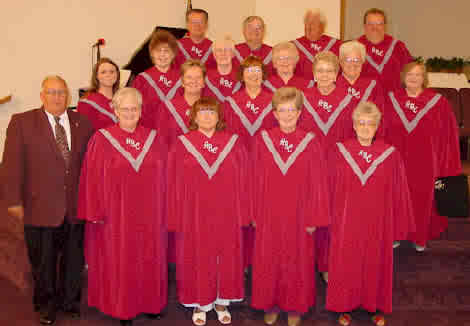 Earlier this week a couple of missional minded colleagues and I met with a few folks who are more apologetically inclined in order to seek understanding over our differing ministry philosophies and methodologies. Over the course of the meeting our apologetic brethren shared their appreciation for even the more aggressive and confrontational forms of preaching by evangelicals at LDS General Conference, and at the Manti Miracle Pageant. Unfortunately, there was no awareness of the complexities of effective communication as it relates to theology or missiology. How often we forget that what makes perfect sense to us in fact makes no sense to others. When I heard these well meaning brethren share their passion for such forms of monological proclamation at LDS I heard a loud voice in my head shouting, "You're preaching to the choir, gentlemen!"
My friend and colleague Philip Johnson sent me an interesting collection of quotes recently that are directly related to this problem found not only in evangelical attempts to communicate to Latter-day Saints, but in other cultural contexts as well, sometimes even within our churches. The quotes come from Christian Faith and Practice in the Modern World: Theology From an Evangelical Point of View (Grand Rapids: Eerdmans, 1988), Mark Noll and David Wells (eds). The quotes speak for themselves for those who have ears to hear:
"In much of the Post-Reformation period, and until relatively recently, the task of the evangelical theologian was easily defined. Theologians were to study the biblical text, crystallize doctrines from its pages, explore their relationships, sharpen their cutting edges, proclaim their truth, and confound those who disagreed or disbelieved. This set of activities was predicated on the assumption that biblical doctrine once explained was not only readily comprehensible to reasonable people, but also self-evident in its aplication to daily life. These assumptions, however, are now in ruins. The theological task no longer can be limited simply to the reception, refinement, repristination, and promulgation of the received orthodoxy; it must now concern itself with understanding what that faith means in a world whose cognitive horizons are so vastly different from the biblical and whose life poses questions the
biblical authors did not foresee nor answer directly. (p 11)
"In the West, evangelical theology must now function cross-culturally. Theologians, by circumstance if not by desire, are missionaries; there is no longer a home base to which they can retreat. For four centuries they had enjoyed such a home base in the broad Christian assumptions on which Western culture was predicated and by which it had been nourished. In the presence of those assumptions, even where they suffered cultural dilution, biblical doctrine had made ready sense. Moreover, the work of theologians had been accorded cultural legitimacy even by those who neither understood theology nor trusted its conclusions. Today, however, those assumptions have not merely been diluted; they have dissipated. Without them, biblical doctrine has lost its cultural coordinates and the professional guardians of that doctrine have been deprived of their legitimacy. They have become disinherited strangers in their own world, wanderers whose message strikes no chords and creates no resonance in a naturalistic, technological age. They are cognitive hermits. (p 12)
"Theologians who work in isolation from these developments are surely living in Alice's Wonderland." (p 12).
"As a matter of fact, there can be no forceful, meaningful evangelical theology that does not seek to communicate between the in-group, the church, and the out-group, the world. This communication, moreover, requires that the world be understood with sensitivity and clarity so that the church states the meaning of faith in terms germane to the world. This necessity calls evangelicals to hard and sympathetic attention to this world and conditions them to accept help from all who advance comprehension of its inner workings. A Christian theology that uses only the resources from the in-group is a paltry thing, both because it talks mostly with itself and because it is deprived of the insights of the out-group." (pp 12-13).
Tuesday, February 28, 2006
A Conversation with Fuller Missiologist Ryan Bolger
EMERGING CULTURE, EMERGING CHURCH, AND EMERGING SPIRITUALITIES:A Conversation with Ryan Bolger
Western culture is experiencing a significant cultural shift from modernity to postmodernity. Various social and spiritual movements have arisen in response to this cultural change. As one response, the emerging church movement has arisen within evangelicalism. This movement is distinctly different from both the contemporary church and seeker church movements, as well as traditional expressions of church. Postmodernism has also given rise to various expressions of new religions and alternative spiritualities. Ryan Bolger is a leading thinker and evangelical strategist in the area of contemporary culture and missions. Ryan is Assistant Professor of Church in Contemporary Culture at Fuller Theological Seminary. Along with Eddie Gibbs, he is the co-author of Emerging Churches: Creating Christian Community in Postmodern Cultures (Baker Academic, 2005). Ryan was gracious enough to agree to an interview for this blog on important issues facing the church in the Western world. (Photo: Ryan Bolger [left], Eddie Gibbs [right]).
MoreheadsMusings: Can you tell us about your background and your perspective of research and analysis related to the emerging culture?
Bolger: Hi John, thanks for hosting this conversation. I’m a native southern Californian – have lived in other places but always find my way back to LA. I’ve studied missiology, specifically mission to the west, under Wilbert R. Shenk, a student himself of Andrew Walls and less formally, of Lesslie Newbigin. In addition, I studied the church and church growth under Eddie Gibbs, the Donald McGavran Professor of Church Growth at Fuller Theological Seminary. It is at Fuller where I received a PhD in missiology. What I learned is that we need to think like missionaries in the West rather than simply as church members. We need to understand the culture and look to foster indigenous faith communities within that same culture. Again, nothing radical for missionaries, but very radical for the Western church. As I look at the West, I am most interested in those communities that engage the culture seriously, as missionaries do. I want to tell their stories in the hopes that it might inspire others to do likewise.
MM: How would you summarize postmodernity in Western culture?
Bolger: Modernity involved the birth of the secular project in the West – the loss of tradition, community, and the centrality of faith. Inherent to modernity is individualism, industrialization, the birth of the powerful state, the fragmentation of societies, to name a few. Postmodernity marks a significant change in all these realms. It marks the end of the secular project of modernity and the re-integration of spirituality and community into public life.
MM: Is it important to make such a distinction between academic postmodernism and postmodernism as expressed on a popular level, and where have evangelicals tended to focus their discussion and critique?
Bolger: I’m concerned with the social manifestations of postmodernity, not necessarily the arguments within the philosophical tradition. So, my interests are academic, but the parallels between the academy and the popular level are more obvious when you focus on the social realm. I do think there are parallels with the philosophical realm as well, but the connections are more difficult to demonstrate. Church-type evangelicals are taught to interact with culture based on philosophy, and so they will think in terms of an apologetic response to postmodernity, addressing issues such as the move away from foundationalism. Mission-type evangelicals will look to understand the culture -- not necessarily debate the culture. For missionaries, cultures just are. Missionaries do not look to change the culture as outsiders, but rather, after fostering an indigenous faith community from within, they may look to the new converts to transform the culture.
MM: Is postmodernism something evangelicalism and mainline Protestantism should carefully consider as a cultural development for broader reasons beyond the issues of epistemology and absolute truth?
Bolger: Definitely – postmodernity represents a new form of culture in our cities, connecting our artists, our spiritual people, our environmentally minded, and our youth. This is where evangelicals make their big mistake – thinking we need to argue with these people. We need cross-cultural mission training for regular Christians. Unless they have gone to the mission field, they just don’t have these sensibilities. They spend their time arguing from the outside rather than helping foster transformation from within.
MM: Let’s talk about the emerging church movement. What is it, and how does it differ from the contemporary church or seeker sensitive models?
Bolger: Emerging churches represent the first post-Christendom movement in Western clture. Christendom churches are attractional, meaning they look to attract people to their church within a churched culture, and this includes movements such as seeker churches, purpose-driven churches, Calvary Capels, Vineyards, not to mention all the traditional denominations. Post-Christendom churches do not see the church service as a primary connecting point with non-Christians. They look to embody their alternative way of life in the midst of the people in the culture – not in the church service. Again – not radical for missionaries but very counter-cultural within historically churched cultures such as the West. Emerging churches look to the life of Jesus as a source of life – not just his death and resurrection. So, hospitality, generosity, inclusion of the marginal, peacemaking, are very important to emerging churches. Emerging churches are truly postmodern – thus, they do not believe in secular space. They believe in spirituality in all realms, in all parts of culture, with all parts of culture, and with all kinds of people. For emerging churches, community is the glue – they would rather be a part of a community that had a service than a church service in hopes of creating a community.
Friday, February 24, 2006
Cross-Cultural Hermeneutics Course Aims: Why Are They Missing Elsewhere?
 Dr. Robert Priest of Trinity International University is teaching an intensive course at Salt Lake Theological Seminary this semester titled "Cross-Cultural Hermeneutics." I was intrigued when I first read the Course Aims section of the syllabus:
"Upon completion of this course each student should demonstrate increasing . . .
A. cognitive . . . .
1. knowledge of theoretical perspectives and research methods employed by scholars who study culture;
2. ability to read scholarly books on other cultures and societies with good comprehension of the vocabulary, concepts and theories assumed or implied in such writings;
3. ability to analyze the culture (customs, beliefs, rituals, symbols, etc.) of other people;
4. ability to understand and analyze the religion and world view of others, since it is in this area that the missionary hopes to effect change, and show how such an understanding can be helpful for the communicator of the gospel;
5. understanding of communication theory and of those elements of culture related to interpersonal interaction and to the communicative task (e.g. body language, symbols, media of communication, interaction styles, etc.);
6. ability to analyze those dimensions of culture which are related closely to the content of the Christian message (e.g. aspects of culture related to suffering and death, to conscience, guilt and shame, to sin and the moral order, to personal and social ethics, to forgiveness of the debt of sin, cleansing from the defilement of sin, to redemptive analogies, etc.);
7. ability to contextualize the gospel message and to contextualize one's ministry strategy in a fashion which is based on the authority of scripture but sensitively related to the social and cultural context because it is also based on an adequate understanding of the human ministry context.
B. affective . . . .
1. sensitivity and deep respect towards those of other cultures and races;
2. deep commitment to understanding the culture of the people to whom one is called;
3. commitment to communicate the gospel in ways that are culturally comprehensible and appropriate;
4. desire to see and affirm the good in other cultures;
5. humility by a comfortable willingness to learn and to be instructed by those to whom one is called and by a willingness to serve under the leadership of others;
6. self-control and patience, being slow to anger or frustration, under circumstances which will be trying and in cultural settings where misunderstandings are inevitable;
7. consciousness of his or her own ethno-centricity; and
8. flexibility and a willingness to constantly reassess and start over with new strategies and plans;
C. skill . . .
1. in the use of ethnographic methods--in conducting interviews and taking fieldnotes on observed events in everyday life--as a basis for gaining understanding of one's ministry context;
2. in intercultural interpersonal relationships;
3. in an ability to employ ministry skills in a culturally appropriate fashion; and
4. in an ability to communicate effectively in cross-cultural settings. "
These goals represent those common in missiology. To what extent do we see them desired, emphasized and utilized among American evangelicals working in the area of new religions and alternative spiritualities in the West? I don't see much of it. Why is this the case? Why does missiology seem to have lofty aims in its understanding and methodology but they seem sorely lacking in apologetic approaches? Should we not aspire to these worthy aims?
Saturday, February 18, 2006
Correct Knowledge and Doctrinal Minimalism
 How much correct knowledge of God, Christ and the gospel is necessary for “genuine conversion?” The answer may not be so easy as we might think for those of us working missionally among adherents of new religions, particularly those sharing some affinities with Christianity.
This week I exchanged some emails with a Fuller student who is working on a religion project paper that compares missional contextualization in Islamic contexts with the development of a similar approach to Latter-day Saints. Our exchange was interesting as we integrated our experiences in LDS culture with the writings on Islamic contextualization, and then wrestled with the question of correct knowledge of God and disavowal of heretical knowledge. I thought it might be helpful to summarize some of our thinking here for others to wrestle with in their missional contexts.
We began with recognition of our cultural assumptions that might influence our thinking on this topic. As children of the Enlightenment and Modernity, we recognize that in the West we tend to understand knowledge, and doctrine, in abstract propositional ways, and to value knowledge as an end unto itself. By contrast, a more Hebraic understanding of knowledge tends to be more relational. As Westerners we need to wrestle with the issues and the biblical texts on their own cultural terms rather than imposing Western understandings of knowledge on the subject matter.
With due consideration of our cultural biases, we then considered the essence of the question as to how much correct doctrine is necessary for converts, especially in connection with heretical doctrine. Most evangelicals have some kind of doctrinal formula in mind, from the simple to the complex, but the assumptions upon which these formulas are based need to be reassessed in light of a fresh exegetical and missional engagement with Scripture.
Rick Brown wrote an interesting article for the International Journal of Frontier Missions titled “What Must One Believe About Jesus for Salvation?” The article provides an interesting survey of relevant biblical texts, and his thesis challenges conventional formulas that speak of the necessity of certain doctrines equated with orthodoxy in Christendom, including the deity of Christ, Trinitarian theology, and a substitutionary atonement. Brown’s argument is worthy of careful reflection.
In addition to the question of knowledge of Jesus related to soteriology, we might also consider the broader question of conversion as it relates to worldview transformation. In our discussion we also considered an article by Paul Hiebert, also found in IJFM titled, appropriately enough, “Conversion and Worldview Transformation.”
For those more inclined toward more expansive definitions of orthodoxy as influenced by systematic theology, we might consider that missions has been called the “mother of theology.” Missiologist Gailyn Van Rheenen has used this term in his writings, and by this he means that the early church developed her theology primarily through the messy process of missional engagement with cultures, rather than through philosophical reflection in the form of systematic theology.
After considering these questions from a missiological perspective, and after engaging in fresh theological reflection, we came to the conclusion that some form of doctrinal minimalism is in order. It appears from the biblical evidence that a minimal amount of correct knowledge and doctrine was presented to and accepted by the “convert,” and our tendencies toward more extensive evangelistic formulas might be not only unbiblical, but also put the doctrinal cart before the horse. Rather than expecting potential converts to have more extensive and orthodox theological views, perhaps this is something that should be developed over time as individuals mature in the discipleship process.
And what of the question of the disavowal of heresy from converts? This too may be more difficult and messy than we had previously thought. The biblical texts seem to indicate an admixture of orthodoxy and heresy on the part of those in the covenant (whether Old or New), and while this is not ideal, and the discipleship process should strive toward a deeper and more accurate understanding, surely new converts should not be expected to disavow much of their doctrine and worldview prior to or immediately after acceptance of the gospel. This too might be viewed as a part of the lengthy process of discipleship and sanctification, and missionaries should give those under their discipleship care plenty of room for the Spirit’s working in human lives.
After these discussions I wondered whether it is possible that we have asked more than we need to of those considering the claims of Christ within new religions.
Subscribe to:
Posts (Atom)