Tuesday, March 07, 2006

Concerns Over Evangelical-LDS Dialogue: Biblically Forbidden or Symptomatic of Evangelical Unpreparedness?

For a few years now a handful of evangelicals have shared their concerns about public dialogues between Greg Johnson, an evangelical pastor of Standing Together, and Robert Millet, a professor at Brigham Young University. Last April I engaged a few colleagues on this topic through a Yahoo discussion group. I recently pulled the copies of our exchanges from my files and reviewed them in light of a renewed chorus of concerns shared by a few individuals a couple of weeks ago.

The responsive thoughts below are the result of my recent reflections and interactions with the helpful comments of my colleagues, Harold Taylor and Amos Yong. Harold served as a missionary for sixteen years in Papua New Guinea and the Solomon Islands, is emeritus vice-principal of the Bible College of Victoria, Australia, and serves on the board of directors for Global Apologetics and Mission. Amos previously served as associate professor of theology at Bethel College, and presently is associate research professor of systematic theology at Regent College. He is the author of a number of scholarly articles and books, including Beyond the Impasse: Toward a Pneumatological Theology of Religions (Baker Academic, 2003).

The reasoning behind evangelical criticism of public evangelical-LDS dialogue might be distilled to the following concerns:

1. False Prophet Motif. In a recent exchange with counter-cult individuals in Utah, they felt strongly that public dialogue is an inappropriate form of interaction with “false prophets.” With this concern certain theological assumptions are made about a biblical concept which is then applied to representatives of Mormonism in leadership roles.

2. Proclamation and Denunciation Over Dialogue. Related to the concern above, evangelicals seem far more comfortable with monological proclamation, confrontation, and denunciation, but have difficulties with two-way dialogue with Mormon representatives. “What is the point since we have the truth and they are cultists?,” seems to be the conscious or unconscious feeling underlying this concern.

3. Fear of Syncretism. Evangelicals frequently share concerns about syncretism in the increasingly pluralistic West. Those who advocate relationships and dialogue with religious others are of particular concern due to the possibility of their creating situations where spiritual confusion and contamination may occur.

4. Compromised Fellowship. Various websites express concern about evangelicals in ongoing relationships with Mormons that do not result in the short-term conversion of either participant. “How long does one maintain such a relationship if no change of heart or thinking takes place?” asks such evangelicals. It seems as if a small time frame is in mind, otherwise the endeavor cannot be justified in their thinking.

I would like to provide some additional considerations that may provide a broader framework for reassessing these concerns. My own thinking on interreligious dialogue has been shaped by theological and missiological reflection, and interaction with colleagues such as Taylor and Yong mentioned above, as well as by Terry Muck of Asbury Theological Seminary, who has also engaged in a lot of theological reflection on the topic, and has exemplified this in his Buddhist-Christian dialogues. While this has been done for world religions we have a lot of work ahead of us in applying this to Mormonism, other New Religious Movements, Paganism, and various alternative spiritualities in the West.

Harold Taylor suggests that the best way to relate in interreligious dialogue is not as “religious other,” which immediately focuses on the differences between “us and them,” which are defined in doctrinal terms, and then become the basis for any ongoing relationship. Starting out with the differences easily leads to confrontation, and in this type of situation, dialogue is both misunderstood and suspect. From this perspective the term “religious other,” let alone the term and concept of “false prophet,” is demeaning as a defining category. Taylor asks whether it is not better to start on common ground, that these “others” are in fact one with “us;” they are made in the image of God, share in the complexities and joys, hopes and fears of life, and are known to our heavenly Father who has the whole world and all peoples in his hands. If the starting point is a fellow person, made in God’s image, sharing in life and known to God – rather than the “other,” the possible “enemy,” whether Mormon, Hindu, Muslim, Wiccan, etc. – then we have an opportunity to develop a dialogue, which acknowledges both the differences and commonalties involved. This is not downplaying the differences in faith and understanding of God, but it is suggesting that the starting oint of our relationship needs to be much more open and affirming than it is for many.

Taylor also agrees with a statement that I made where I recognized that mission and dialogue are both about activities and attitudes. Who we are and what we do cannot be separated, and this lesson is brought home in a very clear way in any study of missionary history. It is as we embody the values and attitudes of the Kingdom towards “others” that the possibility of dialogue actually becomes a reality. The great Dutch missiologist Hendrik Kraemer advocated interreligious dialogue, particularly in his book World Cultures and World Religions: The Coming Dialogue (James Clarke Company, 2002). He rightly identified “the disposition and attitude of the missionary” as the key point of contact with a culture, and this has been recognized time and again by missionaries such as Francis of Assisi and Samuel Zwemer. Both of these were robust in their faith and personal interaction with the “other,” but they refused to view the “other” as “the enemy.”

More recently, other leading evangelicals have spoken affirmatively of dialogue in mission, including David Hesselgrave. In his book Theology and Mission he outlines the possibility of several types of dialogue and urges evangelicals to participate in them. He was one of the strongest voices within evangelicalism to recognize the need for and validity of dialogue with “religious others.” He also suggested why many evangelicals are not ready for dialogue, including that the majority are not open to it because of a lack of understanding of what is involved, dialogue seen in a negative light due to some of the approaches in more liberal expressions of Christianity, and the lack of understanding and openness between evangelicals and the World Council of Churches camps.

Later, people like John Stott, Stephen Neill and Hesselgrave fought to keep dialogue as a valid missionary approach for evangelicals. The validity of dialogue as a true biblical approach was affirmed in the Lausanne Covenant in 1974, and in subsequent evangelical conferences. In fact, it represented a strenuous attempt to go beyond seeing those of other faiths as “the enemy.”

Finally, Taylor wonders whether the reasons for this evangelical rejection and fear of dialogue might arise from not only the excesses and compromises of some of the “liberal” approaches, but also results from a fairly limited understanding of missionary history in its wider dimensions, and especially of the theological hassles and debates from the 1960s to the 1980s.

In addition to these considerations, Amos Yong suggests two others that not only have a bearing on the “religious other,” but are directly related to the evangelical in dialogue. First, if others do bear the imago Dei, then our engagement and interaction with them should have as part of our goal our own transformation (which we can control in terms of our disposition, etc.) rather than their transformation (which we both can’t control, nor is it in capacity to “save” because only God saves). This is going beyond dialogue and evangelism as utilitarian and also beyond evangelism as relational to dialogue and evangelism as for our own transformation.

Yong wonders if we take this relational and transformational approach seriously, with this transformational possibility looming before us as evangelicals, is this why evangelicals shy away from a robust relational missiology, because there is an intuitive sense that such an approach will change us, perhaps even putting at risk our self-identity and Christian commitments?

Second, Yong states that if the interrreligious other is the stranger, then according to the parable of the sheep and the goats (Matt. 25:31-46), the interreligious dialogue partner is in some sense the brother or sister of the Lord through whom (“the least of these”) we serve our Lord; but more than that, insofar as the goats are cast out for not hosting the stranger in their midst, to that degree is our place in the Kingdom itself mediated by the strange religious others in our midst? If so, rather than we being the catalysts for the salvation of those in other faiths, how we respond to them is instead the catalyst for our living the Lordship of Christ and being invited to participate in his Kingdom. In this case, the point about a relational missiology is not so much the evangelism of those have never heard for the sake of their salvation, but the transformation of our own hearts and lives for the sake of our salvation. Hence, we may need the stranger (the religious other) much more so than s/he needs us.

Yong's thoughts in this last paragraph may raise concerns on the part of some evangelicals, and certainly those critical of interreligious dialogue, but they should be understood in their proper context. Yong would not deny that the evangelical dialogue partner brings something valuable to the dialogue process for both the "religious other" and her/his religious community. But he is moving beyond this to consider the possible transformative effects for the evangelicals, a perspective not often considered by evangelicals in general, or by those critical of dialogue in particular. We might wonder not only how the Spirit may work in the "religious other" through dialogue, but also how the Spirit will transform us.

I hope these broader considerations related to interreligious dialogue will be helpful as evangelicals reassess the appropriateness of public evangelical-LDS dialogues. Is it possible that our discomfort with it says more about our unpreparedness for this form of interaction and mission than it expresses a form of engagement that is allegedly unbiblical?

Wednesday, March 01, 2006

Preachers in Wonderland: We're Preaching to the Choir!

Earlier this week a couple of missional minded colleagues and I met with a few folks who are more apologetically inclined in order to seek understanding over our differing ministry philosophies and methodologies. Over the course of the meeting our apologetic brethren shared their appreciation for even the more aggressive and confrontational forms of preaching by evangelicals at LDS General Conference, and at the Manti Miracle Pageant. Unfortunately, there was no awareness of the complexities of effective communication as it relates to theology or missiology. How often we forget that what makes perfect sense to us in fact makes no sense to others. When I heard these well meaning brethren share their passion for such forms of monological proclamation at LDS I heard a loud voice in my head shouting, "You're preaching to the choir, gentlemen!"

My friend and colleague Philip Johnson sent me an interesting collection of quotes recently that are directly related to this problem found not only in evangelical attempts to communicate to Latter-day Saints, but in other cultural contexts as well, sometimes even within our churches. The quotes come from Christian Faith and Practice in the Modern World: Theology From an Evangelical Point of View (Grand Rapids: Eerdmans, 1988), Mark Noll and David Wells (eds). The quotes speak for themselves for those who have ears to hear:

"In much of the Post-Reformation period, and until relatively recently, the task of the evangelical theologian was easily defined. Theologians were to study the biblical text, crystallize doctrines from its pages, explore their relationships, sharpen their cutting edges, proclaim their truth, and confound those who disagreed or disbelieved. This set of activities was predicated on the assumption that biblical doctrine once explained was not only readily comprehensible to reasonable people, but also self-evident in its aplication to daily life. These assumptions, however, are now in ruins. The theological task no longer can be limited simply to the reception, refinement, repristination, and promulgation of the received orthodoxy; it must now concern itself with understanding what that faith means in a world whose cognitive horizons are so vastly different from the biblical and whose life poses questions the
biblical authors did not foresee nor answer directly. (p 11)

"In the West, evangelical theology must now function cross-culturally. Theologians, by circumstance if not by desire, are missionaries; there is no longer a home base to which they can retreat. For four centuries they had enjoyed such a home base in the broad Christian assumptions on which Western culture was predicated and by which it had been nourished. In the presence of those assumptions, even where they suffered cultural dilution, biblical doctrine had made ready sense. Moreover, the work of theologians had been accorded cultural legitimacy even by those who neither understood theology nor trusted its conclusions. Today, however, those assumptions have not merely been diluted; they have dissipated. Without them, biblical doctrine has lost its cultural coordinates and the professional guardians of that doctrine have been deprived of their legitimacy. They have become disinherited strangers in their own world, wanderers whose message strikes no chords and creates no resonance in a naturalistic, technological age. They are cognitive hermits. (p 12)

"Theologians who work in isolation from these developments are surely living in Alice's Wonderland." (p 12).

"As a matter of fact, there can be no forceful, meaningful evangelical theology that does not seek to communicate between the in-group, the church, and the out-group, the world. This communication, moreover, requires that the world be understood with sensitivity and clarity so that the church states the meaning of faith in terms germane to the world. This necessity calls evangelicals to hard and sympathetic attention to this world and conditions them to accept help from all who advance comprehension of its inner workings. A Christian theology that uses only the resources from the in-group is a paltry thing, both because it talks mostly with itself and because it is deprived of the insights of the out-group." (pp 12-13).

Tuesday, February 28, 2006

A Conversation with Fuller Missiologist Ryan Bolger


EMERGING CULTURE, EMERGING CHURCH, AND EMERGING SPIRITUALITIES:A Conversation with Ryan Bolger

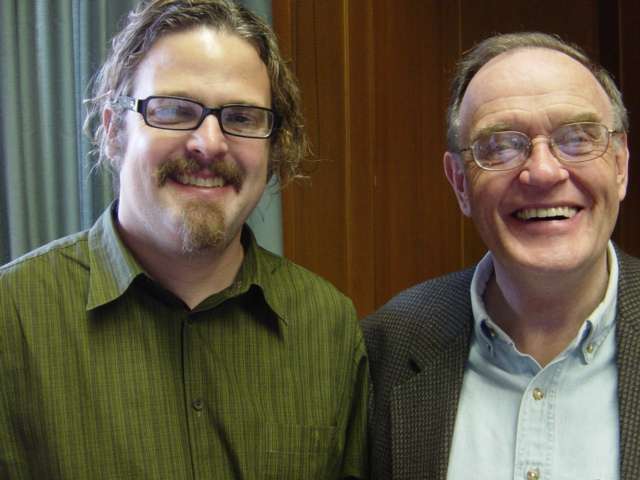
Western culture is experiencing a significant cultural shift from modernity to postmodernity. Various social and spiritual movements have arisen in response to this cultural change. As one response, the emerging church movement has arisen within evangelicalism. This movement is distinctly different from both the contemporary church and seeker church movements, as well as traditional expressions of church. Postmodernism has also given rise to various expressions of new religions and alternative spiritualities. Ryan Bolger is a leading thinker and evangelical strategist in the area of contemporary culture and missions. Ryan is Assistant Professor of Church in Contemporary Culture at Fuller Theological Seminary. Along with Eddie Gibbs, he is the co-author of Emerging Churches: Creating Christian Community in Postmodern Cultures (Baker Academic, 2005). Ryan was gracious enough to agree to an interview for this blog on important issues facing the church in the Western world. (Photo: Ryan Bolger [left], Eddie Gibbs [right]).

MoreheadsMusings:
Can you tell us about your background and your perspective of research and analysis related to the emerging culture?

Bolger:
Hi John, thanks for hosting this conversation. I’m a native southern Californian – have lived in other places but always find my way back to LA. I’ve studied missiology, specifically mission to the west, under Wilbert R. Shenk, a student himself of Andrew Walls and less formally, of Lesslie Newbigin. In addition, I studied the church and church growth under Eddie Gibbs, the Donald McGavran Professor of Church Growth at Fuller Theological Seminary. It is at Fuller where I received a PhD in missiology. What I learned is that we need to think like missionaries in the West rather than simply as church members. We need to understand the culture and look to foster indigenous faith communities within that same culture. Again, nothing radical for missionaries, but very radical for the Western church. As I look at the West, I am most interested in those communities that engage the culture seriously, as missionaries do. I want to tell their stories in the hopes that it might inspire others to do likewise.

MM:
How would you summarize postmodernity in Western culture?

Bolger:
Modernity involved the birth of the secular project in the West – the loss of tradition, community, and the centrality of faith. Inherent to modernity is individualism, industrialization, the birth of the powerful state, the fragmentation of societies, to name a few. Postmodernity marks a significant change in all these realms. It marks the end of the secular project of modernity and the re-integration of spirituality and community into public life.

MM:
Is it important to make such a distinction between academic postmodernism and postmodernism as expressed on a popular level, and where have evangelicals tended to focus their discussion and critique?

Bolger:
I’m concerned with the social manifestations of postmodernity, not necessarily the arguments within the philosophical tradition. So, my interests are academic, but the parallels between the academy and the popular level are more obvious when you focus on the social realm. I do think there are parallels with the philosophical realm as well, but the connections are more difficult to demonstrate. Church-type evangelicals are taught to interact with culture based on philosophy, and so they will think in terms of an apologetic response to postmodernity, addressing issues such as the move away from foundationalism. Mission-type evangelicals will look to understand the culture -- not necessarily debate the culture. For missionaries, cultures just are. Missionaries do not look to change the culture as outsiders, but rather, after fostering an indigenous faith community from within, they may look to the new converts to transform the culture.

MM:
Is postmodernism something evangelicalism and mainline Protestantism should carefully consider as a cultural development for broader reasons beyond the issues of epistemology and absolute truth?

Bolger:
Definitely – postmodernity represents a new form of culture in our cities, connecting our artists, our spiritual people, our environmentally minded, and our youth. This is where evangelicals make their big mistake – thinking we need to argue with these people. We need cross-cultural mission training for regular Christians. Unless they have gone to the mission field, they just don’t have these sensibilities. They spend their time arguing from the outside rather than helping foster transformation from within.

MM:
Let’s talk about the emerging church movement. What is it, and how does it differ from the contemporary church or seeker sensitive models?

Bolger:
Emerging churches represent the first post-Christendom movement in Western clture. Christendom churches are attractional, meaning they look to attract people to their church within a churched culture, and this includes movements such as seeker churches, purpose-driven churches, Calvary Capels, Vineyards, not to mention all the traditional denominations. Post-Christendom churches do not see the church service as a primary connecting point with non-Christians. They look to embody their alternative way of life in the midst of the people in the culture – not in the church service. Again – not radical for missionaries but very counter-cultural within historically churched cultures such as the West. Emerging churches look to the life of Jesus as a source of life – not just his death and resurrection. So, hospitality, generosity, inclusion of the marginal, peacemaking, are very important to emerging churches. Emerging churches are truly postmodern – thus, they do not believe in secular space. They believe in spirituality in all realms, in all parts of culture, with all parts of culture, and with all kinds of people. For emerging churches, community is the glue – they would rather be a part of a community that had a service than a church service in hopes of creating a community.

Friday, February 24, 2006

Cross-Cultural Hermeneutics Course Aims: Why Are They Missing Elsewhere?

Dr. Robert Priest of Trinity International University is teaching an intensive course at Salt Lake Theological Seminary this semester titled "Cross-Cultural Hermeneutics." I was intrigued when I first read the Course Aims section of the syllabus:

"Upon completion of this course each student should demonstrate increasing . . .

A. cognitive . . . .

1. knowledge of theoretical perspectives and research methods employed by scholars who study culture;
2. ability to read scholarly books on other cultures and societies with good comprehension of the vocabulary, concepts and theories assumed or implied in such writings;
3. ability to analyze the culture (customs, beliefs, rituals, symbols, etc.) of other people;
4. ability to understand and analyze the religion and world view of others, since it is in this area that the missionary hopes to effect change, and show how such an understanding can be helpful for the communicator of the gospel;
5. understanding of communication theory and of those elements of culture related to interpersonal interaction and to the communicative task (e.g. body language, symbols, media of communication, interaction styles, etc.);
6. ability to analyze those dimensions of culture which are related closely to the content of the Christian message (e.g. aspects of culture related to suffering and death, to conscience, guilt and shame, to sin and the moral order, to personal and social ethics, to forgiveness of the debt of sin, cleansing from the defilement of sin, to redemptive analogies, etc.);
7. ability to contextualize the gospel message and to contextualize one's ministry strategy in a fashion which is based on the authority of scripture but sensitively related to the social and cultural context because it is also based on an adequate understanding of the human ministry context.

B. affective . . . .

1. sensitivity and deep respect towards those of other cultures and races;
2. deep commitment to understanding the culture of the people to whom one is called;
3. commitment to communicate the gospel in ways that are culturally comprehensible and appropriate;
4. desire to see and affirm the good in other cultures;
5. humility by a comfortable willingness to learn and to be instructed by those to whom one is called and by a willingness to serve under the leadership of others;
6. self-control and patience, being slow to anger or frustration, under circumstances which will be trying and in cultural settings where misunderstandings are inevitable;
7. consciousness of his or her own ethno-centricity; and
8. flexibility and a willingness to constantly reassess and start over with new strategies and plans;

C. skill . . .

1. in the use of ethnographic methods--in conducting interviews and taking fieldnotes on observed events in everyday life--as a basis for gaining understanding of one's ministry context;
2. in intercultural interpersonal relationships;
3. in an ability to employ ministry skills in a culturally appropriate fashion; and
4. in an ability to communicate effectively in cross-cultural settings. "

These goals represent those common in missiology. To what extent do we see them desired, emphasized and utilized among American evangelicals working in the area of new religions and alternative spiritualities in the West? I don't see much of it. Why is this the case? Why does missiology seem to have lofty aims in its understanding and methodology but they seem sorely lacking in apologetic approaches? Should we not aspire to these worthy aims?

Saturday, February 18, 2006

Correct Knowledge and Doctrinal Minimalism

How much correct knowledge of God, Christ and the gospel is necessary for “genuine conversion?” The answer may not be so easy as we might think for those of us working missionally among adherents of new religions, particularly those sharing some affinities with Christianity.

This week I exchanged some emails with a Fuller student who is working on a religion project paper that compares missional contextualization in Islamic contexts with the development of a similar approach to Latter-day Saints. Our exchange was interesting as we integrated our experiences in LDS culture with the writings on Islamic contextualization, and then wrestled with the question of correct knowledge of God and disavowal of heretical knowledge. I thought it might be helpful to summarize some of our thinking here for others to wrestle with in their missional contexts.

We began with recognition of our cultural assumptions that might influence our thinking on this topic. As children of the Enlightenment and Modernity, we recognize that in the West we tend to understand knowledge, and doctrine, in abstract propositional ways, and to value knowledge as an end unto itself. By contrast, a more Hebraic understanding of knowledge tends to be more relational. As Westerners we need to wrestle with the issues and the biblical texts on their own cultural terms rather than imposing Western understandings of knowledge on the subject matter.

With due consideration of our cultural biases, we then considered the essence of the question as to how much correct doctrine is necessary for converts, especially in connection with heretical doctrine. Most evangelicals have some kind of doctrinal formula in mind, from the simple to the complex, but the assumptions upon which these formulas are based need to be reassessed in light of a fresh exegetical and missional engagement with Scripture.

Rick Brown wrote an interesting article for the International Journal of Frontier Missions titled “What Must One Believe About Jesus for Salvation?” The article provides an interesting survey of relevant biblical texts, and his thesis challenges conventional formulas that speak of the necessity of certain doctrines equated with orthodoxy in Christendom, including the deity of Christ, Trinitarian theology, and a substitutionary atonement. Brown’s argument is worthy of careful reflection.

In addition to the question of knowledge of Jesus related to soteriology, we might also consider the broader question of conversion as it relates to worldview transformation. In our discussion we also considered an article by Paul Hiebert, also found in IJFM titled, appropriately enough, “Conversion and Worldview Transformation.”

For those more inclined toward more expansive definitions of orthodoxy as influenced by systematic theology, we might consider that missions has been called the “mother of theology.” Missiologist Gailyn Van Rheenen has used this term in his writings, and by this he means that the early church developed her theology primarily through the messy process of missional engagement with cultures, rather than through philosophical reflection in the form of systematic theology.

After considering these questions from a missiological perspective, and after engaging in fresh theological reflection, we came to the conclusion that some form of doctrinal minimalism is in order. It appears from the biblical evidence that a minimal amount of correct knowledge and doctrine was presented to and accepted by the “convert,” and our tendencies toward more extensive evangelistic formulas might be not only unbiblical, but also put the doctrinal cart before the horse. Rather than expecting potential converts to have more extensive and orthodox theological views, perhaps this is something that should be developed over time as individuals mature in the discipleship process.

And what of the question of the disavowal of heresy from converts? This too may be more difficult and messy than we had previously thought. The biblical texts seem to indicate an admixture of orthodoxy and heresy on the part of those in the covenant (whether Old or New), and while this is not ideal, and the discipleship process should strive toward a deeper and more accurate understanding, surely new converts should not be expected to disavow much of their doctrine and worldview prior to or immediately after acceptance of the gospel. This too might be viewed as a part of the lengthy process of discipleship and sanctification, and missionaries should give those under their discipleship care plenty of room for the Spirit’s working in human lives.

After these discussions I wondered whether it is possible that we have asked more than we need to of those considering the claims of Christ within new religions.

Thursday, February 09, 2006

Considerations on An Islamic Cartoon

The topic of this post is one that stirs great emotions, both among Christians and Muslims. Any comments on such a topic are bound to be misunderstood, and before I get to the specifics of my comments in this post I need to make some introductory comments that I hope will fend off misunderstanding from conservative Christians.

First, I believe that military action is an important part of the war on terror. However, it should not be viewed as the only tool in our toolbag in responding to this complex international problem.

Second, I appreciate concerns about the frequent ridicule of Christianity in the popular media. I am saddened when Christ and the church are slandered, but this should not lead us to the conclusion that if the press treats Christianity this way then similar treatment of other religions, such as Islam should be tolerated.

Third, I recognize Islam in complexity and diversity, and I want to avoid simple black and white understandings and portrayal of this religion. We often hear two extremes, one claiming that true Islam is a religion of peace, while the other extreme claims that true Islam is a religion of violence. I believe that a balanced view on this topic is that Islam is both peaceful and violent, in its origins, historical development, and in current expressions around the world. Christians in the West might strive to represent the "two faces" of Islam (as James Beverley has described it), and also recognize that it is up to the Islamic people around the world to decide which expression of this religion will be the one that dominates in the twenty-first century. Christians should no more interpret what "true Islam" is historically or will be in the present than we would want Muslims tell us what true Christianity is. (A good place to start in reassessing this issue is the fine article by missiologist and missionary Dudley J. Woodberry, "The War On Terrorism: Reflections Of A Guest In The Lands Involved.")

Enough of the introductory statements and on to the present controversy. Unless you have no access to international news you are no doubt aware of the continued controversy in the Muslim world surrounding a cartoon apparently depicting Muhammad in an unflattering way. The cartoon has led to violence around the world and has contributed to international commentary on the specific issue, as well as general aspects related to Islam and the war on terror.

I recognize that a diversity of Christian responses have been offered to this issue, but the one I am hearing quite a bit is commented on above in my initial comments. Many Christians see the cartoon as "fair" in that if Christianity is fair game for ridicule, why not Islam? I think it is fair to say that the reason why more satire is not done in connection with Islam is because of fear of violent backlash from Muslims, something not normally associated with Christianity and surely not on the large scale as we are seeing now in Muslim countries. I've already provided my thoughts on this. Simply because Christianity is fair game for ridicule in the West does not mean other religions should be also. Perhaps Christians might hope for the Golden Rule to be applied by journalists to this issue. Treat other people's religions in cartoons and writing as you would have them treat your religion or spirituality.

But I wonder whether we're missing the broader picture, both on this issue, and in the broader issues of the war on terror against militant Islam, and the culture clash between the West and the Islamic world. I was reading through Books & Culture recently and came across the title of a book that intrigued me: Why the Rest Hates the West: Understanding the Roots of Global Rage, by Meic Pearse (InterVarsity Press, 2004). InterVarsity is a sound evangelical publisher, and the title surely touches on an issue that we desperately need to think through on deeper levels than we have thus far considered. Booklist includes a description of the book on Amazon.com:
The root cause of non-Western nations' anger toward the West lies not in economics, religion, or foreign policy, church historian and business-studies teacher Pearse says, but in modern Western culture, which traditional societies see as barbarism. Specifically, they see in the West societies that forget ancestors, derogate religion, exalt triviality (sports, entertainment, fashion), endorse sexual shamelessness, deprecate family, and discard honor. Westerners are surprised to be called barbarians, because they associate barbarism almost exclusively with dirt and cruelty. To reduce Western surprise, Pearse probes the beliefs that eventuate in the qualities non-Westerners decry. Those doctrines include modern personal integrity (being "true to oneself"), human rights, progress, impartiality or equality of treatment, "imagined communities" (e.g., nation, class), and industrial efficiency. The practical consequences of these beliefs are social atomization; personal riresponsibility; dehumanizing impersonality; and other wounds to traditional families, communities, and conceptions of the person. Perhaps the West itself is dying of modernism through declining birthrates and increasing dependence on immigration in all Western countries. Westerners ought to become normal again, and Pearse urges revivals of belief and behavior in the West that more closely approximate those of "the Rest." This is no "fundamentalist" altar-call harangue, however, but possibly the best, most intelligent, most humane brief argument that the West, rather than the Rest, needs reform. - Ray OlsonCopyright © American Library Association. All rights reserved
While conservative evangelicals who are not positively inclined toward either Islam, or critical self-reflection on American and Western culture, may be tempted to dismiss such a book, it sounds like it might raise important issues for us to consider. These issues are far more complex than portraits of "good vs. evil," and "freedom loving peoples vs. fascists." We're talking about clashes of culture that continue to impact us and our children, probably for decades to come. Christians are called to recognize that they are citizens of a Heavenly City, with their first allegiances being to the King and his Kingdom, rather than to certain national and cultural affinities. Can we use the occasion of international unrest over something so seemingly trivial as a cartoon to wrestle with criticism of our own culture with greater objectivity as members of the community of Jesus?


Unity in Diversity and the Mormon Puzzle

The Southern Baptist Convention's North American Mission Board produced an apologetic video on Mormonism a few years back titled "The Mormon Puzzle." The title of this post should not be construed as referencing this product, but instead I'd like to comment on the many pieces of a puzzle needed to respond properly in ministry to Mormons and Mormonism, as well as other new religions.

Yesterday in a conversation with a colleague I was reminded of how some evangelicals feel that when dialogical and missional approaches to Mormonism are advocated that other approaches, such as those that are largely apologetic in terms of responding to Mormon doctrine or history, are somehow being undermined or considered of no value. Unfortunately, this is an example of hearing something as either/or rather than both/and.

Paul wrote the early church and reminded them of their differing gifts and abilities which were to be valued and utilized for the Body of Christ. Although each Christian has differing gifts and performs different functions in the Body, all are necessary for all the needs of the Body. But the Body of Christ is not only gifted to serve itself, but also to serve the world. Extending Paul's analogy of the body beyond the church to service in the world, we should also recognize that many different gifts, abilities, personality types, and approaches to ministry are necessary and complimentary.

With this perspective in mind, those of us advocating dialogue with LDS leaders are not stating that this is the only approach or the best approach in an evangelical response to Mormonism. We are saying that this is an important part of an overall response, and one that can play an important part. Likewise, those of us advocating missional approaches, whether the Bridges approach of Salt Lake Seminary, team approaches in concert with a Christian mission agency, or missional congregation approaches in LDS culture, are saying that this too is an important aspect of evangelical approaches to Mormonism, but not the only piece.

Although I am sometimes "heard" as disavowing apologetic approaches to Mormonism, let me state clearly that I believe this too has its place. Like the other pieces of the puzzle, this needs to be done carefully, and just as we might try to have high standards in dialogical or missional approaches, our apologetic bar needs to be high as well. We should strive to produce a balanced apologetic that is incorporated as part of an overall strategy for interacting with Mormons, and our apologetic must be contextually appropriate, and serve as a tool for a missional engagement with Mormonism.

Anyone who works with puzzles recognizes that they can only be completed if every part is utilized and plays a part in concert with the other pieces to make a greater whole. My hope is that evangelicals laboring among the LDS people can view themselves and others as valuable pieces of the puzzle being constructed by God. No part of the puzzle is exclusive, and all are needed to play their appropriate part. A few new pieces have been added in the form of dialogue and missions. Let's value all of the pieces and work together to complete the Divine mosaic.

Monday, February 06, 2006

Start Trek Conventions as Sacred Pilgrimage

I have been doing some reading on anthroplogy of pilgrimage to apply this concept to Mormon culture as it relates to the Mormon Miracle Pageant at Manti, and LDS temple openings. One particularly helpful book has been Intersecting Journeys: The Anthropology of Pilgrimage and Tourism, Ellen Badone and Sharon R. Roseman (eds.) (Urbana and Chicago: University of Illinois Press, 2004).

One of the more interesting chapters in the book is "Pilgrimage and the IDIC Ethic: Exploring Star Trek Convention Attendance as Pilgrimage" by Jennifer E. Porter. The chapter begins by referencing the call from anthropologist Victor Turner for students of religion to take the science fiction genre seriously as "futuristic frameworks expressing mythic and liminal states and concerns." The various series making up the Star Trek franchise is then located within this genre as "one location in which to find religion in our society." The dots are then connected to the anthropological discussion of pilgrimage and secular tourism. Anthropologist E. Alan Morinis has stated that even secular journeys can be understood as pilgrimage "if made in pursuit of embodied ideals." Star Trek is known to embody the philosophy of its creator, the late Gene Roddenberry, which can be understood anthropologically as a sacred set of ideals that are then connected to the notion of pilgrimage at conventions, which for many fans function as sacred journeys.

I found this discussion fascinating at a number of levels. First, Roddenberry was well known as a Secular Humanist, and the original series articulated Roddenberry's vision for the future beyondand without religion. As the series progressed it changed with the times and with the new creative influences that came in touch with Roddenberry's project. But regardless of whether we are talking about Roddenberry's Humanist vision, or the postmodern spiritualities that can be seen in subsequent versions of the show, the entire franchise itself embodies a set of ideals that can be understood as sacred.

Second, while this chapter makes a distinction between secular tourism and religious pilgrimage, it also clearly makes a connection between the two, and notes that even visits to secular sites or space (understood geographically as well as in terms of community regarless of location) can fulfill a religious or spiritual dimension akin to religious pilgrimage found in more traditional religious expressions.

All in all this chapter was logical, and took me to places where this man had never gone before. (Sorry, as a Star Trek fan [the original series is the best!] I couldn't resist this closing with a nod to the original series' opening narration.)

Mormonism, Identity, Boundaries, Cultural Allegiance and Experience-Near Theologizing

In my continued reading for intercultural studies I came across a few sources that brought some missional thoughts worth stringing together. I pass them along for missional colleagues to think through with me.

The first pearl of the string comes in the form of an article by Armand Mauss titled "Identity and boundary maintenance: International prospects for Mormonism at the dawn of the twenty-first century," included in the book Mormon Identities in Transition, Douglas J. Davies (ed.) (Cassell, 1996). Mauss reminds us of the important concepts of identity and boundaries that are maintained and constantly negotiated and renegotiated by religious groups in response to surrounding culture. Mauss notes that during the last few decades Mormonism in North America has gone through a retrenchment process in response to negative perceptions of an assimilation process where the boundary between Mormonism and American culture had been blurred, threatening both the boundary and Mormon identity. Evangelicals involved in various forms of missional engagement with Mormon culture will need to remember the concepts of identity and boundaries, as well as the cyclical retrenchment process, as they engage Mormons at levels which threaten LDS uniqueness and identity.

The second string on the pearl which can be tied directly to the preceding point is our tendency toward extraction evangelism approaches as it relates to Mormonism. I have commented on this previously, but by way of reminder, as we engage the religious other our tendency is to expect them to leave their subculture upon conversion, only to reinculturate them in an evangelical subculture, rather than to allow and facilitate indigenous expressions of Christian community drawn from their culture. This tendency toward extractional approaches may be a factor in the lack of interest many adherents of new religions express in Christianity which is often perceived as being counter-cultural in the sense of opposing virtually every aspect of the religious or spiritual subculture of the religious other. As Christian anthropologist Robert Priest has mentioned in another context, "The resistance aroused by such preaching may have little to do with resistance to the Holy Spirit and rejection of Christ, and a great deal to do with allegiance to one's own culture and society in the face of an invitation to a disloyal conversion to an alien culture."

The final pearl on the string has to do with a process of "experience-near theologizing." Priest, mentioned above, has contributed a chapter that describes this process for a book titled Globalizing Theology: Christian Belief and Practice in an Era of Global Christianity, Harold Netland and Craig Ott (eds.) (Baker, Forthcoming 2006). In the article, Priest contrasts experience-near theologizing with the approach of systematic theology, which has "historically employed the assumptions, categories, questions and methods of the disciple of philosophy," resulting in "experience-distant" understandings of theological truths. Experience-near theologizing is missional theologizing, which interacts with anthropology and the human sciences as dialogue partners, resulting in experience-near theology, or theology that is both context-sensitive in relation to cultures, but also draws upon concepts that are intimately related to the daily lives of those in a given culture. Priest notes that each form of theology "pushes the theologian in different directions." While systematic theology moves us toward "logical entailments, formal consistency, and abstract rationality," experience-near theologizing helps us to appreciate "actual lived experiences" that reflect biblical truths as well. Priest states that while there have been a few lone voices calling for the development of experience-near theologizing in missiology, much more work needs to be done.

I hope the reader considers both the importance of the individual pearls, and what the string might look like when they are all put together. Reflection on the individual elements as well as the entire string will be helpful to to those of us in missiological engagement with Mormon culture.

Wednesday, February 01, 2006

Newbigin and McGavran: Western Missional Insights from India

The other day I was reflecting on the various individuals who have influenced my perspective on missions in the West and it occured to me that two very interesting and important insights were born out of missions experiences in India.

The first important influence comes from Lesslie Newbigin. Newbigin is now infamous in mission circles for coming back to his native UK after serving as a missionary in India, only to find that the UK had become a major mission field itself in his absence. As a result of his observations abroad and at home, Newbigin wrote a number of insightful books and articles, including "Can the West Be Converted?" from the International Bulletin of Missionary Research. Newbigin's thought was, and continues to be, groundreaking. As Alan Roxburgh has stated, Newbigen recognized that, "The greatest challenge to Christian mission was now those very nations that had once sent missionaries around the world." In addition he also explored through his writings a theology of culture and ecclesiology informed by the insights of missiology. Newbigin's thinking continues to influence a number of Christians in the West, and he has been especially influential in the emerging church movement.

Another missionary with mportant missional insights for the Western world was Donald McGavran, known for work that helped launch the church growth movement. McGavran's insight was the recognition that churches planted by Western missionaries in India were mission stations rather than indigenous expressions of the gospel in local culture. Thus, these churches became "mission station" churches which were bastions of Western Christianity, culturally disconnected from the local populations, rather than indigenous people movements that drew upon aspects of local culture in the formation new expressions of church community. McGavran discussed these issues in his important book The Bridges of God (World Dominion Press, 1955).

These two individuals might be regarded as missional visionaries. Their thinking remains important and relevant to mission in the West and American post-Christendom. To connect the dots of relevancy to the twenty-first century Western church, Newbigin reminds the great missionary-sending nation of America that cross-cultural missions must also take place in our own neighborhoods. Missions is not just "over there;" more than ever it is "over here." With the shift in the center of gravity of Christianity to the Southern Hemisphere, Western Christianity might also reassess its contribution to world missions in this century.

The insight of McGavran should serve as a wake up call that just as the Western missionary church in India was culturally inappropriate in the local cultural context, so are most of our churches in America, whether Purpose-Driven, seeker friendly, Willow Creek, or whatever the model. Our forms of church subculture are foreign to the neotribal peoples (in terms of social identity) and subcultures of America, hence the need to be truly missional in the development of ecclesiological forms in this country.

As I continue to reflect on the insights of these missional thinkers I find it interesting that God gave these men important insights while they served cross-culturally in India. Their work serves as another indication of the immense value and application of cross-cultural missiology to Western Christianity in our changing cultural context.

Monday, January 30, 2006

Centripetal or Centrifugal?: Radio Control Cars, Israel & the Church

I am currently reading Mission in the Old Testament: Israel as a Light to the Nations (Baker, 2000) by Walter Kaiser, along with many other books for seminary and ministry. I have found his discussion of the missio Dei at the heart of Israel's call, as a responsibility and not merely national privilege, to be helpful in understanding the Old Testament foundation for New Testament missions and the Great Commission. One of the more interesting areas Kaiser touches on is the debate over whether Israel's call to the nations was centripetal or centrifugal. That is, was Israel to serve in a passive role that was inward-moving toward the center, toward Israel and Zion by Gentile "seekers," or was Israel's call to be centrifugal, outward-going from the center to the nations of the world? While many argue for a centripetal role for Israel, Kasier argues briefly but strongly for a centrifugal role (through biblical passages such as Psalm 67, 96 and 117, not to mention the Jonah) , and I believe correctly so. Israel was called and sent in outward moving fashion by Yahweh, and a centripetal response to the nations became one of her many sins.

I see much the same thing in our American churches. While we may still have a strong sense of outward-going missions overseas, we are largely centripetal, inward-moving and attractional in the way we "do church" in America. How many times has the reader been encouraged to simply invite someone to church as a leading form of "evangelism?"

In their excellent book, The Shaping of Things to Come: Innovation and Mission for the 21st-Century Church (Hendrickson/Strand, 2004), Michael Frost and Alan Hirsch contrast centripetal and centrifugal, or attractional and missional forms of church that desire to reach a group of radio control car enthusiasts.

"Next to the field was an asphalted area where a group of model-car enthusiasts had set up a track and were using remote controls to race their cars against one another's. The constant buzz of the miniature motors caught our attention and we wandered over to watch what they were doing. We soon realized we had encountered a lost suburban tribe. Everyone looked the same. They all wore tight black jeans and checkered flannel shirts. They wore baseball caps with car manufacturers' logos on them. They had parked their cars - virtually all drove pickups - beside the track, and their wives or girlfriends sat in one of the truckbeds talking and laughing loudly. It was a tribe in every sense of the word - dress code, language, culture, and customs. We learned that once a month on a Sunday morning they met to race each other, to discuss the latest designs in model cars, and to drink and laugh and build community.

"If the nearby church decided that this suburban tribe needed to hear about the saving work of Christ, how would they reach them? The attractional church would hold special services for model-car racers. It would design an excellent flyer explaining that Jesus loves model-car enthusiasts, and they would place one under the windshield wipers of each pickup. It would try to find a recently converted model-car enthusiast and have him share his testimony one Sunday morning. The attractional church would seek to do anything it could to draw the car racing fraternity into its church building. This might even work if you're dealing with a localized community with some geographic proximity to the church's building. But a car club is probably a citywide community, and its members probably drive great distances to come to its monthly meetings. They are not drawn together by some geographic proximity, but by a commonly held interest. And to complicate matters further, they meet on Sunday mornings!

"The attractional church is stuck! Even though it has a close-knit community of people (likely non-churchgoers) right outside its door, it has no mechanism for sharing Christ with them. Since they (the car club members) are not likely to turn up at the church service one Sunday (doesn't the attractional church love stories of people miraculously turning up at the church service searching for meaning and purpose!), the only way to share Christ's love with them must be to go to them. It would be a decidedly incarnational choice if a few members of a local church, so moved by compassion for the car enthusiasts right across the road, chose to buy a model car and join the club! This would be the kind of thinking and acting we're talking about. If the spirit of our missionary God were to sweep through such a church, we don't doubt that the church itself might buy a few model cars and commission some of its members to miss the morning service so they can fully enter into the community of the car club. By racing cars and repairing cars, they could earn the right of relationship to share their thoughts on life and their love for Jesus. This is the incarnational church in action. If a few car racers came into relationship with Christ, they should not be encouraged to leave the club and join the church. Rather, a home church could be established, and the brand-new Christian car enthusiasts could worship God in the context of their tribal identity." (p.
42-43)

The difference in these approaches is clear, and I believe the centrifugal, missional and incarnational approach is the one that reflects the calling of God, both to Israel and to the church. If we have any desires to see a repeat of the amazing estimated 40-percent-a-decade growth rate that the early church experienced during the first three centuries before Constantine (The Rise of Christianity by Rodney Stark [HarperSanFrancisco, 1997]), then the church in the West and America must recapture the centrality of the missio Dei, and its centrifugal nature applied to people groups and subcultures in recognition of the importance of missions through social networks within their subcultures.

Thursday, January 19, 2006

Santeria and Miguel A. De La Torre

Evangelicals tend to neglect a great number of religious groups in their understanding and analysis of America's religious diversity. This is especially true of those in countercult ministry. Years ago Keith Tolbert wrote an interesting document titled the "ARC Cult Literature Index-1987, Module 4." For me the most interesting part of this document was the section that analyzed Christian "cult-monitoring" literature. After surveying the literature, Tolbert wrote:
"In ratio to the entire analytical literature body, Mormonism constitutes 54.59%, Jehovah's Witnesses make up 14.75%, the New Age is 9.34% and cults, in general, comprise 4.1%. However, together these four categories comprise an overwhelming 82.79%! The remaining 31 categories combined as a mere 17.21% of the total analytical literature. It is interesting to note that not one article on Islam or Judaism appeared in all of this literature in 1987. In fact, they become conspicuous by their absence."
Tolbert went on to speculate as to why a handful of groups receive such a high concentration of treatment by the countercult. He felt that "one major reason for the article disparity is the perceived danger of these groups" (emphasis in original). I agree with Tolbert's reasoning, and although this document was written in the late 1980s, and no doubt some expansion of focus has taken place, I would conjecture that there still exists a large disparity between religious groups that receive analysis by the countercult, and that the perception of threat to the church and orthodoxy are the (perhaps unconscious) factors.

One of the religions that receives little treatment is Santeria. I was looking through various issues of Books & Culture recently and came across an advertisement for a book on the topic titled Santeria (Eerdmans, 2004) by Miguel A. De La Torre. I found an interview with De La Torre by the book's publisher, and was pleased with the author's treatment of the topic. He brings an approach that seeks to understand the religion on its own terms without imposing EuroAmerican cultural or evangelical doctrinal perspectives. De La Torre also notes that while American Christians tend to view Santeria as a "demonic cult," the religion plays an important part in maintaining a sense of identityfor the oppressed and marginalized who are threatened by the mainstream religious culture.

I was not only impressed with De La Torre's approach to Santeria, but a review of his website reveals an interesting body of work on cross-cultural theologizing and mission, religion and popular culture, and other areas of interest. Dr. De La Torre is associate professor at Iliff School of Theology in Denver. I hope to secure his book, and I'd recommend it to anyone interested in Santeria as well as those interested in a sound scholarly and Christian approach to a growing religious movement often ignored by evangelicals.

Tuesday, January 17, 2006

EMNR Annual Conference: Any Shifts in Perspectives?

In the past I served on the board of Evangelical Ministries to New Religions (EMNR), a membership organization for evangelicals involved in countercult ministry. For two years I served as president, and during my involvement with the organization I presented two papers that attempted to move the organization into healthy critical self-reflection in order to engage other disciplines in their understanding of new religions, most notably that of missiology. Unfortunately, these papers and my subsequent efforts generated more heat than light for some on the board, and their membership, so I resigned in an effort to develop my missional paradigm apart from the organization.

In February they will be holding their annual conference, and I recently reviewed their website conference information and developed some musings over plenary session and workshop titles.

The conference title is "A Clash of Cultures: Missionaries in the Marketplace of Religions." The mention and inclusion of the terms "cultures" and "missionaries" reflects an increasing use of intercultural and missional terminology in EMNR, however slight. The question remains to what extent these concepts are engaged independently of the apologetic heresy refutation paradigm.

The following conference sessions caught my eye. I will provide the titles and a few comments.

"Formal Education (Academics) Vs Hands-on-Experience (the Trenches): Which Approach and Form of Training is a Better Biblical Model for Apologetics and Evangelism?" by Craig Hawkins

Given my interests in seeing an increased interaction with academics on the topic of new religions, this title is of interest. Unfortunately, the title appears to be raising a false dichotomy: why can't academic training compliment ministry "in the trenches?" Indeed, the two should be pursued together, not pitted one against the other. Perhaps Mr. Hawkins will explore this option and avoid the dichotomy that appears in the title.

"Cults and Missions in the 21st Century" by Paul Carden

A few years ago when I heard that Paul was doing work on new religions and missions I was intrigued and pleased as this connection was an interest of mine. Unfortunately, in my engagement with his materials in the past on this topic, he has noted the cross-cultural savvy of some new religions on international mission fields, and has called for apologetic engagement by evangelicals in these contexts, but has not considered or developed the application of cross-cultural missions and contextualization in world missions contexts. Perhaps both aspects will be presented in this plenary session.

"Nietzsche, the Death of God, and the Emerging Church Movement" by Bill Honsberger

Several workshops address the emerging church movement, apparently an increasing concern to the countercult community. One of particular interest is referenced above, which notes the influence of Nietzsche on postmodern thought. I fear that such a discussion might be a bit simplistic and engage in guilt by association. First, Nietzsche has been an influential thinker among various postmodern academics, but this must be distinguished from the post-modernism (notice the hyphen) found on a practical level among people in the West. Second, the emerging church is a complex movement that must be understood in its various manifestations, some more problematic than others (a point missed by Don Carson in his book on the topic). Third, simply because the emerging church is experimenting with church community and forms to post-modern subcultures does not mean that they necessarily share post-modern concepts of epistemology and morality that are of concern to evangelicals. Perhaps this session will avoid these problems and provide a balanced assessment.

"Apologetics and Evangelism with Goddess Worshipper, Neopagans, Wiccans and Witches" by Craig Hawkins

I interacted very briefly with Mr. Hawkins through email exchanges and recommended several sources, including the Paganism and Wicca issue of Sacred Tribes Journal. Perhaps his apologetic approach will incorporate the insights of contextual missiology and the efforts of my colleagues in developing promising models of incarnational engagement with these communities.

"Mormons and the Vanishing God-was-once-a-man Doctrine" by Joel Groat

I appreciate the apologetic work of Joel Groat and Luke Wilson of the Institute for Religious Research. In my view they represent a more balanced segment of the countercult community. This title makes me wonder about the direction in which the seminar will take. If there is recognition of the "vanishing" notion of deification within Mormonism, will this be seen as a positive step that should be nurtured and encouraged through cordial dialogue and exploration, as well as through missional engagement with LDS culture, or will it be seen as something more sinister, perhaps masking an allegedly devious intent to deceive evangelicals? Perhaps this seminar will attempt to find middle ground by noting a shift in LDS theology, particularly among rank and file Mormons, and also note that for effective communication some LDS may downplay the significance of this teaching.

After I left the countercult community, I engaged one of the regular members of EMNR in dialogue over a missional approach to new religions. I will never forget the response I got as my perplexed dialogue partner asked, "How will a winsome, missional approach help me keep the forces of darkness at bay?" I found that answer insightful, revealing what I think is at the heart of many self-perceptions in the countercult. Do they conceive of themselves as loving ambassadors of Christ communicating a message of reconciliation through loving service and speech? Or are they twenty-first century crusaders engaged in a holy war against forces of darkness? I wonder which self-conception the upcoming EMNR conference will reinforce. I pray and hope for the former.

Sunday, January 15, 2006

If They Don't Understand, Talk Louder: The Missing Double Hermeneutic

English speaker: "Excuse me. Can you tell me where the train station is? "

Spanish speaker: (Confused.) "Que?"

English speaker: (Speaking more slowly and loudly in an attempt to communicate across the language barrier.) "CAN YOU TELL ME WHERE THE TRAIN STATION IS?"

We've all seen television programs or movies where an English speaking person encounters someone who does not speak the language. After the English speaking person utters a few words and receives a blank look indicating their is no understanding, followed by what appear to be a few words of query in their own language, the English speaking person responds by talking much louder, and more slowly. The English speaking person recognizes that the other person does not understand the language, and no effective communication is taking place, but the assumption is that everyone should understand English, and if we simply keep repeating the same language with a different emphasis that the respondent will understand the message.

When we see an incident like this portrayed in television or the movies we laugh. We recognize that if two people speak different languages then the answer is not for the English speaker to shout a foreign language. We understand this, but the same thing is taking place in our evangelistic attepts with adherents of new religions, and in our churches across America.

In the first instance, when someone attempts to proclaim Christian doctrinal orthodoxy to an adherent from a new religion, and this does not resonate with them because this does not communicate within their spiritual frame of reference, and the evangelical continues on this track by proclaiming even more doctrines and Bible verses, this is the equivalent of shouting English at a Spanish speaker.

In my second example, when our churches construct new buildings and add new programs, or engage in church plants in various communities, and the well-meaning churches continue to send a Christendom culture message that is understood Christians but not understood (or ignored or disdained) by people in the community, this too is an example of shouting English more loudly to a non-English speaking person in the hopes of effective communication.

The missing element in both of this examples is the double hermeneutic. That is, evangelicals tend to emphasize the need for a sound hermeneutic or interpretation of Scripture, but we do a poor job or put no effort at interpreting the culture and subcultures in which we minister. Unless Christians in America recognize the vital importance of a sound hermeneutic of both Scripture and culture then we will continue to our church language at a culture that looks at us and shakes their head in misunderstanding. It's time to recognize and pratice a double hermeneutic.

Bolger on "Marks of a Missional Church"

I've spoken of Fuller missiologist Ryan Bolger in previous posts. He recently posted something interesting on his blog that I am copying below. He addresses the marks of a missional church. This post will be of interest to those churches who think they are already in some sense missional, and to those wondering what that might entail.

Marks of a Missional Church

Eddie Gibbs and I were interviewed (on video) for an upcoming workshop "Living Missionally" in Ventura, CA on January 21, hosted by Reggie McNeal. Here are the prep questions that were asked (and a partial summary of my answers):

1. What are the marks of churches (people) who live missionally?
They no longer see the church service as the primary connecting point with those outside the community. Connecting with those outside happens within the culture, by insiders to that culture who express the gospel through how they live.

2. What is it that keeps a church (people) from thinking missionally?
We have been raised with the idea that much of our life and our responsibilities as Christians are reflected in the weekly church service. It is how we think as Christians in Western cultures where 'going to church' has been an essential part of being a Western citizen. Our context has changed, Christendom is crumbling, but the shift to missional living is a huge shift for Western Christians. It might take the Western church fifty to a hundred years to make the shift, and many won't make the journey. In contrast, those Christians outside the west, who have never lived within 'Christendom', do not think of the church service as the connecting point. They have no illusions that those they are serving would be remotely interested in a church service. Instead, they embody the gospel through serving, both in deeds and words. This is a big, big, shift, and it scares a lot of people.

3. When people (church) suddenly "get it", what does that mean? ... and what do you think brings the revelation?
Christian leaders are burned out. They spend an inordinate amount of hours just keeping the machine running, both in mainline and seeker/purpose driven/gen-x churches. They know no other way to do ministry, and if running the machine isn't it, then what is? When these Christians discover a more organic way of serving God, of emulating Jesus, it gives them hope. They do not need to leave the faith to find integrity or rest. Granted, this shakes up their world, and their future is anything but smooth. But they find a passion again, like a first love, and it sustains them for the tough road ahead...

4. What is/are the hardest obstacle(s) for people/church to overcome in order to being living missionally?
Early in the 21st century, the American church is trained to consume, to be recipients of ministry, to go to church to 'get needs met'. It is how we are formed in the culture, and the church does not train us to be any different. To be active, to be a producer in the faith community, to share the burden, are the birth pangs in the formation of a missional community. Facilitating this type of transformation is one of the most important tasks of leaders today...

5. What is/are the most exciting examples of a people/church who is/are living missionally?
In my book with Eddie Gibbs, I share many, many stories that reveal what missional living in the postmodern West looks like...I couldn't be more excited about these people or their journeys...

6. What was it that drew you into seeking what you found? ... what did you find?
Like many of the people I interviewed, I was on a journey. Was there a way that I could express my faith in my world that would have some integrity? That would look like Jesus? That wouldn't make Christians look unnecessarily weird? As I began to spend time with these leaders and these communities, I found hope. They were asking the same questions! They became my teachers -- and more importantly, my friends...

Thursday, January 12, 2006

Matteo Ricci: 21st Century Missions Lessons from a 16th Century Jesuit

Matteo Ricci is one of the more fascinating figures from the history of Christian missions. Ricci, a Jesuit missionary to China, was the first missionary granted residency in the country after the previous missionary efforts of the Nestorians and previous Roman Catholics were destroyed in the fourteenth century. He continues to serve as a fine example of respect for culture, as well as the contextualization of the gospel and culturally relevant apologetics, and yet he is a figure that is largely unknown in evangelical circles.

Ricci was born October 6, 1552 in Macerata, Italy (interestingly the same year in which Francis Xavier died on China’s doorstep in Shangchuan Island). Ricci engaged in classic studies, and later studied law in Rome for two years. In 1571 he entered the Society of Jesus at the Roman College (now called the Gregorian University in Rome), with a program of studies that included philosophical and theological aspects, as well as mathematics, cosmology, and astronomy. The Jesuit emphasis on education would later be of great benefit to Ricci’s missionary work.

There are several important aspects of Ricci's work worthy of considerartion. The first was Ricci’s patience. He recognized that a successful mission would not happen overnight, and he was content to measure success as a process, and a slow one over a long period of time as well. Ricci recognized that a proper foundation had to be laid, and he was willing to invest the time and effort in appropriate ways in which to see a foundation set and appropriate work built upon it.

Ricci was also willing to devise an approach that was appropriate to the given cultural circumstances. After contrasting his understanding of Chinese culture with his previous experience working among Indian children in India, Ricci recognized that a different approach needed to be utilized. This was because of the highly literate nature of Chinese society compared to India, and the great number of religions that were present. Ricci recognized that China was not a blank slate, and that various cultural influences, including Chinese philosophy and religion, along with their view of cultural superiority, would all have to be considered in formulating an appropriate missions approach.

Another aspect of Ricci’s foundation was his focus on quality rather than quantity in terms of disciples. He set high standards for candidates receiving baptism, and did the same with discipleship as well. This approach caused problems initially, such as with Ricci’s insistence that one Buddhist official leave his concubines prior to baptism. As a result, one of the official’s spurned concubines engaged in a public protest of her treatment, even to the point of threatening suicide, but Ricci was unmoved. The woman did not follow through on her threats, and eventually, the official’s entire family became Christians.

Another foundational aspect of Ricci’s approach was an emphasis on strong interpersonal relationships:
Ricci believed in friendship as a chief virtue in itself, as well as the starting point for a successful presentation of the gospel. He learned the basic manners of Chinese high culture, and was careful not to offend his critics. When he disagreed, he did so in the most generous spirit possible. By contrast, the account of Gandhi, who recalls from his childhood how he could not endure some Christian missionaries who “used to stand in a corner near the high school and hold forth a Bible, pouring abuse on Hindus and their gods,” should make us think twice about the spirit of Incarnational ministry.
A final foundational aspect of Ricci’s ministry was his desire to understand Chinese culture and the people within it as thoroughly as possible before he began sharing the gospel message. Those who have analyzed Ricci’s methodology have characterized it as a “person-centered, dialogical apologetic” and missional approach, one that sought to present the gospel to the Chinese through their culture in light of their beliefs, literature, and history. Ricci wanted to so immerse himself in Chinese culture that he could literally put himself in their thought world, and with this perspective he would be better prepared to communicate the gospel in culturally relevant ways.

Ricci’s accommodation principle on rites for ancestors was hotly disputed after his death. In 1651 a Roman Catholic official was sent to China by Rome to investigate the Jesuit practices influenced by Ricci in connection to the Chinese rites. Although Ricci’s acceptance of the ancestral rites for Chinese converts was supported by Decree in 1656, and later affirmed once again by the Jesuits in 1669, internal conflict within the Jesuit order and others within the Roman Catholic Church led to continued controversy. The Franciscans and Dominicans who entered China after Ricci’s death fueled an inter-order rivalry, and the controversy was not resolved until 1937. This incident is a somber reminder of not only the problems caused to missions by conflict of a political nature within a missionary community itself, but also that such matters are also fueled by disagreements over the relationship between theology and culture in the area of contextualization as well. It seems that current disputes over contextualization practices are not new and have historical precedents.

Three positive aspects stand out in Ricci's approach as most noteworthy:

1. Respect for and understanding of culture. As discussed above, Ricci had a great respect for Chinese culture, and he sought to understand it as thoroughly as possible before engaging it in proclamational form as a missionary. We would do well to emulate him here. The disciplines of sociology, religious studies, and missiology teach the careful student to develop an emic or insiders perspective on a culture and to strive to understand a culture as a member of that culture would understand it. Only then is it permissible to step outside this frame of reference in order to view it from the etic or outsiders perspective. In this writer’s opinion, in general evangelicals in ministry to new religions in the West spend precious little time developing a careful, sympathetic, empathetic, and respectful understanding of these spiritual and religious cultures. As one writer commented on this aspect of his work, “It has been over 400 years since Ricci set foot in China. One of his endearing legacies for the Evangelicals today is the lesson on missionary’s attitude of patience and respect for the other culture, expressed in attentiveness and learning.”

2. Emphasis on relationships. As noted earlier, Ricci valued relationships, and worked hard at developing them, even going so far as to write a book on the topic. This resulted in the establishment of several key relationships that served Ricci’s mission among the literati well.

Human beings are valuable to God in that they reflect the imago Dei. Relationships are an important aspect of what it means to reflect the divine image, and they should b sought in and of themselves as one image bearer seeks to interact with another as a valid activity in and of itself. Beyond this, relationships are also valuable to a missional way of being in discipleship. While an inappropriate emphasis on relationships can be problematic for the missionary, such as when the relationship does not serve as a vehicle to communicate the gospel, relationships must be understood as a vital aspect of the missionary venture. Missions in America is still recovering from its modernist tendencies toward impersonal forms of evangelism, whether by mass crusades or direct mailings and the like, and a rediscovery of the significance of relationships for missions must be a high priority, particularly for missions to new religious subcultures.

3. Contextualization. Ricci drew upon his extensive respect and knowledge of Chinese culture to communicate the gospel in various ways that would speak meaningfully within the cultural context of the Chinese literati. Although some critics have accused Ricci and later Jesuits of creating a “Christian-Confucian syncretism,” and even labeling Jesuit missions in China as “trickery, deception and expedience,” this is an unfair indictment of largely sound missiological efforts. The Jesuits were often pioneering in their appreciation of cultures, and it was the desire of Ricci and the Jesuits for an indigenous Christianity to take root that would survive over time.

Ricci’s example in contextualization points the way forward for the next generation of Christian mission in America and the West.

Anime, Spiritual Seekers, & Cultural Consumption

My Australian friend and colleague, Philip Johnson, recently made me aware of an article that touches on an aspect of the interrelationship between religion and culture in the area of Japanese animation, known as anime. I have not seen the article yet, but hope to track it down in the near future. I had an opportunity to do some research for a series of presentations at Cornerstone Festival a couple of years ago on anime as an influence on gaming cards such as Yu-Gi-Oh!, and I have been interested in the religious influences from Japanese culture on anime, and its cross-cultural signficance.

Jin Kyu Park, "Creating My Own Cultural and Spiritual Bubble": Case of Cultural Consumption by Spiritual Seeker Anime Fans, Culture and Religion, Vol. 6, no. 3 (November 2005): 393-413.

Abstract
"The distinctive quality of Japanese animation (anime) in its descriptions of religious and spiritual realms - integrating symbols, themes, doctrines, and mythologies from various religious traditions - is a cultural manifestation of the new integrative spirituality. This article demonstrates how important the religious aspect of anime is in explaining why younger generations in the USA, who are characterized as a spiritual seekers, become a loyal fan of the cultural aspects. Anime seems to provide them with a cultural resource out of which they create their own cultural and spiritual practices, which is, they claim, not provided by the US mainstream culture. This article argues that since the religious aspect of anime is one of the most disctinctive qualities in distinguishing itself from US pop culture, it would contribute to the generally accepted 'cultural difference' account in explaining the cross-cultural popularity of anime."

A version of this paper, presented at The Intercultural Communications Association in 2003 is available for review on the web.

Monday, January 09, 2006

The Western Church in Exile? Encounters on the Edge

As I reflect on Israel in Exile in the Old Testament, and Jesus' stern rebuke of certain Christian churches in Revelation, I have often wondered about the implications of such things for the Western church in the twenty-first century. Is it possible that the church in the West is, in some sense, in Exile, or at least under some kind of judgment of God? I'd like to put forward this idea at the risk of being dismissed as a modern day Chicken Little or questionable would be prophet standing on a street corner warning of impending doom. If Israel was judged and sent into Exile for failing to be a light to the nations (and with it the attendant idolatry and other sins), and Jesus rebuked lukewarm churches in the first century, why should our generation be excluded from the possibility of judgment for our failures to be missional in the Western world? Before you quickly dismiss such a possibility, consider some interesting quotes from a publication produced by an organization out of the U.K.

While doing some Internet research on this topic a year or so ago I came across an interesting thirteen part series of publications called Encounters on the Edge, published by Church Army of The Sheffield Centre, and written by George Lings. Earlier I had the privilege of connecting with Steve Hollinghurst, a member of his team who does work in the area of Paganism, the New Spirituality, and postmodern spiritualities. In an article in the series titled "Encountering Exile," he begins his reflection on the decline of the church in the U.K. and wonders which parts of Scripture might be most appropriate for understanding the decline of the church in this country. He writes:

We are not in a climate of clear spiritual hunger that positively relates that hunger to Christianity. Like it or not, being "post-Christendom" gives us a history to draw on, a burden of structures to carry and parts of a story to live down. So where in Scripture could we look?...My hypothesis is that the Exile brings me insight and perspective. From its depths, I bring out attitudes and perspectives that help me stay with hopes I entertain and to cope with fears I cannot banish. Without suggesting that there is any explicit or inherent repetition of Jewish history around the 5th Century BC, the number of echoes is uncanny. (Emphasis in original here and following.)
The echoes Lings discusses include a declining influence in culture, a long process of decay within churches, the domination of establishment values, and superficial change in response to cultural shifts. Having laid this groundwork, Lings then considers strands in the prophets during the Exile that have important echoes for us today. As I read through his development of this portion of the article I found the following quotes of interest that are scattered throughout the remainder of the article:

"Plausiblity structures" supporting Christianity have collapsed in the public arena and are only maintained in a private world; pluralism repudiates the centrality of Christian motifs and has little interest in the questions addressed by Christianity.
In discussing the change in Old Testament Jewish society as it shifted from Tabernacle to Temple, he writes:

We too have a heavy emotional dependence on, and heavy financial burden of, religious buildings and public worship, exaggerating the sense of the importance of place in guaranteeing the church's future stake in an emerging society. What might Jeremiah [7:4] say to us?

...

At the end of [the] Decade of Evangelism, cynics observe that the language of everything has changes to mission yet nearly everything has remained much the same.

...

Resources directed to preserve the existing order is the standard response of institutions in decline.
In discussing Israel's lament at being disposed from the land of promised and subjugated to foreign powers, Lings writes:

Psalm 137 laments "how shall we sing the Lord's song in a foreign land?" Yet that very difficulty of being worshippers surrounded by a hostile and alien culture could be precisely the point.

...

I have heard of several dozen Alternative Worship events. These are different from youth congregations in that their age group is wider. They are keeping existing people from falling out of church, more than attracting new people.

While the situation facing the church in the U.K. is surely more dire than that in the U.S., nevertheless, the data indicates that the cultural forces of postmodernity, secularization, and pluralism that are heavily impacting the rest of the Western world are having an impact here as well. Do we have the ability to learn the lessons that the church is learning in the U.K., Australia, and New Zealand, and respond missionally, or will we continue to pursue the same course of action in the face of cultural change and expect different results? We have some time to prepare for the cultural currents sweeping our way from the rest of the Western world, but I fear that American Christians are more likely to prepare for literal tsunamis than spiritual and cultural ones.

George Ling's paper is worth a read. I'd encourage anyone to contact the Church Army to order a copy. It will serve worthwhile in reflection on the possibility of the church in Exile, in America as well as the U.K.

Friday, January 06, 2006

Church as Gay Bar: Coming to Grips with Cultural Distance

Imagine coming home one evening to find a flyer for an exciting new program for your family held in a new building in your neighborhood. You've been looking for something new to get your family involved in, and you are initially excited about the prospects. Then your eyes scan to the bottom of the flyer where you read about the organization sponsoring the program. It just happens to be the owners of a gay bar, and the program will bring you into the gay community. As a conservative evangelical, are you still interested in participating? Of course you aren't. But your lack of interest, perhaps even distaste, for participation in a program in a new building sponsored by a community you have issues with, illustrates a serious problem with the contemporary church in America and the West. A little background on where I got this illustration is in order. (For clarification, I do not believe evangelicals should view or treat homosexuals disparagingly. I cite this illustration as a means of making a point about the gap between church and culture using a community that usually brings a strong and visceral reaction from evangelicals.)

In 2004 I had an opportunity to attend an American Society of Church Growth Conference at Fuller Seminary which was looking at the topic of emerging church. For me, the most beneficial and thought provoking presentation was "The Emerging Church and Donald McGavran in Conversation," presented by Ryan Bolger, a missiologist at Fuller whom I have mentioned before. His presentation looked at Donald McGavran's experience as a missionary in India as discussed in his book Bridges of God: A Study in the Strategy of Missions (Wipf & Stock, 2005), originally published 1954. Bolger discussed McGavran's recognition of both the positive and negative aspects of Western missionary efforts in India. On the positive side, Western missionary efforts resulted in new believers, and great social works in India, such as care for the poor and hospitals. On the negative side, the cultural expressions of church, or mission stations as McGavran called them, were Western enclaves that had little to nothing to do with the surrounding culture. As a result, the cultural distance or gap between the church and the culture was immense. Unless an Indian was interested in leaving their culture and becoming reinculturated in the foreign religion of the white Westerner, the gap between church and culture would not be crossed. The church was foreign to the culture, and as a result it was unable to engage in significant spiritual reproduction.

While we might recognize this problem of cultural distance in the overseas missionary context, we do not recognize it in our own Western missions context, and this is where the illustration from the gay bar is helpful. In his presentation, Bolger mentioned a comment by Steve Collins who heads up an emerging church called Grace in the U.K. Collins has said that church culture is so foreign to the way of life and spirituality of people in the U.K. that people don't visit churches as spiritual seekers any more than an evangelical would visit a gay bar. While large numbers of people are increasingly interested in spirituality in the U.K., only 5-10% attend church because the church community and forms of expression are culturally foreign to contemporary spirituality seekers. So no matter how many programs or new buildings the church may offer, the seeker will not enter the church due to the cultural distance (not to mention hostility to Christendom), just as an evangelical would not enter a gay bar due to cultural distance and differences with this community. While the situation for Christianity is generally more positive in the U.S. than the U.K., nevertheless, increasing numbers of people are likewise finding the church irrelevant to a contemporary spiritual quest.

Enough of the illustration and critique. What might we consider as an alternative? McGavran suggested that instead of mission station churches that engage in extraction evangelism, where individual converts are extracted from their culture and reinculturated in foreign forms of community and church, that we move from mission stations to people movements. That is, instead of practicing institutional church as usual in the Christendom attractional mode (including many of our church plants that clone this model) we should strive to create missional people movements that incarnate the gospel within various subcultures and express the faith in indigenous forms that draw upon the culture of the converts.

The point to remember is that our churches in America and the West are as foreign to increasing numbers of people as gay bars are to evangelicals. Missions teaches us an important lesson here that we need to consider. For further consideration of this and related ideas I highly recommend contacting the American Society of Church Growth to order a copy of Bolger's presentation on audio CD.

Wednesday, January 04, 2006

Gerald McDermott: "Testing the Stark Thesis"

I have been fortunate recently to establish a relationship with Gerald McDermott of Roanoke College. Dr. McDermott has written a number of interesting things in the area of a theology of religions, and I find his perspective and approach of interest, and worthy of further exploration, both for the disciplines of theology and missiology. Of particular interest to me was his book Can Evangelicals Learn From World Religions: Jesus, Revelation & Religious Traditions (IVP, 2000). He has a new book coming out titled God's Rivals: The Challenge of Other Religions in the Bible and the Early Church. I don't have the publishing information, but I have been privileged to see an advance draft, and the book contains many interesting theological gems for missiological consideration and exploration.

Dr. McDermott also brought an article he wrote to my attention titled "Testing the Stark Thesis: Is Mormonism the First New World Religion Since Islam?" The article is published in the new edition of Books & Culture. The article critiques the claim of sociologist Rodney Stark that Mormonism will become the next major world religion. McDermott begins his article with consideration of whether Mormonism constitutes a new religion, or a new religious tradition sufficiently different from traditional Christianity to warrant a separate classification. He then discusses the question of whether Mormonism constitutes a world religion, and along the way notes the difficulties in defining the concept. After offering something of a functional definition of "world religion," McDermott then discusses whether Mormonism is the first such religion to arise since Islam, and notes that several others have arisen since the seventh century, and with far more adherents, such as True Pure Land Buddhism. In this section of his argument, McDermott contrasts The Watchtower Bible and Tract Society with the LDS Church using Stark's ten marks of a major world faith, and after noting a brief parity between the groups he concludes this section by stating: "Because the Witnesses have planted communities in 88% more countries, and are not as associated theologically with America in this increasingly anti-American world, their prospects for further growth might be a little better."

McDermott then concludes his critique by considering the "translatability" of traditional Christianity in its worldwide expansion as contrasted with Mormonism. McDermott interacts with leading scholars in the area of world Christianity studies, including Andrew Walls and Lamin Sanneh, and notes that through Christianity's history it has been enormously adept at translating its core concepts within the cultural frameworks of new cultures. By contrast, McDermott notes that Mormonism suffers from many obstacles to cross-cultural translation, with the exceptions of the South Pacific and Latin America. McDermott believes that this lack of cross-cultural translatability, coupled with its lack of a formal theology, will hamper any possibilities for Mormonism to become a world religion.

This article does not appear to be available at Books & Culture electronically, but the article contains some good information that make a hard copy worth finding and reviewing.