Dr. Mikel Neumann is associate professor of intercultural studies at Western Seminary in Portland, Oregon, where he supervises the intercultural internship program and teaches in doctoral- and master's-level intercultural programs. He served as a church-planting missionary for twenty-five years in Madagasdcar under the auspices of CBInternational. Dr. Neumann was the missionary scholar-in-residence at the Billy Graham Center at Wheaton College, Illinois (1995-1996), where the researched the intercultural dimension of small group ministries. His research took him to Chicago, Caraas, Bombay, Accra, and Moscow. His book Home Groups for Urban Culture was published by William Carey and the Billy Graham Center in 1999. He has degrees from Western Seminary and Fuller Theological Seminary (M.A. and D.Miss.). He is an international resource consultant with CBInternational, and this ministry has taken him to thirty-five nations to teach, encourage, and help local people.
Morehead's Musings: Mikel, thank you for agreeing to respond to a few questions about your chapter in Encountering New Religious Movements, and related issues. The title of your chapter is "The Incarnational Ministry of Jesus." Christians are familiar with the doctrine of the incarnation, but can you tell us how you define the "incarnational ministry" of Jesus and what this means?
Mikel Neumann: The idea incarnational ministry goes back to the fact that Jesus adapted himself to humans. He became one. That is the most radical adaptation in the universe known to humans. The example then, is for us to adapt to our hearers. The burden is on us to communicate in such a way as to be understood. Let the message of the cross be communicated in both our lives and words. It is a simple idea yet not so simple in working it out because it touches every area of our lives.
MM: How was this type of ministry modeled by Jesus?
Mikel Neumann: He became human in space and time, identified as to family, tribe and nation. He lived among people and served them at their point of expressed need. He taught them in a way they understood. There are a number of examples in the gospel of Jesus communicating in different ways to different audiences, whether the religious leaders of Jerusalem, the common peoples of the Middle East, or his discussions with Gentiles.
MM: In your chapter you discuss definitions of ministry, or as you say "getting it right" in ministry, as whether people respond positively. Another definition of success often used by pragmatic evangelicals is counting the numbers of converts, another way of looking at a positive response. How do you define correct ministry, or whatever term we want to use, in relation to an incarnational ministry model as exemplified by Jesus?
Mikel Neumann: I would suggest that if through our lives, service, and finally, words we have opened people’s minds to the gospel message and it’s implication for them, we have succeeded. I’m not against counting people but that is not the primary success indicator.
MM: In your article you discuss relationships, levels of cultural interaction, and practical demonstrations by Jesus as aspects of his incarnational ministry. How is this applicable to cross-cultural missions approaches overseas, and how might it also be applicable to the West, particularly where the new religions and alternative spiritualities are concerned?
Mikel Neumann: Many people wiser than I have spoken of cultural interactions in cross-cultural situations. However, in dealing with new religions and alternative spiritualities we have a different situation. We still need to incarnate the gospel but we also must maintain our identity in Christ. Because many of these groups, particularly those related to the Christian tradition, are often aggressively evangelistic in nature and apologetic in approach we can find ourselves being led in a fruitless direction. Personal service to these people and our own spiritual pilgrimage by way of personal testimony may evidence more fruit.
MM: You also discuss the book of Acts, and contrast a traditional apologetic response with that of incarnational ministry. Can you summarize and contrast these for us?
Mikel Neumann: By traditional apologetic I mean giving a logical/philosophical reasoning as to why the Christian faith is correct or superior to another. While I see a lot of correction of false practice and belief in the new system it is directed to Christians. The incarnational ministry assumes the truth and serves people at their point of need, declaring the gospel truth in understandable ways.
MM: One of the most interesting parts of your article for me was your discussion of an apparent change in Paul's ministry as it developed. I think many of us hold Paul in such esteem that we forget that he didn't always have ministry figured out correctly, and that he was making mistakes and modifying his methods as he pursued missions in the first century. How do you see Paul becoming increasingly relational in his ministry with the Gentiles?
Mikel Neumann: Yes, and increasingly gentle. Immediately after his conversion he was the same fiery preacher he was before conversion (Acts 9:20ff) which as he became more and more powerful caused people to try and kill him. I take that to mean he was so much better at proving his point that the leaders realized the only way to stop him was to kill him. They were not convinced by his arguments. That is the problem with an “apologetic” approach. Later in his ministry we see his gentleness, especially in the epistles. The two approaches can work together but a incarnational spirit must precede any would-be apologetic.
MM: You propose an incarnational ministry approach to new religionists. This involves recognition of and interaction with various cultural levels and an incarnational application. Can you summarize the model you propose and tell us how various facets of incarnational ministry interact with the various levels of culture?
Mikel Neumann: I used the model that Dr. Donald K. Smith brings forth in his work, Creating Understanding. It’s a simple, yet useful, model for this approach. He uses an onion to demonstrate four levels of communication. The outside or most surface level, the onion skin, is the behavior level. This level encompasses speech, culture, non-verbal communication and other obvious interactions. Our works of service can be applied as incarnation at this level. A second, slightly deeper level is designated authority which subsumes both formal authorities (governments, religious books, etc.) and informal (charismatic leaders, peer pressure, etc.). Experience is a deep level of culture that is unique to each person. That is the level where testimony can be effective whereas apologetic really only works at the more surface authority level. Core values are the deepest level and those change only gradually over time. Peeling an onion causes a lot of grief and tears. The metaphor is apt as we seek to communicate with those we love and desire to see understand the gospel message.
MM: You conclude your chapter with a comparison of traditional apologetic approaches with incarnational approaches, and you illustrate this with a helpful chart. Can you describe the similarities between these approaches, and touch on the very real differences in terms of tendencies?
Mikel Neumann: I think the practical difference is one between winning a debate (apologetic) and winning a person (incarnational). The former brings forth a tendency to verbal interaction, the later causes the much more difficult effort toward involvement in a person’s life.
MM: How might we shift from approaches that are largely apologetic-based and move to a blending of incarnational ministry informed by cross-cultural missions and that of contextualized apologetics?
Mikel Neumann: The shift is already in place. Many colleges and seminaries are teaching these principles in their intercultural studies programs. That is a huge change over the years. Many theologians as well have had cross cultural experiences that have brought them understanding of incarnational approaches. The basic issue is one of caring for people enough to become their friends, spending time with them, to the point where our “words” will be heard. Then the gospel can be made plain. That is the goal.
MM: Mikel, thanks again for taking the time to answer these questions.
Monday, August 13, 2007


Monday, August 06, 2007
Christian-Pagan Intolerance, and the West Memphis Three
 In posts on this blog, as well as TheoFantastique, I have commented on my ongoing research project related to Western esotericism and Neo-Paganism, and how film and television in horror and fantasy help shape popular conceptions of these spiritual pathways. One of the issues that I am passionate about that relates to this is that of intolerance. I note that it takes place in the Christian community in relation to Pagans and other esotericists, but it also takes place on the other side of the coin as directed at Christians and Christianity. In my recent reading of the Pagan site Witchvox, I was therefore pleased to read the article "Anti-Christian Prejudice in the Pagan Community" by Pax. At least if we recognize that it exists in both communities, and we talk about it publicly, perhaps some of us can begin to deal with these issues. I know that I try to do my part with my dialogue with Pagans, and in my participation in the list for the Alternative Religions Educational Network, where the motto is "Freedom for religion means all religions."
Beyond this, my research project also made me aware of an interesting case that I am surprised I had not been aware of until just last week. I refer to the infamous West Memphis Three. As the WM3.org website describes the case:
Shortly after three eight-year-old boys were found mutilated and murdered in West Memphis, Arkansas, local newspapers stated the killers had been caught. The police assured the public that the three teenagers in custody were definitely responsible for these horrible crimes. Evidence?
The same police officers coerced an error-filled "confession" from Jessie Misskelley Jr., who is mentally handicapped. They subjected him to 12 hours of questioning without counsel or parental consent, audio-taping only two fragments totaling 46 minutes. Jessie recanted it that evening, but it was too late— Misskelley, Jason Baldwin and Damien Echols were all arrested on June 3, 1993, and convicted of murder in early 1994.
Although there was no physical evidence, murder weapon, motive, or connection to the victims, the prosecution pathetically resorted to presenting black hair and clothing, heavy metal t-shirts, and Stephen King novels as proof that the boys were sacrificed in a satanic cult ritual. Unfathomably, Echols was sentenced to death, Baldwin received life without parole, and Misskelley got life plus 40.
For ever 14 years, The West Memphis Three have been imprisoned for crimes they didn’t commit. Echols waits in solitary confinement for the lethal injection our tax dollars will pay for. They were all condemned by their poverty, incompetent defense, satanic panic and a rush to judgment.
I have done enough reading on the satanic panics of the 1980s and 1990s, and the various historic witch-hunts to know that this case may be a tragic legacy of these strange socio-cultural phenomena. In addition to these considerations, "according to the DNA Status Report filed on July 17, 'none of the genetic material recovered at the scene of the crimes was attributable to Mr. Echols, Echols co-defendant, Jason Baldwin, or defendant Jessie Misskelley.'" For further information on this case see the WM3 website, and pick up copies of the documentary on the case on DVD titled Paradise Lost: The Child Murders at Robin Hood Hills, as well as the book Devil's Knot: The True Story of the West Memphis Three.
It doesn't take a rocket scientist to recognize that something is very wrong with this case, and this may indeed be an instance of gross misjustice that Christians should be involved in just as much as Pagans. Perhaps we can work together to overcome our intolerance toward each other, and to right a social and judicial injustice.
Thursday, August 02, 2007
New Interview on TheoFantastique: Esotericism and Witchcraft in Entertainment and Commodification
 Readers might be interested in a new interview posted on my other blog, TheoFantastique, titled "Jason Winslade Interview: Esotericism and Witchcraft in Entertainment and Commodification." The interview touches on Western esotericism and Wicca and how these topics are portrayed in popular culture. The interview can be found here.
Friday, July 27, 2007
Pew Forum News Item: Evangelical-Muslim Dialogue Involves Questionable Partners
 The recent Pew Forum on Religion and Public Life involves a number of items that touches on Islam. One that caught my eye is titled "Evangelicals, Muslims Start Rare Dialogue." While it is a positive thing to see dialogue between these religious groups, the participants on the evangelical side raise questions as to the appropriateness of their participation as dialogue partners. Here are exceprts from the item as reported in the ChicagoTribune.com:
July 23, 2007
WASHINGTON - They sat facing each other, 14 evangelical preachers on one side, 12 U.S-based Arab diplomats on the other. Nabil Fahmy, the Egyptian ambassador to the U.S., listened as introductions began, and he found himself amazed."Robertson, Falwell, Youssef. ... I had heard these names before," Fahmy later recounted, "and I have to admit I was surprised they were here.
The initiative launched at that July 2 meeting came as a surprise to many. The evangelical community is known for its support of Israel, and many of its most outspoken leaders, such as Pat Robertson and the late Jerry Falwell, have made incendiary comments about the Muslim world. But in recent months, an unusual rapprochement has begun between these two powerful communities, and the sons of some of those same pastors are participating.
[...]
Whether this dialogue will lead to any concrete changes in an increasingly tense environment remains to be seen.
"These interfaith dialogues often take a long time to produce any tangible results," said John Green, a senior fellow at The Pew Forum on Religion and Public Life. "The evangelicals have had similar dialogues with the Jewish community and with Roman Catholics. The impediments to cooperation between evangelicals and Muslims are much larger, but more understanding could have a much greater effect."
[...]
The initiative grew out of a private meeting between Benny Hinn, a televangelist who draws millions of viewers to his dramatic faith-healing campaigns, and a handful of Arab ambassadors this year at the Washington home of Nasser bin Khalifa, who was then Qatar's ambassador to the United States.
At that session, Hinn told Fahmy he would gladly bring other evangelical leaders to meet Arab representatives, and Fahmy volunteered to host such a get-together at his home.'
New generation of leaders
Those who attended included Gordon Robertson, son of Pat and co-host of "The 700 Club"; Jonathan Falwell, whose father, Jerry, died in May; Paul Crouch Jr., whose father, Paul Crouch Sr., founded Trinity Broadcasting Network; and Joshua Youssef, son of Michael Youssef, an Egyptian-born evangelist.
They are part of what is being identified as a new generation of evangelicals with a less confrontational style and a broader political agenda. Richard Cizik, vice president for governmental affairs of the National Association of Evangelicals, which represents 60 denominations and 45,000 congregations in the United States, attended the meeting and said it demonstrated the generational changes.
[...]
"The idea of a dialogue is extremely good, though there will likely be little impact on Middle East policies," said Aaron David Miller, a Middle East scholar at the Woodrow Wilson Center. "The relationship between the evangelicals and Israel is so close that there is very little danger of it being disrupted."
[End article excerpt quotes.]
Not only are the evangelical participants questionable in their participation in terms of their theological depth on knowledge of Islam and interreligious dialogue, but their views related to Israel are problematic as hinted at in the last paragraph quoted from the article above. Indeed, it has been argued by scholars such as Stephen Sizer, that such thinking in evangelicalism represents a form of Christian zionism which he discusses in his book Christian Zionism: Roadmap to Armageddon? (IVP, 2007). While evangelical-Muslim dialogue is rare, and it desperately needs to take place, this void needs to be filled by qualified evangelical participants and this present scenario is frightening with the potential to hamper effective Christian-Muslim relationships rather than move it along in more promising directions.
Tuesday, July 24, 2007
John Taylor on the Theological Basis of Interfaith Dialogue
 I am continuing to work through various bibliographical materials on interreligious dialogue in preparation for the fall workshop on this topic that I will be teaching at Salt Lake Theological Seminary. Last night I read through various chapters in Gerald H. Anderson and Thomas F. Sttransky, eds, Faith Meets Faith (Paulist Fathers & William B. Eerdmans, 1981), and a couple of items in John V. Taylor's chapter caught my eye. The chapter is titled "The Theological Basis of Interfaith Dialogue." The first quote is helpful as Taylor defines what he means by dialogue:
"Dialogue, as I understand it, means a sustained conversation between parties who are not saying the same thing and who recognize and respect the differences, the contradictions, and the mutual exclusions between their various ways of thinking. The object of this dialogue is understanding and appreciation, leading to further reflection upon the implication for one's own position of the convictions and sensitivities of the other traditions."
Later on on this same page just a couple of paragraphs below, Taylor discusses the function of dialogue in respect to maturity in the process of discussion with others with whom one disagrees:
"The loving which is expressed through the attempt to listen and understand and honor, through the frank recognition and appreciation of convictions that deny one's own, through the opening of one's imagination to the real otherness of the other, is, in my view, the function of interfaith dialogue."
On the following page Taylor then moves to a discussion of barriers to dialogue on the part of Christians in a section titled "Past Isolation Has Bred Ignorance and Suspicion." After discussing the society of Western Christendom that developed in reaction to Islam, which included an aspect of isolation from other religious communities, Taylor states:
"As a counter-aggression the Church developed a crusading ethos that became a fundamental feature of its tradition, an ethos which even today is second nature to many Christians."
I find each of these quotes helpful in reflecting on contemporary dialogue between Christianity and the new religions, particularly in the contexts in which I am involved, that of evangelical-Mormon dialogue and Christian-Pagan dialogue. First, Taylor defines dialogue, and although dialogue is taking place in various ways between Christianity and the new religions it is not always defined for those involved and those watching the process. In the second quote Taylor discusses dialogue as a means of both respect for the "religious other" and as a means of self-transformation on the part of the Christian dialogue participant. This aspect is similar to that expressed by Leonard Swidler in his "Dialogue Decalogue" discussed previously on this blog. Third, in the final quotation Taylor notes that a "crusading ethos" has become an important part of the Christian tradition in relation to the "religious other." Perhaps if we are reminded of this facet of our tradition that persists in our postures in regard to the new religions then we will be able to move beyond it.
Wednesday, July 18, 2007
John Saliba: Interview on Dialogue with New Religions
 John A. Saliba, S.J., has been professor of religious studies at the University of Detroit Mercy since 1987, having taught there since 1970. Born in Malta, he holds licentiates in philosophy and theology from Heythrop College (England), a diploma in (social) anthropology from Oxford University, and a Ph. D. in Religion and Religious Education (1971) from the Catholic University of America. In the early 1990's he took part in a three-year study of the new religious movements conducted for the Vatican by the International Federation of Catholic Universities. He has compiled two annotated bibliographies on the new religious movements: Psychiatry and the Cults (New York: Garland Publishing, 1987) and Social Science and the Cults (New York: Garland Publishing, 1990). His more recent publications include Christian Responses to the New Age Movement (London: Geoffrey Chapman, 1998) Perspectives on New Religious Movements (Walnut Creek, CA: Altamira Press, 2nd ed., 2003), “Psychology and the New Religious Movements,” The Oxford Handbook of New Religious Movement, ed. by James R. Lewis (NY: Oxford University Press, 2004), “The Study of UFO Religions: A Review Essay,” Nova Religio: The Journal of Alternative and Emergent Religions, vol. 10.2, November 2006, 103-23; and “Teaching New Religious Movements: Views from the Humanities and the Social Sciences,” in Teaching New Religious Movements, ed. David Go. Bromley (Oxford University Press, 2007).
Morehead's Musings: Dr. Saliba, thank you for your willingness to answer a few questions related to dialogue with new religious movements (NRMs). You wrote an article for the Journal of Ecumenical Studies in 1993 and at that time you wrote that the literature on new religions by Christians reflects "fear, suspicion, confrontation, antagonism, and belligerency." Do you think that these types of attitudes still tend to a general perspective in the attitudes and relationships between Christianity and the new religions?
John Saliba: I am not sure to what degree these attitudes prevail (since I wrote my essay). I think that there’s a little more tolerance (and maybe understanding) among people who have come into contact with new religions. This may be caused by several factors: the new religions are less visible than they used to be. Thus, you do not see, for example, members of the Hare Krishna Movement evangelizing their faith in the open as frequently as you used to. Also, members of the new religions seem to have adopted a less confrontational approach in their recruiting efforts. Again, many members of the new religions have “grown up,” both in age and in maturity. And further, several NRMs appear to have made some accommodation to Western culture.
What is interesting is that one finds less mention of “cults” in newspapers. Even at conferences of professional societies, there are fewer sessions on NRMs. [Exactly what this means is not yet clear].
MM: In your article you also mention that the debates within Christianity about the new religions tend to center around questions of orthodoxy, and that the "standard theological response to the new religions has been apologetic and dogmatic." How might the various branches of Christendom, particularly some expressions of Protestantism, need to move beyond this in order to develop a broader theology of religious pluralism and engagement of the religions, particularly the new religions?
John Saliba: First, for a good survey of the major theologies of religion, a survey which also evaluates these theologies, the best book I have come across is Paul K. Knitter’s book, Introducing Theologies of Religion (2002).
Christianity has been concerned with orthodoxy from apostolic times. Christian Churches have constantly passed judgment on one another with reference to “correct” beliefs. With this in mind, it is easy to see how defending one’s beliefs and attacking beliefs held to be wrong have been common. The first book which comes to mind is Irenaeus’s “Against the Heretics.”
MM: As a follow up to this, you also wrote that the anticult [or counter-cult] movement "is neither an appropriate Christian response nor a productive social and religious reaction to the rising pluralism of the late twentieth century." Now that we have moved into the twenty-first century, do you still feel this way, and how do you see dialogue with the new religions as a more promising facet of a different response?
John Saliba: It seems to me that Christian charity should play a decisive role in the way Christians should treat people of other faiths. This does not imply that Christians must agree with the belief systems and moral behavior of the NRMs. Many of the actions of the anticult movement have intensified both the social and religious conflicts between people of different faiths. Moreover, some of the reactions against the NRMs have not been a good advertisement of Christianity. While it is appropriate to make it clear how the NRMs differ from Christianity, this should be done with respect to the religious freedom which we all desire. Of course, not all NRMs are open to genuine dialogue, just as not all Christians are prepared to enter into dialogue with people of other faiths.
MM: Your article interacts with Leonard Swidler's "Dialogue Decalogue." You note that he wrote this for ecumenical dialogue, and with dialogue between Christianity and world religions, but that "Swidler did not seem to have the NRM's in mind." What types of problems have you noted in dialogue with NRMs that might necessitate a modification in Swidler's Decalogue as applied to this context?
John Saliba: Swidler’s article deals with dialogue between religions that has been taking place for a while. Dialogue between traditional religions and NRMs must take into account several new factors. Till recently at least, most members of NRMs have been converts to the new religions. Some many harbor some dissatisfaction with the religions of their upbringing.
Some modifications of the Swidler’s rules are necessary for dialogue with NRMs. Since some dialogue has in fact taken place, one can start by observation what went well and what didn’t in such interactions. But one must note that just as Christians have to be educated in the process of dialogue, so have members of NRMs.
MM: Are you aware of the various forms of evangelical-Mormon dialogue that are taking place, the controversy that surrounds them, and do you have any reflections on this?
John Saliba: Yes, I am aware of this dialogue, but I must admit that I haven’t followed it in detail. One of the problems in such dialogue is that there are different views as to where the Mormon Church fits into the religions of the world. Is it a branch of Christianity (mainly Protestantism), a syncretistic faith, or a new religion, sui generis? Some Christian groups list Mormonism with “destructive cults.” Also, Mormonism has a very aggressive evangelization program and, according to some scholars, is one, if not the most, fast-growing religion. Dialogue with Mormonism may have its unique difficulties. As a Christian I feel that I should make an attempt to start a dialogue. My attempt may be unsuccessful or I may run into serious problems which might necessitate the termination of the dialogue.
MM: One of the problems that seem to be involved in the evangelical-Mormon dialogue from both sides of the religious divide is a questioning of motives and honesty in the dialogue partners. How does this attitude conflict with the idea of Swidler's ideals for dialogue partners, and how might it represent a serious challenge to this expression of dialogue that calls into question whether evangelicalism is ready for such dialogue?
John Saliba: The questions regarding motives and honesty are serious ones. In general, one must assume good motives and honesty in others, unless there is clear evidence to the contrary. In all forms of dialogue, one can assume that both parties have some evangelical intentions. If nothing else, they are making sure that misunderstandings of their faiths are corrected. Blatant expressions of evangelicalism would include direct or indirect attempts to covert the other party, unwillingness to listen to others and to correct one views if this is needed, and efforts to monopolize the conversation. Needles to say, such expressions are not conducive to dialogue.
MM: You also state in your article that "[m]embers of both new and traditional religions who take a conservative dogmatic stance are not ready for interreligious dialogue." Can you describe what you mean by this?
John Saliba: By a conservative dogmatic stance I have in mind the following: an attitude which stresses dogma, that is, which beliefs are true and which are false. This is a judgmental attitude which leads to conflict. Dialogue is not a discussion forum. Those in dialogue are not called to evaluate the views of the other parties engaged in dialogue. While people in dialogue should not be afraid to bring out differences between different faiths, the stress should be to find points of contact and cooperation. Of course, this applies also to Christians.
MM: In your view, why is dialogue with the new religions necessary?
John Saliba: New religions are here to stay, though I personally doubt that anyone of the current new religions will ever become a major faith. They have many members and they have also created some problems (e.g., between parents and their adult children). These problems can be better solved of alleviated by dialogue, rather than by some form of conflict. Thus, for example, the conflict between parents and their children who have joined NRMs cannot be addressed, much less solved, by mutual antagonism etc.
MM: Your article concludes with a suggestion of various "steps toward dialogue." Can you summarize these for us?
John Saliba: I have not developed this section to any degree. In general, I would say that correct information about NRMs needs to be disseminated. People must be educated in the implications of religious freedom. And ways of coping with both the psychological and theological problems brought about by pluralism must be found. I have briefly dealt with these issues in my book Understanding New Religious Movements (Altamira Press 2003).
MM: Do you have any other thoughts that might reflect a development in your views on these issues since you wrote the article?
John Saliba: There are different kinds of dialogue. Thus, for instance, dialogue between the Christians Churches is not the same as dialogue between Christianity and Hinduism. There is also dialogue between scholars and dialogue between what one could call the average believers who are not theologically trained. I think more work needs to be done regarding dialogue between average believers.
MM: Dr. Saliba, thank you again for answering these questions and for your contribution to dialogue with the new religions.
"Grounded": New Youth Ministries Resource Now Available
 Shortly after my relocation to Utah for seminary studies two years ago I became involved in a great project through Salt Lake Theological Seminary. After two years of planning, scripting, editing, and production, followed by a year of languishing without sufficient funds for mass production, Grounded-- Salt Lake Theological Seminary's new training program for youth -- is finally available for order!
Similar to the relational approach to evangelism to Latter-day Saints that underlies the seminary's popular Bridges program, Grounded speaks to teens and young adults from mainstream Christian backgrounds who are seeking ways to balance commitment to their faith with the friendships they have developed with Latter-day Saints.
This exciting, fast-paced training program explores ways Christian youth can have honest friendships with Latter-day Saints while maintaining the integrity of their own beliefs and effectively sharing their faith in Jesus Christ. The fully packed 5-week curriculum invites young viewers to dig deeper into their faith and get grounded in Jesus Christ. The program includes a 5-part movie documentary on DVD filled with interviews with Christian and Latter-day Saint teens, a Student Workbook with daily faith-promoting activities, and an extensive Leader’s Guide full of additional resources on the history and theology of the Mormon Church and helpful tips on effective evangelism.
The Grounded training program costs $95 plus shipping. This price includes the DVD, the Leader's Guide, and one Student Workbook. Additional workbooks can be purchased for $5 each. Those interested in receiving a preview CD for Grounded for youth or Bridges for adults can send a request to me via email to johnwmorehead@msn.com or by phone at (801) 728-0334.
I look forward to promoting this new resource and to preparing youth and adults in a cultural and relational understanding of the Latter-day Saints.
Monday, July 16, 2007
Interview with Gordon Lynch: "After Religion: 'Generation X' and the search for meaning"
 Gordon Lynch is Professor of Sociology of Religion at Birkbeck College, University of London, and the author of four books addressing different aspects of religion, spirituality and contemporary culture. He has previously trained as a counsellor and taught counselling studies for four years, before moving on to lecture in practical theology at Birmingham University. He has a range of interests in contemporary culture, and also has a Masters’ degree in Art and Design History. He was the co-founder of the UK Research Network for Theology, Religion and Popular Culture and is co-chair of the Religion, Media and Culture group within the American Academy of Religion. His most recent book (just out in June) is The New Spirituality: An Introduction to Progressive Belief in the Twenty-First Century (IB Tauris, 2007).
Morehead's Musings: Gordon, thank you for agreeing to answer some questions for this interview. I was intrigued by your book After Religion: 'Generation X' and the search for meaning (Darton, Longman & Todd, 2002). You begin this book somewhat autobiographically as you share your own story of growing up Evangelical in the U.K. only to lose your faith. Can you summarize some of your personal story?
Gordon Lynch: It’s hard to summarise this briefly, but essentially like many other people, I found that the Evangelical culture that I lived in didn’t grow as my experience of myself and the world did. In my case, I became much more conscious of issues of suffering and how it was hard to reconcile what I heard and sang about God in the Church with the realities of many people’s lives. I totally accept that for some people these tensions can be resolved within the Evangelical tradition, or Christian faith more generally, but for me, once I’d started to question things I found that this eventually left me outside the mainstream of the Christian tradition. This was a slow process, taking several years to work through. In terms of where I am now, broadly speaking, the ideas that I’ve been writing about in The New Spirituality represent the religious milieu that I’m more comfortable with.
MM: Can you also tell us something about your academic background, where you received your training and what academic posts you have held and currently hold?
Gordon Lynch: Like many people interested in religion and contemporary culture, I’ve had quite an eclectic background with degrees in theology, counselling psychology and art/design history, from universities in Durham and Birmingham in the UK. I think that getting a handle on contemporary religion and culture demands an inter-disciplinary approach, and that sharp social analysis requires us to engage with theories and methods that we wouldn’t necessarily get simply on traditional theology degrees.
MM: In the book you set the social and cultural stage for the first chapter titled "After Religion?." Can you describe the differing attitudes to traditional religion and Christianity in the U.K. and the United States? And do you see any general trends towards the types of spirituality that people seem to be moving toward and experimenting with that might be at odds with traditional church experiences?
Gordon Lynch: This is a really big question. To put this briefly, in the USA there is much more residual connection to institutional religion in the UK. In the UK, only around 6% of the population attend church on a regular basis and this will probably fall a bit more for demographic reasons in the next couple of decades. People are also more likely to say that they are not religious (or spiritual) in the UK than they are in the USA. However, under the surface there may be more similarities. Two recent studies of youth attitudes to religion and spirituality – one in the USA, Soul Searching by Christian Smith and Melissa Denton, and one in the UK, Making Sense of Generation Y by Sara Savage et al – actually came up with very similar findings. These were that young people, regardless of what their formal connection to religion was, actually placed little emphasis on religion in their lives. In Smith and Denton’s terms, where young people did think about God, God featured as a divine therapist only to be sought out in times of trouble, and as someone who rewarded good people with heaven when they died. God or religion played little active role in these young people’s sense of meaning and identity – their sense of meaning and value seems to come from elsewhere.
In terms of spirituality beyond institutional religion, I’ve actually become much more sceptical about how widespread this is. The numbers of practising Wiccans and Pagans in the UK and USA are tiny, for example – probably just over 1% in the USA at most. Similarly when Heelas and Woodhead measured the number of people actively involved in alternative spiritualities in the town of Kendal in the UK (which has a relatively thriving alternative spirituality scene), they found that only 1.6% of the population were involved. I suspect that the reason why Mind-Body-Spirit sections of bookstores have grown is that people who buy books in that genre tend to buy lots of books of that kind. Similarly, surveys of bookstore genres suggest that there are roughly similar numbers of specialist alternative spirituality bookstores to specialist comic bookstores. In terms of the wider population, these are pretty minor scenes. I suspect that in the UK, the default position is for people not to be interested in spirituality at all, and in the USA where people are interested in spirituality they’re most likely to combine with this some form of Christianity (albeit it mixed in with some elements from other traditions).
MM: You point out in your book that "Generation X" is often defined by a certain age range through date of birth. But you take exception to this. Can you briefly describe the influences on your thinking here and touch on your suggestion that Gen X might more helpfully be thought of as a mindset? And can you summarize the various qualities that you see exemplifying Gen X?
Gordon Lynch: It’s hard to summarise this briefly, but essentially like many other people, I found that the Evangelical culture that I lived in didn’t grow as my experience of myself and the world did. In my case, I became much more conscious of issues of suffering and how it was hard to reconcile what I heard and sang about God in the Church with the realities of many people’s lives. I totally accept that for some people these tensions can be resolved within the Evangelical tradition, or Christian faith more generally, but for me, once I’d started to question things I found that this eventually left me outside the mainstream of the Christian tradition. This was a slow process, taking several years to work through. In terms of where I am now, broadly speaking, the ideas that I’ve been writing about in The New Spirituality represent the religious milieu that I’m more comfortable with.
MM: Can you also tell us something about your academic background, where you received your training and what academic posts you have held and currently hold?
Gordon Lynch: Like many people interested in religion and contemporary culture, I’ve had quite an eclectic background with degrees in theology, counselling psychology and art/design history, from universities in Durham and Birmingham in the UK. I think that getting a handle on contemporary religion and culture demands an inter-disciplinary approach, and that sharp social analysis requires us to engage with theories and methods that we wouldn’t necessarily get simply on traditional theology degrees.
MM: In the book you set the social and cultural stage for the first chapter titled "After Religion?." Can you describe the differing attitudes to traditional religion and Christianity in the U.K. and the United States? And do you see any general trends towards the types of spirituality that people seem to be moving toward and experimenting with that might be at odds with traditional church experiences?
Gordon Lynch: This is a really big question. To put this briefly, in the USA there is much more residual connection to institutional religion in the UK. In the UK, only around 6% of the population attend church on a regular basis and this will probably fall a bit more for demographic reasons in the next couple of decades. People are also more likely to say that they are not religious (or spiritual) in the UK than they are in the USA. However, under the surface there may be more similarities. Two recent studies of youth attitudes to religion and spirituality – one in the USA, Soul Searching by Christian Smith and Melissa Denton, and one in the UK, Making Sense of Generation Y by Sara Savage et al – actually came up with very similar findings. These were that young people, regardless of what their formal connection to religion was, actually placed little emphasis on religion in their lives. In Smith and Denton’s terms, where young people did think about God, God featured as a divine therapist only to be sought out in times of trouble, and as someone who rewarded good people with heaven when they died. God or religion played little active role in these young people’s sense of meaning and identity – their sense of meaning and value seems to come from elsewhere.
In terms of spirituality beyond institutional religion, I’ve actually become much more sceptical about how widespread this is. The numbers of practising Wiccans and Pagans in the UK and USA are tiny, for example – probably just over 1% in the USA at most. Similarly when Heelas and Woodhead measured the number of people actively involved in alternative spiritualities in the town of Kendal in the UK (which has a relatively thriving alternative spirituality scene), they found that only 1.6% of the population were involved. I suspect that the reason why Mind-Body-Spirit sections of bookstores have grown is that people who buy books in that genre tend to buy lots of books of that kind. Similarly, surveys of bookstore genres suggest that there are roughly similar numbers of specialist alternative spirituality bookstores to specialist comic bookstores. In terms of the wider population, these are pretty minor scenes. I suspect that in the UK, the default position is for people not to be interested in spirituality at all, and in the USA where people are interested in spirituality they’re most likely to combine with this some form of Christianity (albeit it mixed in with some elements from other traditions).
MM: You point out in your book that "Generation X" is often defined by a certain age range through date of birth. But you take exception to this. Can you briefly describe the influences on your thinking here and touch on your suggestion that Gen X might more helpfully be thought of as a mindset? And can you summarize the various qualities that you see exemplifying Gen X?
Gordon Lynch: I’m personally not sure how useful the term Generation X is now, because it’s too in-grained in people’s minds as a description of a particular generational cohort (i.e. ‘baby-busters’ born between the early 1960’s and late 1970’s). My scepticism about this was fuelled when I read an interview with Douglas Coupland (the author of the novel Generation X in which he lamented the way in which a certain ironic, detached yet longing approach to life that he portrayed came to be depicted as the attitude of a whole generational group. I wrote After Religion at quite an early stage of my thinking about these issues, and I wouldn’t even talk in terms of a "Generation X" set of attitudes now. People are more complex than this, and its probably more of a priority for missiologists to think about the very different ways in which people find meaning, value and purpose in life – and the spiritual horizons they construct for themselves – rather than trying to construct generalized patterns of ideas and values. Having said that, Ronald Inglehart’s work on post-materialist values is worth thinking about as a reflection of a contemporary shift in values, as in Paul Heelas and Linda Woodhead’s work on the turn to the self in their book, The Spiritual Revolution.
MM: In one section of the book you talk about the post-evangelicals and the emergents within evangelicalism. Why do you see this as an important facet of late modernity and the Gen X mindset?
Gordon Lynch: In After Religion, I was trying to describe an approach to faith which was critical, sceptical of pre-packaged ideas, yet also wanting to find forms of meaning that connected with contemporary cultural life. These emphases definitely underpin the currents that led to Dave Tomlinson publishing his very influential book The Post-Evangelical in the mid-1990’s in the UK, and we’ve also seen these concerns coming more to prominence in the USA in the emerging church movement of recent years. I think it’s not surprising that if people engage with advanced educational resources and a media critical of received truths, then these emphases will be brought into the life of faith communities. This has got to be a good thing. One of the underlying points in my book Losing My Religion? is that churches can sometimes not be good environments for adult learners, in which they are able to connect their changing experiences with their religious context. If churches want people to think exactly the same thing in ten years time as they think now, then they close down people’s capacity for ongoing reflection and development, and this is intellectually and emotionally stifling.
MM: In the past I read Tom Beaudoin's book Virtual Faith: The Irreverent Spiritual Quest of Generation X (Jossey-Bass Publishers, 1998). You interact with Beaudoin as you discuss the relationship between Gen X and popular culture, but you disagree with his thesis that popular culture serves as a "Scriptural text". Can you describe your view in contrast with Beaudoin's, and how might we properly recognize the significance of popular culture and the role it plays in the social and spiritual expressions of Gen X?
Gordon Lynch: My criticism of Virtual Faith there was that Tom had moved too quickly from his own interpretations of popular culture to assuming that this was how other people would interpret popular culture as well. There are problems with this, though. For example, I used to set a classroom assignment in which students would watch the video of REM’s "Losing My Religion" and then read Tom’s interpretation of it. Hardly any of them interpreted it in the same way that Tom did. This shows that, as scholars, we need to be careful that what seems to us to be obvious readings of popular culture may not be obvious to other people. In academic terms this has led to growing interest in the "turn to the audience"; actually going out and studying what sense and uses people make of popular culture, and not assuming for instance that just because there are religious symbols in The Matrix trilogy that people who watch those films actually see any religious significance in them. This can be a big shift for people trained theologically who are used to interpreting texts, rather than studying what audiences actually do with those texts, but it’s a really important area to develop. Incidentally, I know Tom well and it’s worth saying that he wrote Virtual Faith when he was doing his MA, which was an amazing achievement. Tom agrees with that criticism about the lack of attention to audiences in Virtual Faith. I think he’s also one of the most innovative and interesting young theologians working in the USA today.
MM: In the final chapter you discuss the place of God and traditional religion such as Christianity in relation to Gen X. You mention how many have moved beyond a consumerist approach to spirituality and now seek "to live with a sense of meaning, value and mystery." Can you describe the alternative approach to thinking about God that you discuss in this chapter and how this differs from a traditional Christian conception and an atheistic view as polar opposites?
Gordon Lynch: I think what I was suggesting there was that some people are drawn to a mystical faith, grounded in their experience of nature and the body, rather than to atheism or more orthodox, doctrinal religion. It’s an idea that’s developed much more fully in David Tacey’s book, The Spirituality Revolution. I have to say, now, that I think that’s slightly wishful thinking on my part. When I subsequently developed more research on the mainstream club scene, I found very little evidence of this mystical spirituality, and more evidence of a general concern with personal development and well-being, and the quality of friendships and intimate relations. As I’ve suggested earlier, interest in spirituality beyond institutional religion is a relatively small cultural scene. I might be sympathetic to it, but numerically it’s not huge.
MM: How has your thinking developed since the book After Religion was written?
Gordon Lynch: I think some of the previous answers will touch on this. One thing is that I’ve developed a much greater regard for paying attention to the fruits of empirical research. Theologians and missiologists are too often guilty of making broad claims about cultural changes and patterns without looking to see whether empirical data actually supports these claims or not. This is a shame, as it means that some theological truisms (e.g., about post-modern culture) fail to do justice to the complex ways in which different people live their lives today, and fail to account for how different social variable and structures shape the horizons within which people live their lives. In a similar vein, I hope I’ve learned to separate out what I wish was happening in the contemporary religious landscape from what is actually happening. I think I’ve also become more cautious about how easy communication is between religious and secular views, and in my next bit of work I want to try to encourage some more constructive dialogue there than is currently taking place, courtesy of Richard Dawkins, etc.
MM: Gordon, again, thank you for taking the time for this interview. You have given readers a lot to think about as they attempt to live out a spiritually meaningful life in the late modern West, and there is much here for evangelical reflection as well.
Gordon: Thanks John, pleasure to take time for this.
MM: In one section of the book you talk about the post-evangelicals and the emergents within evangelicalism. Why do you see this as an important facet of late modernity and the Gen X mindset?
Gordon Lynch: In After Religion, I was trying to describe an approach to faith which was critical, sceptical of pre-packaged ideas, yet also wanting to find forms of meaning that connected with contemporary cultural life. These emphases definitely underpin the currents that led to Dave Tomlinson publishing his very influential book The Post-Evangelical in the mid-1990’s in the UK, and we’ve also seen these concerns coming more to prominence in the USA in the emerging church movement of recent years. I think it’s not surprising that if people engage with advanced educational resources and a media critical of received truths, then these emphases will be brought into the life of faith communities. This has got to be a good thing. One of the underlying points in my book Losing My Religion? is that churches can sometimes not be good environments for adult learners, in which they are able to connect their changing experiences with their religious context. If churches want people to think exactly the same thing in ten years time as they think now, then they close down people’s capacity for ongoing reflection and development, and this is intellectually and emotionally stifling.
MM: In the past I read Tom Beaudoin's book Virtual Faith: The Irreverent Spiritual Quest of Generation X (Jossey-Bass Publishers, 1998). You interact with Beaudoin as you discuss the relationship between Gen X and popular culture, but you disagree with his thesis that popular culture serves as a "Scriptural text". Can you describe your view in contrast with Beaudoin's, and how might we properly recognize the significance of popular culture and the role it plays in the social and spiritual expressions of Gen X?
Gordon Lynch: My criticism of Virtual Faith there was that Tom had moved too quickly from his own interpretations of popular culture to assuming that this was how other people would interpret popular culture as well. There are problems with this, though. For example, I used to set a classroom assignment in which students would watch the video of REM’s "Losing My Religion" and then read Tom’s interpretation of it. Hardly any of them interpreted it in the same way that Tom did. This shows that, as scholars, we need to be careful that what seems to us to be obvious readings of popular culture may not be obvious to other people. In academic terms this has led to growing interest in the "turn to the audience"; actually going out and studying what sense and uses people make of popular culture, and not assuming for instance that just because there are religious symbols in The Matrix trilogy that people who watch those films actually see any religious significance in them. This can be a big shift for people trained theologically who are used to interpreting texts, rather than studying what audiences actually do with those texts, but it’s a really important area to develop. Incidentally, I know Tom well and it’s worth saying that he wrote Virtual Faith when he was doing his MA, which was an amazing achievement. Tom agrees with that criticism about the lack of attention to audiences in Virtual Faith. I think he’s also one of the most innovative and interesting young theologians working in the USA today.
MM: In the final chapter you discuss the place of God and traditional religion such as Christianity in relation to Gen X. You mention how many have moved beyond a consumerist approach to spirituality and now seek "to live with a sense of meaning, value and mystery." Can you describe the alternative approach to thinking about God that you discuss in this chapter and how this differs from a traditional Christian conception and an atheistic view as polar opposites?
Gordon Lynch: I think what I was suggesting there was that some people are drawn to a mystical faith, grounded in their experience of nature and the body, rather than to atheism or more orthodox, doctrinal religion. It’s an idea that’s developed much more fully in David Tacey’s book, The Spirituality Revolution. I have to say, now, that I think that’s slightly wishful thinking on my part. When I subsequently developed more research on the mainstream club scene, I found very little evidence of this mystical spirituality, and more evidence of a general concern with personal development and well-being, and the quality of friendships and intimate relations. As I’ve suggested earlier, interest in spirituality beyond institutional religion is a relatively small cultural scene. I might be sympathetic to it, but numerically it’s not huge.
MM: How has your thinking developed since the book After Religion was written?
Gordon Lynch: I think some of the previous answers will touch on this. One thing is that I’ve developed a much greater regard for paying attention to the fruits of empirical research. Theologians and missiologists are too often guilty of making broad claims about cultural changes and patterns without looking to see whether empirical data actually supports these claims or not. This is a shame, as it means that some theological truisms (e.g., about post-modern culture) fail to do justice to the complex ways in which different people live their lives today, and fail to account for how different social variable and structures shape the horizons within which people live their lives. In a similar vein, I hope I’ve learned to separate out what I wish was happening in the contemporary religious landscape from what is actually happening. I think I’ve also become more cautious about how easy communication is between religious and secular views, and in my next bit of work I want to try to encourage some more constructive dialogue there than is currently taking place, courtesy of Richard Dawkins, etc.
MM: Gordon, again, thank you for taking the time for this interview. You have given readers a lot to think about as they attempt to live out a spiritually meaningful life in the late modern West, and there is much here for evangelical reflection as well.
Gordon: Thanks John, pleasure to take time for this.
Friday, July 13, 2007
Can We Talk?: Evangelical-Mormon Dialogue and the "Dialogue Decalogue"
 I have been working through a lot of academic material in preparation for the October course on Interreligious Dialogue I will be leading at Salt Lake Theological Seminary. One of the more interesting pieces of research is an article titled "The Dialogue Decalogue: Ground Rules for Interreligious Dialogue" by Leonard Swidler. The article appeared in the Journal of Ecumenical Studies 20/1 (Winter 1983): 1-4, and was revised and expanded in The Drew Gateway 58 (Spring 1989: 5-9. The entire article from JES can be found here. While Swidler had dialogue between Christianity and world religions in mind when he wrote the article, nevertheless they do present some interesting considerations for dialogue between Christianity and new religions that are relevant to evangelical-Mormon dialogue and the Christian-Pagan dialogue as well. John Saliba has some interesting thoughts related to Christian dialogue with new religions which he put forward in "Dialogue with the New Religious Movements: Issues and Prospects," Journal of Ecumenical Studies 30/1 (Winter 1993): 51-80 that relate to special considerations and possible modifications in Swidler's commandments. I will comment on these in future posts, but for now I present the Dialogue Decalogue for consideration by evangelicals and Mormons. These commandments, and related issues, raise questions as to whether many evangelicals and Mormons are prepared as individuals and religious communities to move beyond confrontation and debate and into dialogue.
FIRST COMMANDMENT: The primary purpose of dialogue is to change and grow in the perception and understanding of reality and then to act accordingly.
SECOND COMMANDMENT. Interreligious dialogue must be a two-sided project - within each religious community and between religious communities.
THIRD COMMANDMENT: Each participant must come to the dialogue with complete honest and sincerity.
FOURTH COMMANDMENT: Each participant must assume a similar complete honesty and sincerity in the other partners.
FIFTH COMMANDMENT: Each participant must define himself.... Conversely - the one interpreted must be able to recognize herself in the interpretation.
SIXTH COMMANDMENT: Each participant must come to the dialogue with no hard-and-fast assumptions as to where the points of disagreement are.
SEVENTH COMMANDMENT: Dialogue can take place only between equals.
EIGHTH COMMANDMENT: Dialogue can take place only on the basis of mutual trust.
NINTH COMMANDMENT: Persons entering into interreligious dialogue must be at least minimally self-critical of both themselves and their own religious traditions.
TENTH COMMANDMENT: Each participant eventually must attempt to experience the partner's religion "from within."
Pew Forum on Religion and Public Life News Items
 The Pew Forum on Religion and Public Life had a few news items that were of interest to me in their weekly update.
The first is titled "How Muslims Compare With Other Religious Americans: In Intensity of Religious Identity, Not Unlike Evangelicals." This article by Robert Ruby and Greg Smith begins by stating:
Although Muslims constitute a small minority in the United States, and their holy book and many of their religious rituals are distinctly their own, Muslim Americans are by no means "the other" when it comes to religious life or politics in the United States. In many ways, they stand out not so much for their differences as for their similarities with other religious groups.
The article then develops this notion by examining various areas including the importance of religion in life, the question of religious and national identity as primary, and views on scriptural literalism. The article includes charts that help compare American Muslim perspectives with those of Protestants and Roman Catholics.
The second news item of interest is titled "Romney Faces Uphill Battle for Evangelical Voters." Barbara Bradley Haggerty writes that:
Nearly a half-century after John F. Kennedy broke the Catholic barrier to the presidency, Mitt Romney is attempting a similar feat.
His Mormon faith raises the fur of some conservative Christians. Many evangelical believers — a group that Romney must win over to prevail in the primaries — say the Church of Jesus Christ of Latter-day Saints is not Christianity.
The article goes on to say that Romney's ability to woo evangelical Republicans in order to win the primaries will not be easy. Negative evangelical attidues on a Mormon presidential candidate are shaped by the history of American negative attitudes towards the "religious other" from the perspective of Protestantism, and its views related to "cults." Two evangelicals are quoted in this news piece as they share their perspectives on Mormonism and Romney that reflects such views:
Mary Doren, a stay-at-home mom, said Romney's Mormon faith was a deal breaker.
"I'm a Christian," Doren said. "I don't think a Mormon or a Catholic is a Christian."
Suzanne Clackey, who home schools her children, echoed similar theological concerns.
"My understanding is they don't believe in the triune God, and so that would bother me," she said.
As the article nears its conclusion the author makes the following observations which seem to indicate that the political ramifications of religious pluralism in America represent a significant theological issue for evangelicalism:
Whether Romney will deter Christians from voting for him remains to be seen, but John Green, a senior fellow at Pew Research Center says that it might. Polls show that Americans say they are less comfortable with the idea of a Mormon president than with a Catholic, Protestant or Jew, though Mormons rank higher than Muslims or atheists.
"When asked in polls whether they would vote for a Mormon candidate, a substantial minority of conservative Christians say they would be less likely to vote for a Mormon candidate," Green notes. "And when those questions are followed up, there's a significant group that says there's no chance that they would vote for a Mormon candidate."
Missions Concepts Consulting Launched
Two friends and colleagues have recently announced the launch of a new ministry venture called Missions Concepts Consulting. From their email release on the topic:
Our vision is to help leaders, non-profit organizations, businesses, churches, and community groups to navigate the difficult to follow and often misunderstood world of New Religious Movements (NRM's), and similarly to help give guidance toward becoming missional in the 21st century.
Missional Concepts Consulting has the following goals: Mapping popular trends in the occult and NRMs among youth and adults, allaying fears and misunderstandings surrounding unique religious expressions, giving sensitivity training toward religiously diverse individuals and groups, as well as identifying legitimate concerns attached to occult practices, understanding the worldview and the subculture of NRMs, and creating an effective evangelistic and apologetic model towards the occult and NRMs.
We will be making ourselves available to denominational groups, churches, schools, and any group or organization which has concerns about the rise of NRMs and desires to form a healthy response to those who are involved with them.
Although New Religious Movements are our specialty, we also will be working to help churches navigate the issues of defining what it means to be missional in the 21st century. Both of us are pastors with a passion for developing missional Jesus-followers. However, we also have a deep desire to help churches and other organizations do what we've focused on for years--develop strategies for Jesus-followers to connect with the spiritual marketplace that has enveloped them.
We are going to be releasing a post on our blogs with this announcement today. We are giving you a heads up hoping you might be willing to let others know about our consultancy group. If you have a blog, we would greatly appreciate it if you would post something about the launch of Missional Concepts Consulting. Feel free to copy any of the above information, or that which is on our blogs that you find helpful.
Our blogs can be found at www.squarenomore.blogspot.com and http://johnsmulo.com
If we can assist your church, organization, parachurch group, or educational institution, or if you know of any others who you think might be interested in our services, please don’t hesitate to contact us at the following addresses or to forward this email on:
John Smulo - jjsmulo@yahoo.com
Phil Wyman - pastorphil@salemgathering.com
John and Phil are well qualified and experienced to engage in this kind of ministry. I wish them the best in this new venture and in our continued collaboration.
Our vision is to help leaders, non-profit organizations, businesses, churches, and community groups to navigate the difficult to follow and often misunderstood world of New Religious Movements (NRM's), and similarly to help give guidance toward becoming missional in the 21st century.
Missional Concepts Consulting has the following goals: Mapping popular trends in the occult and NRMs among youth and adults, allaying fears and misunderstandings surrounding unique religious expressions, giving sensitivity training toward religiously diverse individuals and groups, as well as identifying legitimate concerns attached to occult practices, understanding the worldview and the subculture of NRMs, and creating an effective evangelistic and apologetic model towards the occult and NRMs.
We will be making ourselves available to denominational groups, churches, schools, and any group or organization which has concerns about the rise of NRMs and desires to form a healthy response to those who are involved with them.
Although New Religious Movements are our specialty, we also will be working to help churches navigate the issues of defining what it means to be missional in the 21st century. Both of us are pastors with a passion for developing missional Jesus-followers. However, we also have a deep desire to help churches and other organizations do what we've focused on for years--develop strategies for Jesus-followers to connect with the spiritual marketplace that has enveloped them.
We are going to be releasing a post on our blogs with this announcement today. We are giving you a heads up hoping you might be willing to let others know about our consultancy group. If you have a blog, we would greatly appreciate it if you would post something about the launch of Missional Concepts Consulting. Feel free to copy any of the above information, or that which is on our blogs that you find helpful.
Our blogs can be found at www.squarenomore.blogspot.com and http://johnsmulo.com
If we can assist your church, organization, parachurch group, or educational institution, or if you know of any others who you think might be interested in our services, please don’t hesitate to contact us at the following addresses or to forward this email on:
John Smulo - jjsmulo@yahoo.com
Phil Wyman - pastorphil@salemgathering.com
John and Phil are well qualified and experienced to engage in this kind of ministry. I wish them the best in this new venture and in our continued collaboration.
Melton Interview on Vampire Myth on TheoFantastique
 Readers of this blog may not always make the connection to my other blog with its related but differing topics. Some readers might enjoy my recent interview with Gordon Melton, a noted scholar of new religions who also happens to be a sought after expert on Dracula and the vampire myth. The interview can be found here.
Wednesday, July 11, 2007
Utopia and the Myopic Evangelical Vision
 I am participating in this month's Synchroblog with the theme of utopias. The topic was stimulated by my recent post on the topic as I read through an issue of What is Enlightenment? magazine with this as the theme.
As I've commented on before, as I researched the Burning Man Festival and intentional community for my graduate degree, particularly as I considered what lessons it might have for Christians who can practice personal and community reflexivity, I considered the aspect of utopian thinking. One of the scholars I interacted with defined utopianism as "a state of mind embodied in actual conduct seeking 'to burst the bounds of an existing order.'" This author went further and noted that there "would seem to be some innate connection between utopianism as a mode of thought and social action and the vision of salvation held out by different world-historical religions."
As this author developed the idea of utopian thinking he made the connection to Christianity, and it is earliest expression he understood this as a form of utopian community. As I wrote in my thesis:
"...the early Christian community and its utopian unity in Christ, drew upon 'the Jewish prophetic tradition of the end of days, [and thus] Christianity was itself an attempt to radically alter the social world of late antiquity in line with a vision of a new order, of a new heaven and a new earth.' This utopian community 'was symbolized by the Eucharist,' and as an alternative community '[e]arly Christianity thus presented an alternative locus of social identity and community that was rooted in the experience of grace and the experience of the Parusia [sic].'"
I found this analysis of Christianity as a form of utopianism interesting. I'm not aware of many Christians who consider their church membership or participation in Christian community as a form of a realized eschatological utopia. But thisline of thought is particularly interesting as it is tracd historically in the development of the church. In the view of the scholar quoted above, the Protestant Reformation brought about a change in the assumptions underlying the Christian utopian vision.
"Seligman states that, '[w]ith the Reformation, secular callings were given a religious legitimation and were perceived as possible paths to salvation, thus opening up the possibility of a radically new articulation of utopian themes in terms of this-worldly realization of spiritual ends.'"
This would make for an interesting historical and theological thread for further exploration, and there may be great validity to it. My research indicates that the Christian celebration of festival as part of the sacred calendar (beyond Christmas and Easter) may have been stamped out of the church in a reaction against Roman Catholicism. Is it possible that the Reformation also brought about changes in the way the church viewed itself and its relationship to culture, and with this came a redefinition of the utopian vision, perhaps myopically so, one that may be perpetuated by evangelicalism? Perhaps the presence of utopian or heterotopian communities like Burning Man can provide a point of self-reflection and redefinition for the church in the West so that it might rediscover the current presence of the Kingdom, a realized eschatology that is already/not yet, and a new sense of Christian community as a foretaste of the utopian vision.
Please visit the other contributors to this month's Synchroblog:
Steve Hayes at Notes from the Underground
Phil Wyman at Phil Wyman's Square No More
David Fisher at Be the Revolution
Adam Gonnerman at Igneous Quill
Sam Norton at Elizaphanian
Sally Coleman at Eternal Echoes
Sonja Andrews at Calacirian
Erin Word at Decompressing Faith
Julie Clawson at One Hand Clapping
"...the early Christian community and its utopian unity in Christ, drew upon 'the Jewish prophetic tradition of the end of days, [and thus] Christianity was itself an attempt to radically alter the social world of late antiquity in line with a vision of a new order, of a new heaven and a new earth.' This utopian community 'was symbolized by the Eucharist,' and as an alternative community '[e]arly Christianity thus presented an alternative locus of social identity and community that was rooted in the experience of grace and the experience of the Parusia [sic].'"
I found this analysis of Christianity as a form of utopianism interesting. I'm not aware of many Christians who consider their church membership or participation in Christian community as a form of a realized eschatological utopia. But thisline of thought is particularly interesting as it is tracd historically in the development of the church. In the view of the scholar quoted above, the Protestant Reformation brought about a change in the assumptions underlying the Christian utopian vision.
"Seligman states that, '[w]ith the Reformation, secular callings were given a religious legitimation and were perceived as possible paths to salvation, thus opening up the possibility of a radically new articulation of utopian themes in terms of this-worldly realization of spiritual ends.'"
This would make for an interesting historical and theological thread for further exploration, and there may be great validity to it. My research indicates that the Christian celebration of festival as part of the sacred calendar (beyond Christmas and Easter) may have been stamped out of the church in a reaction against Roman Catholicism. Is it possible that the Reformation also brought about changes in the way the church viewed itself and its relationship to culture, and with this came a redefinition of the utopian vision, perhaps myopically so, one that may be perpetuated by evangelicalism? Perhaps the presence of utopian or heterotopian communities like Burning Man can provide a point of self-reflection and redefinition for the church in the West so that it might rediscover the current presence of the Kingdom, a realized eschatology that is already/not yet, and a new sense of Christian community as a foretaste of the utopian vision.
Please visit the other contributors to this month's Synchroblog:
Steve Hayes at Notes from the Underground
Phil Wyman at Phil Wyman's Square No More
David Fisher at Be the Revolution
Adam Gonnerman at Igneous Quill
Sam Norton at Elizaphanian
Sally Coleman at Eternal Echoes
Sonja Andrews at Calacirian
Erin Word at Decompressing Faith
Julie Clawson at One Hand Clapping
Evangelical-Mormon Dialogue Conference, and Seminary Course on Interreligious Dialogue
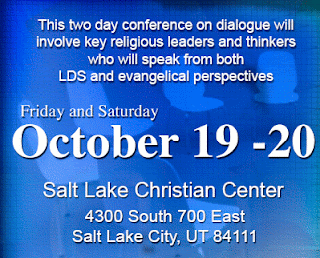 Standing Together will be presenting a National Student Dialogue Conference on October 19-20 at Salt Lake Christian Center. The event will feature a number of plenary sessions and workshops that exemplify and explore Evangelical-Mormon dialogue. The list of plenary sessions may be found here, and the event poster can be downloaded here.
In connection with the conference, I have been asked by Salt Lake Theological Seminary to teach a course that is titled "InterReligious Dialogue: Foundations for Discussion Beyond Debate, Ecumenism, and Relativism." The draft course description reads:
Dialogue between Christians and adherents of other religions has been part of the inter-religious encounter for quite some time, but it is still relatively new in the context of evangelical Christianity and Mormonism. Evangelical-Mormon dialogue takes place in differing ways in differing contexts, and the response has been mixed on both sides of the religious divide. This course will look at a variety of facets that provide a foundation to inter-religious dialogue, including why it is important in a pluralistic and post-9/11 world, a spectrum of definitions of dialogue, biblical precedents for the process, theological considerations related to the process, evangelical concerns about dialogue, and how dialogue relates to Christian mission and evangelism. A solid foundation for dialogue will be put down and then specific application will be made to evangelical-Mormon dialogue.
The course is open to those who attend the Student Dialogue Conference and want to explore the issues surrounding interreligious dialogue in general, and Evangelical-Mormon dialogue in particular, in more depth. The course includes a Student Resource Packet of relevant academic articles, a helpful bibliography, and will use Robert L. Millet and Gerald R. McDermott's Claiming Christ: A Mormon-Evangelical Debate (Brazos Press, Forthcoming 2007) as the textbook. A syllabus and registration should be available at the seminary website as they post course information for the fall semester.
Dialogue between Christians and adherents of other religions has been part of the inter-religious encounter for quite some time, but it is still relatively new in the context of evangelical Christianity and Mormonism. Evangelical-Mormon dialogue takes place in differing ways in differing contexts, and the response has been mixed on both sides of the religious divide. This course will look at a variety of facets that provide a foundation to inter-religious dialogue, including why it is important in a pluralistic and post-9/11 world, a spectrum of definitions of dialogue, biblical precedents for the process, theological considerations related to the process, evangelical concerns about dialogue, and how dialogue relates to Christian mission and evangelism. A solid foundation for dialogue will be put down and then specific application will be made to evangelical-Mormon dialogue.
The course is open to those who attend the Student Dialogue Conference and want to explore the issues surrounding interreligious dialogue in general, and Evangelical-Mormon dialogue in particular, in more depth. The course includes a Student Resource Packet of relevant academic articles, a helpful bibliography, and will use Robert L. Millet and Gerald R. McDermott's Claiming Christ: A Mormon-Evangelical Debate (Brazos Press, Forthcoming 2007) as the textbook. A syllabus and registration should be available at the seminary website as they post course information for the fall semester.
The Question of Pagan Mixing with Harry Potter
 The Wildhunt Blog has an interesting post concering the question of Pagan mixing with Harry Potter. With the latest film now hitting theaters, the post notes that Pagans have taken different postures concerning Potter, with some eschewing any connection and others drawing upon the interest and success of Potter as a tool for promoting Pagan interests. This interesting post concludes by raising an interesting question:
But the larger question is, should we be intentionally mixing with Harry Potter? Isn't using the books and films as a recruitment tool for a Pagan-run organization exactly what intolerant Christians blast J.K. Rowling for all the time? Isn't it a bit unseemly to hijack an author's work in order to make money for your own organization?
Friday, July 06, 2007
Utah Summer Spirit Fest Workshop
 Tomorrow I will be presenting a workshop at the Utah Summer Spirit Fest. This is a Pagan gatherng put together by Eagles Kindred of Utah. The event begins this afternoon and runs through Sunday and it will be held in Ogden. The title of my workshop is "Reflections of a Christian Guest on Hospitality and Dialogue in a World of Pluralism."
My relationship with some in the Utah Pagan community has also resulted in an invitation to present a workshop at Pagan Pride Day on September 22 in Murray Park in Salt Lake City. I have been asked to address my Burning Man Festival research and experiences, and how spirituality might be found in such places.
I am looking forward to these opportunities, and to fostering additional relationships within Utah's Pagan community.
Thursday, July 05, 2007
"Discernment" From the Lunatic Fringe
 I'm really loathe to give this any more publicity, but as I was checking the sources for the hits on my TheoFantastique blog and came across an article from the Walter Martin.org ministry of Jill Martin Rische as written by Dwayna Litz of Lighting the Way. Dwayna was one of the driving forces behind the blog controversy over the Imaginarium venue at Cornerstone last year where the presentations on the Mexican Day of the Dead and Halloween were misunderstood and misconstrued.
In her reporting on Cornerstone 2007, Litz devotes most of her writing space to a promotion of the Festival, including its speakers and the Imaginarium, but concludes with the following commentary and critique at the end:
"Thank God I will be doing mission work in NYC this year, where the lost are a breath of fresh air compared to another oppressive experience with the 'Jesus People' and their neo-pagan, emergent celebrations of death and zombies and the Divine Feminine at the 'Christian' camp meeting."
This sentiment is all well and good except that there was no neo-pagan expression at fesival, death was not celebrated but it was analyzed as part of a genre's narrative, zombies were discussed with connection to Christian theology and popular culture, and the Divine Feminine did not come up as something advocated for Christian worship (although the concept needs to be reflected on in light of concerns over Christian patriarchy in its representation of a genderless deity). One could also wonder why if Jesus People is allegedly neo-pagan and referred to as "Christian" only with the qualifiying quotes, why didn't Litz care enough about these unbelievers in order to brave "another oppressive experience?" Apparently not attending an event and casting judgment based upon promotial material is the engagement of choice for Litz in analysis and evangelism. It would seem that some evangelicals are selective in their reflection on the Decalogue, but I would remind Litz and Rische about the one which frowns on bearing false witness about your neighbor.
I bring this to my readers attention to point out that Litz misrepresents the Festival, both this year and last, as does Rische for providing having Litz as a columnist who provides this kind of questionable reporting. These folks present themselves as guardians of orthodoxy and the epitome of discernment, and yet they can't accurately represent a Christian festival. But then again Litz is on record on her blog in denying that the United States ever went to the moon, and has supported Mike Warnke's falsified claims about involvement in Satanism and Wicca, so this latest rant about Cornerstone merely represents her latest example of discernment from the lunatic fringe. It's too bad that other evangelicals and fundamentalists find any value in these sources.
We might ask that since they can't manage to accurately understand and describe a Christian festival, can we really trust their analysis of new religions, alternative spiritualities, or trends within the broader Christian church in the West (like the emergents)? Is this the direction that some in the counter-cult and broader discernment ministries are taking us? I'll have none of this, thanks so much. I prefer my discernment done without the need for straightjackets.
Tuesday, July 03, 2007
Film and Faith Course at Salt Lake Theological Seminary
 On Thursday I begin co-teaching a course of film and faith on Tuesday and Thursday evenings at Salt Lake Theological Seminary. The course description reads as follows:
Christians engage with films in various ways, from rejection, to critique, to embracing these expressions of popular culture. While designed primarily for entertainment, popular films also shed light on religious, spiritual, and ethical aspects of the cultures in which we live. In this course, we will watch and reflect on a variety of genres of film to develop skills in both cinematic interpretation and theological reflection. This will allow us more responsively to engage the spiritual climate of cultures reflected in films and more faithfully to bring the Gospel into conversation with these cultures. Come join us for an interactive exploration of films and faith!
For my part will lead the first discussion that lays the foundation for engagement with film. The course textbook is Robert K. Johnston, Reel Spirituality: Theology and Film in Dialogue (Baker Academic, 2000), and I will also be drawing upon Gordon Lynch, Understanding Theology and Popular Culture (Blackwell Publishing, 2005). As I discuss using the texts and practices of popular culture as material for theological reflection I will show clips from Minority Report (2002) (with the issues of divine foreknowledge and free will) and Devil's Advocate (1997) (with the issues of freedom and theodicy). Later on in the series I will lead a discussion on race and religion as we watch the original Planet of the Apes (1968) in its entirety, with the assistance of Eric Green, Planet of the Apes As American Myth: Race, Politics, and Popular Culture (Wesleyan University Press, 1996).
Afterthoughts on Cornerstone Festival 2007
 I just returned from another great experience at Cornerstone Festival. I was pretty busy this year, presenting two different workshop series, leading a film discusion on a fantasy role playing game (see my thoughts on this at TheoFantastique), participating in a panel discussion on emerging church, and facilitating a discussion on cross-cultural communication and Wicca. In addition, I thoroughly enjoyed many of the presentations in the Imaginarium that touch on areas related to pop culture.
One of my seminar series was a popularization of my graduate thesis on Burning Man Festival. Thankfully the attendees were willing to consider a fresh understanding of this festival and intentional community, and the ramifications for Christian reflection.
The other series I presented was on the issues of cross-cultural missions and syncretism. This series had its genesis in the unfortunate controversy that resulted from my presentations and other activities in Imaginarium in 2006 where discussion of Halloween and the Mexican Dia de los Muertos or Mexican Day of the Day took place. Some of the more fundamentalist and reactionary brethren were present in stealth mode, and they misunderstood what was presented. After the festival they proceeded to share their "expertise" on the topics with accompanying Bible proof-texting on their blogs. As a result, Cornerstone thought the resulting questions of cross-cultural understanding, missions, and syncretism might flow naturally from such considerations.
My series related to these issues was fairly straight forward. The first session introduced the issues by defining the positive concept (in missions and missiology) of "contextualization" or the process of translating the gospel from one culture to another by framing it in a differing cultural context, as well as the negative concept (in theology and missiology) "syncretism" or the inappropriate blending of Christianity with aspects of indigeneous religion. After consideration of definitions I pointed out that while we are used to thinking about such issues in overseas missions contexts, this represents largely foreign thinking in America and the West where a Christendom mindset and a rather homogeneous concept of America that is supposedly familiar with the gospel and Christianity still holds sway.
The second session built on the first by nothing that contextualization was a well accepted concept in missions, and that it is exemplified in the Bible where God is the supreme contextualizer. I then shared several examples of missional contextualization, including Matteo Ricci among Confucianists, Karl Ludvig Reichelt among Taoists and Buddhists, various contextualization efforts among Muslims, and the work of my colleagues in Australia in contextualization at Mind Body Spirit festivals. I argued that we need to be drawing upon such examples in the creative exploration of contextualization in increasing frequency in Western churches.
The third and final session summarized the preceding seminars and the concluded with a series of basic principles that I hoped attendees would remember. One of the most important noted that while evangelical missions and missiology appears to be moving more in the direction of conservatism in relation to contextualization out of concern or fears over syncretism, in my view the real challenge is our own fears over mistakes (or potential mistakes) in this area. While we are often quick to point the finger at alleged syncretism overseas, we ignore syncretism in our churches in an Americanized Christianity, and this often prevents us from being risk takers in developing new contextualization models and in experimentation. In my view the problem is not that we have gone too far, but rather, I agree with thinkers like Terry Muck at Asbury who argue that we have not gone far enough in contextualization overseas and especially not in the West. I also called for the application of artistry and imagination to this process where "theo-" and "missio-imagineers" can be encouraged to experiment creatively with these processes.
There was nothing controversial in my seminar series this year, and nothing that should have pushed fundamentalist buttons in Imaginarium either, so perhaps the blogosphere will not reflect the alarmist postings of those supposedly sounding the warnings of discernment. But then again, last year wasn't controversial either, nevertheless, the fear mongers and reactionaries among us felt as if they had plenty of fodder.
I appreciate and value Cornerstone Festival as a place where I can explore my own reflections, I can challenge other Christians to expand their thinking, and I can benefit from the creative thinking of other speakers, not to mention the fine people who put Cornerstone Festival on for us all to enjoy.
I can't wait to see what next year holds.
Tuesday, June 26, 2007
Off to Cornerstone Festival
Tomorrow morning I leave for Cornerstone Festival and I will not return until Sunday afternoon. I will likely not be able to check email, and I will not be able to participate in the blogging world until next week.
I hope I might have a chance to see some of my readers at the festival where I will be leading two seminar series, one on missions and syncretism, and the other on Burning Man and its lessons for the church. I will also be participating in various panel discussions on missions, emerging church, women and Wicca, and leading a film discussion on fantasy role playing games.
I hope I might have a chance to see some of my readers at the festival where I will be leading two seminar series, one on missions and syncretism, and the other on Burning Man and its lessons for the church. I will also be participating in various panel discussions on missions, emerging church, women and Wicca, and leading a film discussion on fantasy role playing games.
Monday, June 25, 2007
Searching for Utopia
 Last week I spent some time in the local Barnes & Noble bookstore and as I perused the titles of various magazines the cover of What is Enlightenment? magazine caught my eye with its cover theme of "Searching for Utopia: Exploring humanity's timeless quest for heaven on earth." This topic is of great interest as it surfaced as a consideration during my Burning Man research and thesis. As I commented in the third chapter of my thesis where application for the festival is made to Christianity in the West, the desire for a utopian community has been a facet of human experience for quite some time, and we see it expressed in a variety of ways, whether through Burning Man and its temporary community or a plethora of other forms.
What is Enlightenment? (WIE) summarizes their special feature on utopias in this way:
"From the idyllic Garden of Eden to Teilhard de Chardin's enlightened noosphere, our conceptions of utopia have changed dramatically over time. WIE takes a closer look at the evolutionary significance of humankind's enduring impulse to make heaven into a place on earth."
WIE includes a number of features in its exploration of utopias, and the first is a dialogue between two New Spirituality leaders, Andrew Cohen and Ken Wilber, who discuss "Community and the Utopian Impulse in a Post-Postmodern World" in an article titled "Creative Friction." While their entire discussion is of interest, the following excerpt on individualism and community in postmodernity seemed especially significant:
COHEN: And a big part of the postmodern predicament for so many people, is that we find ourselves very sophisticated, very evolved and developed, but very much alone and experiencing a deep emotional, psychological, and spiritual sense of alienation. We all long for deeper connections, but we are unwilling to give up our attachment to our self-importance in order to be able to experience that connection. One extreme example of this is in Holland, where they have the most liberal society in the entire world. It's fairly common and socially accepted for couples to have this funny thing called an 'alone-together relationship,' which means, 'We're in a relationship, but we live separately so we can each have our own space.' The idea is to hold on, at all costs, to one's own space, personal freedom, and autonomy. I've spent a lot of time in that crazy country and most people are really unhappy.
WILBER: So I've heard.
COHEN: It seems that we've evolved and developed, this truly miraculous capacity for individuation has really put us in a very difficult predicament. And so a big part of the evolutionary impulse right now is calling us, compelling us to find a new way to connect, not only with our own deepest sense of self but also with other people at a deeper level. I think it's very difficult to even think about spiritual development today without speaking about how it relates to this desperate urge to connect with others.
WILBER: Right. Relationship seems to be more important than ever and yet more elusive than ever. That's the real irony of the postmodern situation, that the thing that is probably valued most highly, which is relatedness - everything is contextual, everything is relational - is the thing that people have the least of in any authentic sort of way.
Another facet of WIE's exploration of utopia in this issue is an interview with historian Fritzie P. Manuel in an article titled "The Utopian Propensity." Manuel worked with her late husband Frank to research utopias and together they co-authored Utopian Thought in the Western World, 3rd ed. (Bellknap Press, 1982). As this interview unfolds the discussion turns to a comparison of nineteenth-century intentional communities with those that arose with the 1960s counterculture in America. The contrasts are interesting:
WIE: We think of the "radical sixties" as a time of cultural upheaval and change, with many younger people pursuing alternative lifestyles. However, you point out in your book that these countercultures experiments were often not as novel or "utopian" as the communities that emerged over a century earlier.
MANUEL: Yes, I think that's true. There were many groups that got together in the sixties, but I didn't think of them as utopian....In one respect, these groups were similar to the communities of the mid-nineteenth century - they tried to live lives that were very different from the society around them. But I think the nineteenth-century communities had different ideals. They wanted freedom, but not drug-induced freedom or freedom derived from being irresponsible. And they didn't place themselves in direct opposition to society at large. They was isolation and separation, but not attack, as there was in the 1960s. The nineteenth-century groups were trying to reform society, not reject it. That's a generalization, but I think there's some validity to it. I don't remember any reforming zeal in the 1960s. They were thumbing their noses at society at the same time that they were using the luxuries of the world they were criticizing. That doesn't go for everyone, but it goes for many. The flower kids were also organizing communities on the West Coast, and they obviously wanted individual freedoms that my generation didn't have. I suspect they were thinking about society as a whole, but I was curious to know if these groups were merely seeking refuge from a society that seemed cold and headed in the wrong direction or if they really wanted to change this world.
Further on in this issue is a feature titled "Prototyping the Future: Four radical communities dream of a better world," which profiles differing contemporary intentional communities as those embodying a utopian vision. The groups profiled include The Vistar Foundation in Stamford, Connecticut which began in 1994, Or Haganuz ("Hidden Light") in Merom Hagalil, Galilee, Israel which began in 1989, Sekem ("Vitality") in Belbeis, Egypt which began in 1977, and surprisingly (given that WIE is a magazine with a New Spirituality orientation) Mars Hill Church is also featured, located in Seattle, Washington, which began in 1996.
One of the last features of the magazine that touches on the theme of utopias is an article titled "Dreams of a Digital Utopia." This article looks at how the Internet and technology have impacted the utopian dream. One section of this article references Fred Turner, author of From Countercultures to Cyberculture: Stewart Brand, the Whole Earth Network, and the Rise of Digital Utopianism (University of Chicago Press, 2006). Turner is quoted in this section:
"[Turner] suggests that for the last several decades there has been a 'countercultural dream of empowered individualism, collaborative community, and spiritual communion' that hovers around the idea of the internet and computing like a mythological halo. It is, Turner explains, the 'image of an ideal society,' a utopian ideal, this once digital and networked, which has become part and parcel of the conversation around the explosion of ubiquitous global computing and the tremendous social upheaval and transformation it is causing worldwide. In the same way that Eastern philosophy, LSD, and countercultural ideas once provided the means of radically reframing the context of individuals' lives in the 1960s, Turner's book chronicles the development of the idea that the microchip and the adoption of increasingly sophisticated computer technology are having a similar effect today - reframing the context of life in our global society by destroying rigid hierarchies and bureaucracies the world over; transforming the slow and inhuman institutions of government and business; rendering dictatorship politically unfeasible; making business uber-responsive, efficient, and consumer driven; and remaking loose social networks into newly empowered collaborative virtual communities."
There is quite a lot that his worth considering in this issue of WIE for those interested utopian studies, new religions, and the New Spirituality. I was especially struck by something Fritzie Manuel said in her interview:
"The utopian propensity is a universal impulse. It's just like thinking or breathing. If we lost our minds and totally stopped thinking, then we could stop dreaming....Sometimes we go through periods of discouragement where we don't see the possibility of evolving to a better society. But those are very black moods, and they are not sustained for long. Inevitably, we dream again."
Sometimes I wonder whether evangelical Christianity has stopped dreaming the utopian dream. I don't refer to a desire for escapism into a realm beyond this one that Christians frequently talk about with the notion of heaven. I mean the realization of the restoration of the totality of God's creation in the here and now, and a taste of fully realized individuals fit for real relationships and community between themselves, creation, and the Spirit. Maybe Christians haven't stopped dreaming so much as we're dreaming the wrong dreams, and we're sadly content with attempts at the realization of utopia through the political process, or being content with the fulfillment of the utopian vision after death. For many people this is not enough. It is time to dream again.
Who Will Underwrite the Missional Revolution?
 Last week I picked up a copy of What is Enlightentment? magazine due to a cover theme that caught my eye (which I will post on subsequently). On the inside I found an ad for the magazine that I thought captured a great idea that has application to those of us involved in missions in the West, and more specifically to mission to new religions and alternative spiritualities. Readers can find the ad included with this post as the image that accompanies it. It may be a little hard to read due to the size, but it says:
Five hundred
individuals led the Renaissance
One
family funded it
The Medicis single-handedly fueled a revolution. Will you?
Missional leaders to missions in the West are few, and there are even fewer engaged in missions to new religions. This work has the potential to drive the next revolution in culture.
Who will underwrite the missions revolution?
Subscribe to:
Posts (Atom)