Tuesday, September 12, 2006

Surveys: America's Image of God and Twentysomethings Spiritual Shift

Yesterday I came across two interesting surveys about religious and spiritual beliefs of two segments of Americans. The first survey was wirtten by sociologists from Baylor University's Studies on Religion, as reported in an article in USAToday. It reported that "while 91.8% say they believe in God, a power or a cosmic force, they had four distinct views of God's personality and engagement in human affairs. The Baylor proffesors analyzing the survey data describe these views of the divine as Authoritarian, Benevolent, Critical and Distant. While there is closer proximity between the Authoritarian and Critical views of God and conceptions of God in American evangelicalism, the survey hints at other views that may be just as popular. The survey also noted that belief in the paranormal still holds fascination for many Americans.

The survey has come into question given Baylor's Southern Baptist affiliation and whether the questions include a "conservative Protetant tilt." The article noted that the "questions often used 'church," with no mention of synogogue or mosque." Despite Baylor's assurances that the survey was not leading in its questions in favor of a Christian orientation at the expense of other religious or spiritual traditions, this blogger has reservations about extrapolating from this sampling to arrive at national implications. It may be that if the questioning were oriented differently greater numbers of respondents would have provided answers farther away from conservative evangelicalism and mainline Protestanism and toward Do-It-Yourself Spiritualities.

Another survey, this one by the Barna organization, looked at the move away from Christianity by twentysomethings even after great spiritual activity in churches during teen years. The Barna organization cites a statistic of 61% of today's young adults who fit into this category, adn that this is not a temporary phase before returning to church in later adulthood. Barna notes in this new study that this same group also engages in "at least one type of psychic or witchcraft-related activity during their teen years." This survey is in keeping with Lynn Schofield Clark's work in this area described in her book From Angels to Aliens: Teenagers, the Media, and the Supernatural (Oxford University Press, 2003). As a result of these findings the article insightfully notes that "the current state of ministry to twentysomethings is woefully inadequate to address the spiritual needs of millions of young adults."

The conclusion of Barna's organization is correct, and with the survey results from Baylor the same might be said of older American adults as well. It would seem that our attractional and inward focus of church life independent of constant cultural engagement has failed to adequately prepare people for Christian spirituality in pluralistic America.

Sunday, September 10, 2006

Burning Man, Communitas and the Church


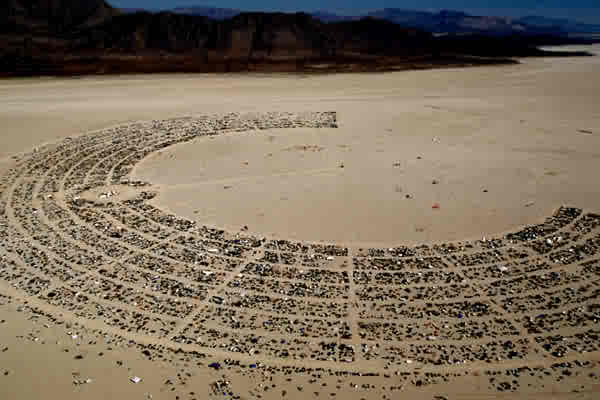
As I biked around the desert playa of Burning Man during the festival as a culmination of my summer research, I wrestled with understanding the essence of the event. I recognize the incredible complexity of this cultural and social phenomenon and that any such understanding must resist oversimplification to the point of misunderstanding.

A number of elements which comprise the Burning Man experience have been suggested, and several come from the Burning Man website itself. These include a sense of belonging as a part of a group; survival in a hostile desert environment; empowerment through art and other forms of personal expression; sensuality as it relates to the festival serving as a feast for the senses; celebration through performance art and the burning of the Man; and liminality which understands the festival as a threshold event in time, space, and culture. Frost and Hirsch have recognized and commented on these facets of Burning Man in their fine book on missional Christianity, The Shaping of Things to Come (Hendrickson/Strand, 2003). In addition, I would add the strong emphasis on art and festivity, but these might be considered subsets of sensuality and celebration (although festivity might be understood much more broadly and with greater social and theological significance than celebration).

But even with these elements in my my questions remained as to the essence of Burning Man. Previously I thought I had boiled it down to either art or festivity as the key elements, and then wondered whether one gave rise to the or whether they should be recognized as occurring in tandem without one being an epiphenomenon of the other. In my earlier thinking I leaned toward festivity giving rise to the art, a point of view which runs counter to much of the thinking on this event. I hope to include a future post on Burning Man and festivity which will discuss this further.

But last night I was reminded how curiously seemingly unrelated strands of research and thinking can come together to shed new light on research. I have commented in the past on symbolic anthropology as it relates to understanding Latter-day Saint pageants and temple openings. Much of my thinking here has been influenced by the work of the late Victor Turner. In reviewing some of this previous research I became convinced that it is also directly relevant to understanding a if not the key element of Burning Man.

Researchers into the Burning Man phenomenon often point to community as a major facet of the appeal of the festival. I believe this is a step in the right direction but it does not go far enough. Burning Man holds great appeal and significance as a social and cultural experience because it offers far more than community, it offers what Turner called communitas.

Victor Turner was a symbolic anthropologist who did some groundbreaking work in Africa studying the place of rituals and their symbolic meaning. He studied initiation rites and their role in the social situations of given tribal cultures. Turner noted that in these rites the participants pass through a liminal state of transition from their previous place of social location in the tribe to eventually transition to a new social location of the mainstream on the other side of the threshold. Turner’s work was fascinating in that he noted that the experience of the participants in the liminal state resulted in an intense feeling of intimacy among the participants. Turner saw this as an experience that approximated what occurs in religious events and he described the strong liminal experience of social togetherness of the initiates as communitas.

Turner’s insights are valid both in non-Western societies in which he first observed them as well as in Western societies. He noted that societies include the stability of normal life, or "structure" as well as communitas that might be labeled “anti-structure.” Turner’s explanation of this juxtaposition of these elements illustrates much of what can be seen at Burning Man in terms of the social forces that under gird and energize the creative expression of the festival:

“I have used the term ‘anti-structure’ . . . to describe both liminality and what I have called ‘communitas.’ I meant by it not a structural reversal . . . but the liberation of human capacities of cognition, affect, volition, creativity, etc., from the normative constraints incumbent upon occupying a sequence of social statuses.”
Understand what Turner is saying: the strong feelings of community in the liminal state results in a liberation that affects human thinking and creativity that is not often found normal social situations. Communitas is a key facet to understanding both the increasing popularity of Burning Man itself, and what is often lacking in Chrisitan community in Western Christendom. Consider the following:

1. While Christian churches often experience a sense of community, rarely do they experience the intensity of communitas. We need not think in either/or terms, but the church might consider the significance of the community/communitas distinction.

2. Community tends to be inward focused and follows from a sense of working together as a result of a focus on each other and common goals; whereas the intensity and strong social bonds of communitas come from an outward focus of people working sacrificially toward a task.

3. Community can be artificial as people come together through shared beliefs, history and ideals, whereas communitas occurs naturally and intensely through shared experience.

4. Communitas has far greater potential to unleash creative thinking and artistic expression, elements desperately needed in Western Christendom.

5. If Christians in the West moved outside of community concepts in order to enter the liminal spaces of culture, the result would likely be communitas resulting in societal change both within local churches and the broader culture as well.

Michael Frost has recognized the importance of communitas to missional expression in the West, as spurned on by his association with Alan Hirsch. Missional Christians are encouraged to reflect on this idea further both as an aid to understanding the citizens of Black Rock City and as a means of transformation and empowerment for Christian communities.

Michael Frost, Exiles: Living Missionally in a Post-Christian Culture (Hendrickson/Strand, 2006)

Victor Turner, The Ritual Process: Structure and Anti-structure (Aldine, 1969)

Victor Turner, From Ritual to Theater: The Human Seriousness of Play (PAJ Publications, 1982)


Image source: Copyright Burning Man LLC, Michael Stewart – photographer
Thursday, September 07, 2006

Burning Man: A Few Impressions After the Red Pill


I pulled my journaling notes from Burning Man and thought it might be helpful to share my daily impressions. Keep in mind that describing Burning Man is difficult. As Morpheus told Neo in The Matrix, "No one can really tell you what the Matrix is. You have to see it for yourself." The same can be said about Burning Man.

We arrived at Burning Man in the late afternoon. As we worked our way through a slow procession of vehicles they kicked up playa dust, but eventually the greeters to the community because visible. I knew immediately that the festival would be very different than my previous participation in community as the greeters were dressed (and undressed) very differently than in the default world (a Burning Man term for reality the other 52 weeks a year). Our greeter shared a phrase we were to hear many times during the week: "Welcome home." Each member of our group then took turns striking a bell type object and shouting out "I'm no longer a virgin," referring to our first-time experience participating in the festival. From this moment on I knew we had swallowed the red pill. How far would the rabbit trail go as we followed Alice into an experimental new world?

My initial experience of Burning Man involved ,a combination of cultural, visual, and sensual overload. The festival is a lively expression of various forms of art, sensuality (distinguished from sexuality), and festivity. These are expressed not only through various "cultural artifacts," but also within the citizens of Black Rock City as well. This was demonstrated through the common adoption of playa names, Mardi Gras-like costuming and various forms of nudity expressed by festival participants. These elements all support individual experimentation with identity play as well as self-expression and celebration.

My unscientific impression of the age group representation was that it is mixed, encompassing all groups, from children to senior citizens (the oldest person we encountered was a proud 79!). Two primary age groups appeared to be those in the 20s and 30s, and another in the 30s to 50s or 60s. My feeling is that the younger demographic appears to be primarily involved in the celebration of what Burning Man offers, while the second group continues to exercise the primary creative control and development of the festival while also enjoying its celebration. The festival organizers circulated demographic surveys which stated that the results would be posted on the Internet. I look forward to reviewing this data for its sociological significance.

My final impression of the festival was that there was something significant here. While the popular media (and the church) often focus on the salacious activities of nudity, sex, and drugs, I believe it is a mistake to characterize Burning Man, or dismiss it, through these elements. While these elements are surely there, they do not represent the totality or essence of the Burning Man experience. In my view the event functions as a spiritual pilgrimage, an embodiment of sacred space and the ideals that its participants yearn for but do not find in the default world. The more I reflect on this pilgrimage and my interactions with the pilgrims themselves, the more I recognize the great significance of this festive community in the desert.

Image source: http://www.filmbespreking.be/2red_pill_1024x768-med.jpg

Table Fellowship, Third Places and Social Outcasts


I really enjoyed John Smulo's interview with Mike Frost on his blog that I mentioned yesterday. As I read through it two points struck me. In the first instance, I was struck by the distinction Frost made in our understanding of Jesus and his practice of table fellowship. Frost is correct in noting that technically Jesus did not extend table fellowship in that his ministry was itinerant in nature. What he did was to accept the invitations to table fellowship extended by various peoples that would have been considered social outcasts in the first century. This distinction is important for Christians in that not only should we be willing to extend an invitation for intimate fellowship to those that our culture and subculture consider undesirable in "come to us" fashion, but we should also be willing to accept their gracious invitations to enjoy fellowship with them, to the extent that our behavior and spirituality merit such invitations. This insight should speak volumes to evangelicals who many times seem more interested in boundary maintenance in their fears over contamination through interaction with others, whether at Burning Man Festivals or neighborhood parks. If we are to emulate Jesus surely we should be spending great amounts of time in real and meaningful fellowships with contemporary "social outcasts," and perhaps one could argue that if Christians aren't perceived in this fashion then our identification with the cultural establishment should tell us we've missed the boat on Christian living and missional incarnation.

The second insight in the Frost interview came for me in his discussion of Third Places. Frost describes this as follows:
"The term ‘third place’ comes from Ray Oldenburg’s book, The Great, Good Place, which is a sociological analysis of the cultural landscape of the US. Oldenburg contends that Americans orient their lives around three broad ‘places’ in their worlds. The first place is the home or neighborhood. The second place is the workplace. And the third place is that public space where we interact with others at a significant level over core issues."
Frost notes that for many (most?) evangelicals the "third place" is the church and evangelical subculture, and because of this we neglect our opportunities to incarnate in neighborhood bowling allies, community functions, and other social events. Christians need to move outside of the Christian ghetto to develop a sense of their spaces of social influence as their primary third place, and this needs to be done with authenticity as they seek to develop real relationships and meaningful participation in these spaces, rather than seeing the third place as a means to an evangelistic end. But the question remains with our existing church structures as to whether less time in the holy huddle will be permissible.

I long for fellow exiles to experiment with me in stepping into new realms of table fellowship and third places.

Image source: http://www.myownself.com/new/images/SocialOutcast.jpg

Five Years After 9/11, 'Dialogue' with Islam Cause for Hope

Conservatives reading the title of this post will likely cringe. Let me state up front that I believe the war on terrorism must be fought on multiple fronts that include law enforcement and, at times, military action, but as I put forward in my seminars at Cornerstone on the rage of the non-West directed at the Western world, an essential element is missing, and that is intercultural understanding. With this in mind I was pleased to receive the latest update from The Pew Forum on Religion & Public Life which included an interview with a Pakistani anthropologist on the topic of dialogue with Islam. Following is the introduction.

A native of Pakistan who served as his country's high commissioner to Great Britain, Akbar Ahmed offers the unique perspective of an anthropologist who has lived in and studied both Islamic and Western cultures. The BBC has described him as "the world's leading authority on contemporary Islam." He is the principal investigator for the "Islam in the Age of Globalization" research project at the Brookings Institution, with support from the Pew Forum on Religion & Public Life and American University. The central thesis of Ahmed's work is that dialogue is required to reduce conflict between the U.S. and Islam. For his traveling dialogues with Judea Pearl, the father of slain Wall Street Journal reporter Daniel Pearl, Ahmed was nominated as a 2005 finalist for Beliefnet’s "Most Inspiring Person of the Year" award. Ahmed, 63, was interviewed in the living room of his home, just outside Washington, D.C.

For a contrasting view, see Five Years After 9/11, The Clash of Civilizations Revisited

Featuring: Akbar Ahmed, Ibn Khaldun Chair of Islamic Studies, professor of International Relations, American University, Washington, D.C. His books include After Terror: Promoting Dialogue among Civilizations (2005) and Islam Under Siege: Living Dangerously in a Post-Honor World (2003).

Interviewer: Mark O'Keefe, Associate Director, Editorial, Pew Forum on Religion & Public Life.

Wednesday, September 06, 2006

Missional Exiles in Post-Christian Culture


Today in my mailbox I received a promotional flyer from a major evangelical ministry that promotes "outreach" through mass marketing. The flyer served as an example of what churches can purchase and use in mass mailings for their communities. Across the top were the words "Invite your community back to church!" On the other side were the words "You're invited" with cozy Autumn photos of smiling people, pumpkins, Autumn leaves, and hot chocolate (with marshmallows, of course).

Do evangelical churches really think it's this easy? Simply mail a seasonal flyer with smiling evangelicals offering pumpkins and hot chocolate, and the community comes "back" to church. I question the premise: Invite your community back to church. It assumes they were there in the first place. And it assumes that people are willing to come into our sacred space and engage church culture, a very questionable notion given the anti-institutional nature of the post-modern spiritual quest. We continue to ignore the increasing numbers of people who have never been to church, as well as the post-Christendom context of the West. While American Christianity may be faring better than the church in the U.K. and Australia, the winds of late modernity/post-modernity and post-Christendom are blowing our way and the leaves have already fallen off the trees of church in modernity. Gone are the days of the church as the focus of the community, and yet our self-understanding and approaches to Christian spirituality and how we "do church and outreach" still presume a Christendom context.

We need a wake up call, and ideas as to how to think missionally in post-Christian culture. This is why I was pleased to secure a copy of Michael Frost's new book, Exiles: Living Missionally in a Post-Christian Culture (Hendrickson/Strand, 2006). I had the privilege of meeting Mike during my trip to Australia a few years ago. He's part of the Forge Training Network, and he is the co-author with Alan Hirsch of The Shaping of Things to Come. My friend and colleague John Smulo has a two-part interview with Mike where they discuss the book on his blog.

To wet your appetite, feast on a sample from the first chapter:
This book is written for those Christians who find themselves falling into the cracks between contemporary secular Western culture and a quaint, old-fashioned church culture of respectability and conservatism. This book is for the many people who wish to be faithful followers of the radical Jesus but no longer find themselves able to fit into the bland, limp, unsavory straightjacket of a church that seems to be yearning to return to the days when "everyone" used to attend church and "Christian family values" reigned. This book is for those who can't remain in the safe modes of church and who wish to live expansive, confident Christian lives in this world without having to abandon themselves to the values of contemporary society. This book is for those Christians who feel themselves ready (or yearning) to jump ship but don't want to be left adrift in a world where greed, consumerism, laziness, and materialism toss them about endlessly and pointlessly. Such Christians live with the nagging tension of being at home neither in the world nor in the church as they've known it. Is there some way of embracing a Christ-centered faith and lifestyle that are lived tenaciously and confidently right out in the open where such a faith is not normally valued? I think so, but it will require a dangerous departure from standard church practice. It seems that the church is still hoping and praing that the ground will shift back and our society will embrace once again the values that it once shared with the Christian community. But for many of us, and for those to whom this book is written, this hoping and praying is a lost cause. We acknowledge that the epoch of history that shaped the contemporary church has crashed like a wave on a shore and lef the church high and dry. That epoch is known as the era of Christendom.
As a missional Christian in exile in the post-Christian West I encourage other exiles to join me in benefitting from Michael's wisdom. May our tribe increase.

Tuesday, September 05, 2006

I've Been Burned


I returned to the Salt Lake City area yesterday on my return trip from Burning Man Festival. I'm currently playing "catch up" in my workload from seminary and ministry, not to mention trying to spend some reconnecting with my wife and kids. Over the course of the next week and beyond I will post comments as I reflect on my experiences, and as I work on my paper on the festival for seminary credit.

I thought in this initial post it might be appropriate to comment on my personal experiences. The posts that follow will likely be more academic as I try to understand the meaning of Burning Man, for its participants as well as for church in the Western world. I thought it might be appropriate with this first post to simply share some initial emotional and experiential reactions.

First, I and my fellow small group of participants that I traveled with went with something of a biblical "theme verse" that guided our initial thinking about the festival. Although I am usually opposed to theme verses given their tendency to serve personal application at the expense of sound exegesis, I resonated with a verse quoted in AfterBurn: Reflections on Burning Man, Lee Gilmore & Mark Van Proyen (eds), (University of New Mexico Press, 2005), Hosea 2:14: "I will entice you into the desert and there I will speak to you in the depths of your heart."

God did speak to me through my experiences, and I'll share three brief highlights. In the first instance, my greatest apprehension on attending Burning Man was not the people or the culture, often characterized by the popular media and the church as the lunatic fringe, but rather the harsh elements of the desert. I admit it: I'm a creature of modern civilization who loves all of our conveniences, including air conditioning. The prospect of a week in the heat of the day, freezing nights, and sandstorms was less than appealing. But I followed God's enticement into the desert, I experienced the heat, the cold, and one serious sandstorm, and I lived. Perhaps I need to take my own commentary more to heart in venturing out as a traveler rather than a tourist.

In the second instance, I experienced a time of great emotional unity with fellow Burners in an experience that was the most moving for me during this event. As I biked across the playa I almost went past the Temple, but as my fellow travelers stopped for a look inside I joined them. This open air Temple made of wood included small pieces of wood for participants to write their notes of love and remembrance for lost loved ones. At the conclusion of the festival the temple and the memorials are burned up. The mood in the Temple was somber as people sobbed, hugged, and remembered. Reading the messages was moving, and felt a little intrusive as well. I decided to use the opportunity to write a message to my son Jacob who I lost to suicide a couple of years ago. My experience at the Temple in doing this was intensely moving and cathartic as I anticipated my loving memorial message being burned as an offering to my son. The experience was in many ways more therapeutic than other forms of dealing with grief that I experienced, including those found in church and other civic forms of grief expression in society. (Sarah Pike touches on this in her chapter "No Novenas for the Dead: Ritual Action and Communal Memory at the Temple of Tears" in AfterBurn.)

Third, my experience at Burning Man challenged my stereotypes. It is all too easy to dismiss Burning Man participants as Bohemian liberals of little or no consequence to the rest of "normal" society. But an experience with one of the citizens of Black Rock City illustrated that participation in the ethos of Burning Man exceeds its 40,000 attendees. On the first full day of our experience we were privileged to meet Krusty (his playa name). How can I describe Krusty? I suppose the easiest way to do it is to think of the 1980s film Fast Times at Ridgemont High, and recall Sean Penn's colorful surfer character, Jeff Spicoli. If you modify this character by the addition of passionate intensity for Burning Man, and add an expletive "f***" for every third word or so, that's close to a representation of Krusty. On the second day of our Burning Man experience, it was easy for me to come away from my encounter with Krusty as confirmation of the festival's stereotypical attendee. But this would be wrong, as we discovered toward the end of the event. As I and fellow Burner Scott Eggert discovered while washing dishes for our camp in a later encounter with Krusty, there is more to this colorful Burner than meets the eye (and the stereotype). Scott asked Krust what he does when he's not at the festival and he said that he lived for the Burn. When pressed further, Krusty replied that he works at a hospital. Intrigued, Scott asked whether he was a LVN or RN. Krusty said no, he was a physician, and that he had been "catching babies" for a hospital in southern California for several years. Krusty, the intense Burner who had been so easy to dismiss early in the week was in fact a very intelligent OB/GYN. Amazing.

So with this first post I must admit that I've been Burned, not only in participating in the festival, but in having my attitudes, my stereotypes, my assumptions about people and culture burned and reconfigured. It will be interesting to see what rises from the ashes.

Saturday, August 26, 2006

Off to Burning Man

I leave Monday morning, August 28 for Black Rock Desert in Nevada and my participation in the Burning Man Festival. I will not be posting during this week and will resume my musings here after my return during the week of September 3.

Thursday, August 24, 2006

Simulation and Pseudo-Events: Travelers or Tourists in Culture and Spirituality


Yesterday was the first day of the new semester for seminary. During chapel the president, Dr. Don McCullough, presented a message that was interesting not only in the application he drew, but also in applications in other contexts.

Don’s devotional presentation touched on the topic of the early disciples and what it meant to follow Jesus. Of course, McCullough read a New Testament passage as his point of departure, but then referenced the book The Image: A Guide to Pseudo-Events in America by Daniel Boorstin (Vintage; Reissue edition 1992). Boorstin is a historian who, in this book, developed the idea of simulation as a social category. The main thesis of the book is that Americans live in an “age of contrivance” and that our public lives are filled with various “pseudo-events” or “artificial products” that simulate reality and which leave the individual who experiences the events or utilizes the products feeling as if they have experienced reality when in fact they have had their stereotypes confirmed by an encounter with the simulation. Although this book was first published in 1961, Boorstin’s cultural analysis might be considered somewhat prescient if not prophetic.

During the chapel devotion McCullough focused in on chapter three of Boorstin’s book, “From Traveler to Tourist: The Lost Art of Traveling.” In this chapter Boorstin notes the etymological connection between the words “travel” and “travail.” In the not-so-distant past travel was a dangerous experience that exposed the traveler to various hazards such as the mode of traveling (consider cross-Atlantic seafaring), disease, robbery and the like. In the past a traveler would literally experience travail if she wanted to experience another culture. There was a cost and great personal investment in the process.

Today, of course, travel is very different. It is possible to leave the comforts of home and get on a train or jet with controlled climate, good food, and entertainment and travel around the world, only to check in to a hotel with all the comforts of home in establishments catering to the desires of pampered Americans and other Westerners. Little travail often accompanies modern travel.

Beyond this, travelers today are more often tourists, crossing land and sea ostensibly to experience another culture, but instead they encounter a series of pseudo-events, simulations of culture that conform to the expectations and stereotypes of the tourist.

McCullough applied this concept to Christians and their spiritual journey with Jesus. Are they following the difficult path of the traveler who willingly experienced travail, or are they the modern tourist content with a pseudo-event and a pre-packaged discipleship experience?

As I reflected on these ideas I thought of other applications in terms of our understandings and sojourn. First, in our American and broader Western contexts, does our understanding of the various subcultures and their spiritualities reflect the complex and messy realities of the subcultures themselves, or is our understanding really a pseudo-culture and pseudo-religion, an oversimplified and reified image that conforms to our evangelical presuppositions that then become all too easy to dismiss and demonize? And second, in terms of our spiritual sojourn, are evangelicals willing to walk the difficult path of the traveler rather than the tourist, not only in terms of our own spiritual journey with Christ, but also to come alongside other spiritual travelers on differing paths? Or perhaps we’re more spiritual tourists, content with the prepackaged simulations of what we think other people’s spiritual journeys are all about?

Image source: http://www.polyu.edu.hk/~or/photo/Artificial%20eye%202.jpg

Monday, August 21, 2006

Dance, Festivity, Christianity, and Burning Man


I am still reading through and reflecting on The Feast of Fools: A Theological Essay on Festivity by Harvey Cox (Harper Colophon Books, 1969) for its application to understanding cultures and festivity, particularly as it relates to spirituality in Christianity in late modernity. Chapter three is titled "A Dance Before the Lord," and in this chapter Cox includes a quote that caught my eye:

"A people who dance before their gods are generally freer and less repressed than a people who cannot."

Cox notes that dance within expressions of worship has a long history in Christianity, going back to the Old Testament. He reminds us of the "widespread use of dance not only in pre-Christian and pagan religions but in the Christian church itself. While I have not finished this chapter, I have found the ideas in it thus far thought provoking, especially in light of my upcoming attendance at Burning Man where dance and the celebration of the body are valued in this artistic community. The relationship between issues of the body and its connection to spirituality have also been in my mind in my interaction with various Pagan and Gnostic websites where Christianity is critiqued for its attitudes toward the body. Cox's conclusion in this chapter is worth reflecting on in this regard:

"What eventually happens to the church or to liturgical dancing is not a matter of urgent concern in itself. What happens to our stifled, sensually numbed culture is important. To reclaim the body, with all its earthly exquisiteness in worship is a hopeful sign only if it means we are ready to put away our deodorants and prickliness and welcome the body's smell and feel back into our ascetic cultural consciousness. Only when that happens will we know that our civilization has left behind the gnostics and their wan successors and has moved to a period when once again we can talk about the redemption of the body without embarassment."

Image source: http://www.moonski.net/burningman/burningman/art/dance.jpg

Emergent Mormon Village?: When Satire Misses the Mark

My friend and colleague Matt Stone recently posted on a blog discovery called Emergent Mormon Village. Matt wonders whether this is a blog that reveals a real emergent Mormon community, or whether it is the product of "a counter-cultist will too much time on his hands and too little sensitivity in his heart." I have a very healthy sense of humor and appreciate satire, even religious satire (Christians frequently take life far too seriously and fail to be able to laught at themselves), but this apparent spoof of both the emerging church in evangelicalism and the Church of Jesus Christ of Latter-day Saints misses the mark. In my opinion, this is an example of ridicule rather than satire.

Burning Man: Experience Leads Pastor to Redefine Weird

A friend of mine at Fair Oaks Presbyterian Church passed along an interesting article by Randy Bohlender, Lead Pastor of SpiritLife Community Church. The article is titled "The redefinition of my personal concept of weird," and it was written after Pastor Bohlender attended a Burning Man Festival, which I am preparing to attend next week. The article includes the following conclusions:

1. I no longer find it weird that Burning Man thrives in a harsh setting with no advertising budget.

2. I do find it weird that the church strives to convenience people when people really thrive on challenge.

3. I no longer find it weird when people express themselves in ways I never thought of.

4. I find it weird that the church world appears to have been made from a cookie cutter.

5. I no longer find it weird that people will go to great lengths to escape their reality.

6. I find it weird that so many Christians are satisfied with their present reality.

Read the article to find the context for these conclusions, and how Pastor Bohlender came to these ideas.

Saturday, August 19, 2006

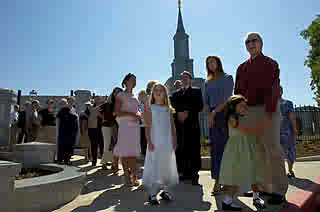
Perspectives on the Sacramento LDS Temple


My friend and colleague, John Smulo, Lead Pastor of LifeSong Church, has posted his article on the temple opening, and readers might also find the comments of interest from varying perspectives from those in the community.

Image Source: The Sacramento Bee

Thursday, August 17, 2006

Pew Forum and Islam in the West

The latest bulletin from the Pew Forum on Religion & Public Life has some interesting items on Islam and the West.

The first is a story of cooperation between two unlikely parties, Muslims and Mormons, working together to provide humanitarian aid in the Middle East as a result of the fallout from the war between Israel and Hezbollah. If such divergetnt religious groups as Muslims and Mormons can come together to meet human need then perhaps there's hope for Mormons and evangelicals doing the same.

The second item is an interview in response to a recent Pew Forum Survey:

On July 7, 2006, the Pew Global Attitudes Project released an international survey focusing on Muslim and Western perceptions of each other and on the Muslim experience in Europe. The poll surveyed more than 14,000 people in 13 nations: India, Egypt, Indonesia, Jordan, Nigeria, Pakistan, Russia, Turkey, the United States, Britain, France, Germany and Spain. A survey of Muslim populations in the four European countries was conducted in partnership with the Pew Forum on Religion & Public Life.

In a wide-ranging interview at the Pew Forum on Religion & Public Life, Amaney Jamal, assistant professor in the department of politics at Princeton University and a specialist in the study of Muslim public opinion, commented on the survey's findings and their implications. Jamal is also a senior advisor for a Pew Research Center project on a comprehensive study of the views and attitudes of Muslim Americans. The Forum is a partner in this year-long survey project, which will be completed by next summer.

In the interview, Jamal discusses, among other things, the negative perceptions Westerners and Muslims have of each other, the role of the media in perpetuating stereotypes and what the findings mean for U.S. foreign policy.

Chas Clifton and a Pagan Writer's Blog

Chas Clifton is a Pagan writer and editor, and as such he has authored or co-authored several books, and is the editor of the academic journal The Pomegranate. He graciously provided me with a review copy of his latest book, Her Hidden Children: The Rise of Wicca and Paganism in America (AltaMira Press, 2006).

I monitor the referral sites for my blog through Extreme Tracking and noted that a few hits came from Mr. Clifton's blog, Letter From Hard Scrabble Creek. These come from two entries, one commenting on Sacred Tribes, the e-journal I co-edit, and the other commenting on my post on Morwics, the Pagan-Mormon synthesis in Utah. Thoughtful evangelical readers interested in Pagan studies might appreciate reviewing Clifton's comments. But please, no proselytizing and no rude comments. Let's try to apply the Golden Rule to interreligious or interspiritual dialogue: Blog unto others as you would have them blog unto you.

Wednesday, August 16, 2006

Forbidden Faith: The Continuing Gnostic Legacy


I recently went to my local library to pick up a couple of books on the changes in American spirituality from that associated with institutionalism and place to that of a personal quest orientation. As I was leaving, the library display of books caught my eye. It was a collection of books associated with The Da Vinci Code, but a book on Gnosticism engaged my curiosity. I ended up checking it out, Richard Smoley's Forbidden Faith: The Gnostic Legacy From the Gospels to the Da Vinci Code (HarperSanFrancisco, 2006). The dust jacket for the book describes Smoley as the editor of Gnosis magazine, and co-author of or author of several books on esotericism and "inner Christianity."

Smoley writes in popular fashion and provides an overview of the history and varieties of Gnostic thought. He looks not only at ancient forms of Gnosticism but also traces it to more recent times in what he calls the "Gnostic Revival." This chapter, along with Gnosis and Modernity, and The Future of Gnosis, represent some of the more interesting treatments as he traces neo-Gnostic elements in various facets American culture, including pop culture as exemplified by The Matrix films and The Da Vinci Code.

It should come as no surprise to either traditional Christians or those supportive of various forms of neo-Gnosticism that I disagreed with portions of his book, particularly his discussion of the canonical Gospels and his claim that none of them were written by eyewitnesses. Smoley also speculates that the Gnostic Gospel of Thomas might indeed be dated earlier than the second century due to its alleged resemblances to the hypothetical Q document, and therefore it might be the first gospel and represent some of the earliest expressions of the faith of the early Christian communities. A blog is not the place to rehash these debates, but suffice it to say I believe the weight of scholarship runs counter to Smoley's claims. Hopefully traditional and "inner Christians" can continue to not only debate but also to discuss our differing views in these areas.

The book also includes other troubling areas when Smoley describes the evangelical emphasis on a personal relationship with Christ as little more than a mental construct that represents a relationship with an imaginary friend. But before evangelicals get too upset we need to consider Smoley's reminder that, "As harsh as this characterization may sound, it is in many ways milder than the accusations flung by many evangelical Christians at the spiritual experiences of others, which (insofar as they are granted any reality at all) are frequently dismissed as delusions engendered by demons."

Despite these disagreements, traditional Christians should take note of several items in this book. For example, Smoley touches on the shortcomings of Christian clergy that reveals problems in the education and contemporary cultural awareness of Christian clergy:

"A modern priest or minister might be well schooled in the theology of Bultmann, Tillich, and Karl Barth and may be intimately familiar with the question of the Q document and its strata of composition, and yet find himself at a total loss when a parishioner has seen an angel."

Here Smoley touches on Western Christendom's tendencies toward emphasis on the rational elements of faith, on doctrine, and on the history of Christianity in the West, but its frequent inability to address the experiential elements, specifically within the contexts of the shift away from preferences for an institutionalized form of faith and toward a spirituality of quest with the increasing influence of Eastern and esoteric spiritualities. Such insights demonstrate that it is time for our seminaries and other Christian educational institutions to broaden their theological educational focus in light of changing cultural circumstances in order to address our shortcomings. It appears that we need to prepare less for educating chaplains in Christendom culture and instead prepare missional apostolic types for cultural engagement as well as pastoral care.

How can we explain the increasing interest in neo-Gnosticism, often more readily accepted than the institutionally and modernity connected Chrisendom? Smoley notes that the reasons are multiple and complex, but he states that one of the reasons seems to be perceived shortcomings and a loss of vitality in Christianity. He uses the illustration of an egg with the yoke and white sucked out of the inside leaving only the shell. While it still looks good on the outside, the inner vitality is gone and the remaining shell is fragile. Might the interest of growing numbers of Westerners in forms of neo-Gnosticism be due at leas in part to our failures to live out and put forward a robust form of the spiritual path of Jesus?

Finally, Smoley concludes the book with a discussion of faith, reason, and gnosis (inner knowledge). He interacts with the insights of Wouter Hanegraaff, a noted scholar of esotericism in the West. Hanegraaff states that Western civilization is rooted in the "three major impulses" of reason, faith, and gnosis:

"Reason holds that 'truth - if attainable at all - can only be discovered by making use of the human rational faculties, whether or not in combination with the senses.' Faith, by contrast, says that reason in itself does not provide us with ultimate answers, which can only come from a transcendental realm and are encapsulated in dogmas, creeds, and scriptures. Gnosis teaches us that 'truth can only be found by personal, inner revelation. . . .This 'inner knowing' cannot be transmitted by discursive language (that would reduce it to rational knowledge). Nor can it be the subject of faith . . .because there is in the last resort no other authority than personal, inner experience."

Hanegraaf notes that the scientific enterprise has valued reason, while institutional Christianity has valued faith, although these are not mutually exclusive categories and institutional category has valued faith within an epistemological framework that also places great value on reason . Hanegraff notes that gnosis has been much less valued. While I disagree with the characterization of gnosis in the quote above, opting instead for forms of inner experience that provide one but not the only means to truth, and which can to some extent be described and transmitted by discursive language, thus removing the gnosis-rationality dichotomy, I am sympathetic to the notion that Western Christianity has not valued inner experience, or a form of gnosis if you will, as much as it should. Might it be possible for missional and culturally engaged Christians to rethink and rework the relationship between reason, faith and a form of Christian gnosis? Perhaps if we can it will bring us closer to recapturing a more biblical form of faith, and put some of the substance and vitality back into the shell of Christianity.

Monday, August 14, 2006

Morwics?: Religious Synthesis in Utah


When I heard the term “Morwics” in one of the Yahoo groups on alternative religions that I am part of I first thought of an alien race from a science fiction novel. But apparently the term refers to something very real in Utah, and perhaps beyond this state.

After relocating to Utah for seminary studies last year I learned about the small Pagan community in the state that lives among the dominant Mormon population. It seems that ex-Mormons not only gravitate toward evangelicalism and atheism as their religious choice options, but also toward Paganism. This makes sense in terms of a religious logic in that a rejection of what is considered a strict form of Christianity might lend itself toward identification with a variety of nature-based spiritualities such as Wicca.

What came as a surprise to me was to discover the existence of practicing Mormons who also practice forms of Paganism, resulting in the religious synthesis labeled “Morwics” by a Salt Lake City area practitioner of this spirituality. The claim is made that Morwics are a large and growing group whose interest in esotericism and magick has as its foundation early Mormonism’s interest in these areas as documented by researchers such as D. Michael Quinn in his book Early Mormonism and the Magic World View (Signature Books, 1998). I am working through my contact in a Yahoo group to talk to a leading Morwic in the near future to learn more about these folks.

Image source: http://altreligion.about.com/library/graphics/levi/solarserpent.jpg

Saturday, August 12, 2006

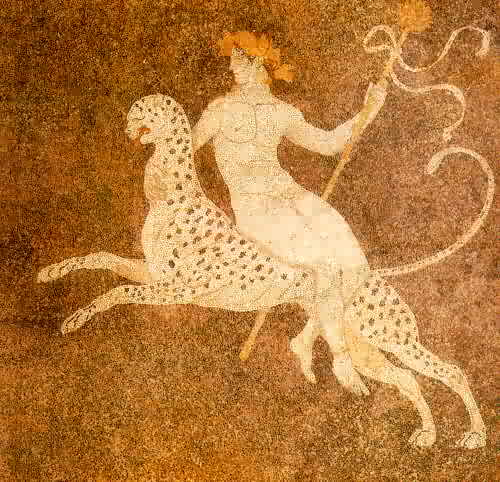
Hertenstein and Imaginarium: Christianity as Apollonian or Dionysian?


My friend and colleague at Cornerstone, Mike Hertenstein, who is a major creative force behind the Imaginarium, has written an article that is the substance of his seminar at this year's festival. It is titled "Why Should the Devil Have All the Good Bacchanals?," and it represents a fascinating discussion on myth, symbol, culture, Christian hsitory, and conceptions of the faith that raises the question as to whether Christianity should be understood as an Apollonian or Dionysian faith. This is a great article that discusses a fascinating topic covering ground from Carnival and Lent, to Dionysus and Apollo, to C. S. Lewis and Narnia. Enjoy, but as Mike notes in his article's subtitle, beware, "this is not a tame article."

Image source: http://www.culture.gr/2/21/211/21117a/00/lk17a013.jpg

Friday, August 11, 2006

The Feast of Fools: Theological Feasting on Festivity and Fantasy


One of the things I enjoy about reading the types of books that I do, and in engaging in a continual research process, is the discovery of various rabbit trails that take a research project and thinking into new and exciting areas. This happened recently with my studies for the Burning Man festival. One of the books I read, Brian Doherty’s This is Burning Man (Little, Brown and Company, 2004), recommended another book as a means of trying to understand this festival phenomenon. The book was The Feast of Fools (Harper Colophon Books, 1969). I found the title and the context of sacred festivity in which the book was recommended highly intriguing. When I went to Amazon.com to find out more about the book, I discovered the subtitle, “A Theological Essay on Festivity and Fantasy,” and I figured this was an important read. I ordered a used copy (for a steal at a mere forty-nine cents plus shipping) and after receiving it earlier this week (and balancing it out with my reading for the rapidly approaching Fall semester at seminary) I’ve managed to read the Overture, the Introduction, and the first chapter.

I hope to gain further insights and applications as I continue to read through the book and reflect on its wisdom. But from what little I’ve read so far the book seems to have application not only to Burning Man, as well as to the Imaginarium theme for 2006 which looked at cultural festivals related to death, and to broader questions of culture, festivity, and fantasy. The latter application was apparent with Cox’s discussion of the Feast of Fools celebration in parts of Europe that flourished during the medieval era, but which has largely died out, surviving only in vestigial form in events like Halloween and New Year’s Eve parties.

Cox believes that human beings are “essentially festive and ritual creatures,” designed for both the expression of festivity and fantasy, but for a variety of reasons this aspect of celebrating what it means to be human and spiritual has largely died out in the modern and late modern West. Western forms of Christianity may have played a part in this as Cox rightly notes that “Christianity has often adjusted too quickly to the categories of modernity.” This has included a heavy emphasis on the Protestant work ethic. Not a bad thing to be productive mind you, but at the same something in us as individuals and as a culture dies without equal time given to festivity and fantasy. At this juncture might we ask just where any robust sense of sacred festivity and fantasy is to be found within typical expressions of Western evangelicalism?

I am part way through Cox’s discussion of festivity in relation to the philosophical notions of the death of God in the West. Remember that this book was written in 1969 as the so-called “counter-culture” was in full swing. While the death of God movement has largely died itself with various forms of Christianity as well as Western esotericism and Eastern spiritualities filling the vacuum, Cox’s discussion of the death of festivity and fantasy in the 1960s is instructive for its continued impoverishment in the 21st century West. For example, Cox discusses the differing ways in which religious traditions approach religion, with the historical religions of Judaism, Christianity, and Islam representing historical religions, and others, such as Tibetan Buddhism representing so-called “non-historical” religions that emphasize “the recurrent fundamentals of life and nature – the wheeling stars, the changing seasons, birth, sex, death. They help man situation himself in the larger cosmic setting. Cox notes that both approaches to religion have their value and place, but that we are missing the critical "point of intersection" between these worlds of history and divine mileu, and “our distorted Western attitude toward history and history-making” needs the corrective provided by celebration through festivity. (Might Christians be reminded of our shortcomings here with the emphasis on nature and festivity in neo-Paganism, if after all the so-called "cults" are indeed in some sense the unpaid bills of the church?) One sentence stuck out as I read this section where Cox provocatively asks, “If God returns we may have to meet him first in the dance before we can define him in the doctrine.”

I’m looking forward to my continued journey through this book that will surely involve lots of highlighting, wrestling with new theological and cultural questions, and attempts at applying it to a contemporary spiritual and cultural context.

Image source: http://www.feastoffools-phxaz.com/feast%20of%20fools%20mask%20left.jpg

Tuesday, August 08, 2006

Pan's Labyrinth, Myth and Popular Culture


Guillermo Del Toro is a film director from Mexico. He has directed a number of horror and fantasy films, including Cronos (1992), Mimic (1997), The Devil's Backbone (2001), Blade II (2002), and Hellboy (2004).

Del Toro's latest project is the fantasy film Pan's Labyrinth, set for release in America on December 29, 2006. The Official Movie Website press release summarizes the film:

"PAN'S LABYRINTH is a fanciful and chilling story set against the backdrop of a fascist regime in 1944 rural Spain. The film centers on Ofelia, a lonely and dreamy child living with her mother and adoptive father; a military officer tasked with ridding the area of rebels. In her loneliness, Ofelia creates a world filled with fantastical creatures and secret destinies. With post-war repression at its height, Ofelia must come to terms with her world through a fable of her own creation."

I bring attention to this film not only because of my appreciation of the fantasy and horror genres, and my appreciation for the creativity and directoral work of Del Toro, but also because of mention of this film on WildHunt, a Pagan blog. WildHunt was intrigued by the film when it made its debut at Cannes due to Pagan themes within it. (We might also note that a remake of the classic 1973 horror film The Wicker Man that touched on Pagan themes is also in production.) The blog includes an excerpt of dialogue from the film that illustrates this element:

OFELIA: My name is Ofelia. Who are you?

PAN: Me? I've had so many names...Old names that only the wind and the trees can pronounce. I am the mountain, the forest and the earth. I am...I am a faun. Your most humble servant, Your Highness.

This intersection between popular culture and religious studies is of great interest to me for a number of reasons.

First, as Western culture continues its journey in late modernity or postmodernity it seems as though fantasy is increasingly popular as opposed to science fiction in previous decades.

Second, various subcultures are drawing upon this interest in fantasy, whether evangelicals and other varieties of Christians through The Chronicles of Narnia, or Pagans with their interest in Pan's Labyrinth.

Third, although a number of film critic websites have praised Labyrinth, it has thus far received little attention on the radar screen of American pop culture.

Fourth, as the film release draws closer and its promotion increases it will be interesting to watch the response of some segments of evangelicalism. One website has already linked it with Satanism and pedophilia. But then again, it takes issue with the mythology within Narnia as well.

I'll try to be optimistic here in my hopes for evangelical engagement with popular culture with this films' release later this year. My hope is that American evangelicals will develop a more sophisticated form of engagement with myth, symbolism, religion, and culture than we have previously in the culture wars. I don't know that I should hold my breath.

Image source: http://www.twitchfilm.net/pics/pan_lab_6.jpg