Monday, August 07, 2006

Eugene Peterson and Relevancy of the Message

Many Christians in America and the West are familiar with Eugene Peterson. He is a prolific author who writes with a pastor's heart. He is perhaps best known for not only his writing on Christian spirituality, but also for his Bible paraphrase The Message. I recently came across a March 2005 interview with him in Christianity Today magazine. The interview addresses concerns over shallowness in American Christianity, and includes the following question by CT and the response by Peterson:

What if we were to frame this not in terms of needs but relevance? Many Christians hope to speak to generation X or Y or postmoderns, or some subgroup, like cowboys or bikers—people for whom the typical church seems irrelevant.

When you start tailoring the gospel to the culture, whether it's a youth culture, a generation culture or any other kind of culture, you have taken the guts out of the gospel. The gospel of Jesus Christ is not the kingdom of this world. It's a different kingdom.

...

I think relevance is a crock. I don't think people care a whole lot about what kind of music you have or how you shape the service. They want a place where God is taken seriously, where they're taken seriously, where there is no manipulation of their emotions or their consumer needs.

Why did we get captured by this advertising, publicity mindset? I think it's destroying our church.

As I read this portion of the interview I was struck by a sense of both agreement and disagreement with Peterson. Let me explain. I understand and share his concerns for the shallow approach to Christian living and spirituality by many Americans, no doubt a reflection of the shallow nature of many of our churches influenced by America's sense of rugged individualism and consumer culture. From this perspective in mind we certainly do not want to "gut" the gospel out of a desire for relevancy to a given subculture that ends up compromising the radical message of Jesus' Kingdom.

However, I disagree with Person in another sense. I wonder whether he has not confused all forms of communicating the gospel within culturally appropriate forms with compromise of the gospel. The biblical message and the history of Christian missions is filled with a number of examples of communicating the narrative of the missio Dei through and into the various cultures that the narrative encountered. While this may at times have been done in inappropriate ways as evidenced in the history of both Catholic and Protestant missions, missiologists have attempted to do so in a way that strives for a critical contextualization whch is faithful to both the essence of the gospel and cultural contexts. As Darrell Whiteman has noted in an article in the International Bulletin of Missionary Research 21:1 (January 1997), "Contextualization is not something we pursue motivated by an agenda of pragmatic efficiency. Rather, it must be followed because of our faithfulness to God.."

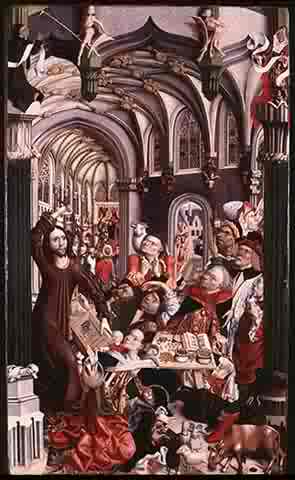
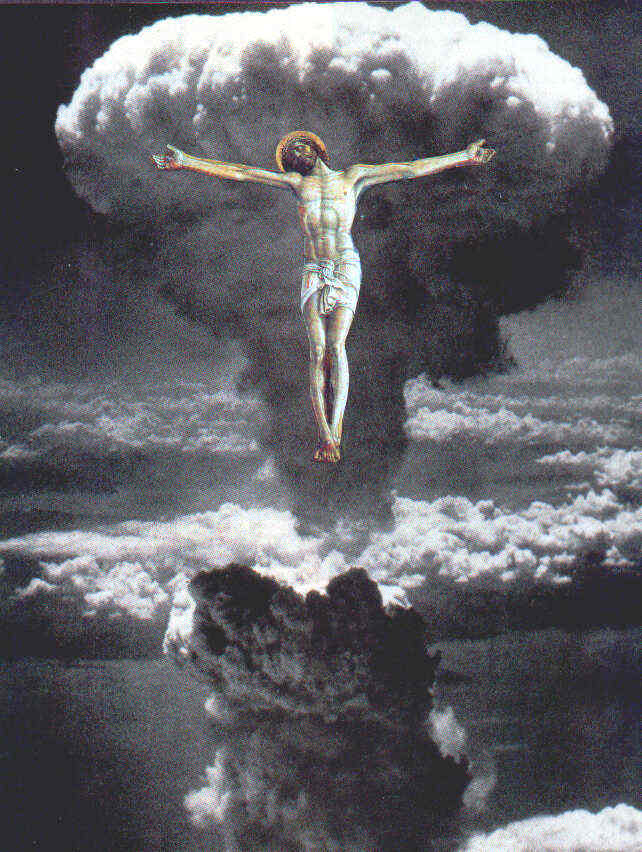
Cultures change regularly, and have done so in dramatic ways since Jesus walked in Palestine as graphically illustrated in the provocative "atomic Jesus" image that accompanies this blog post. And yet the ancient message of the gospel is important and relevant for people of the twenty-first century. But it must be communicated in ways that speak meaningfully and relevantly to differing cultural contexts. We seem to understand this in cross-cultural contexts overseas, especially through our support and endorsement of Bible translation projects. Peterson himself seems to understand this to some extent through his paraphrase of the Bible for contemporary Westerners. But communication of Jesus' message goes far beyond language and contemporary vernacular and embraces the totality of a culture or subculture's thought forms and lifeways, that includes but goes far beyond considerations of worship styles and music. Critical missional contextualization must not be confused with compromise, and is critical whether expressions of church take place in Africa or Los Angeles. If we forget these we have compromised the message.

Image source: http://desertpastor.typepad.com/paradoxology/atomic_christ.jpg

Tuesday, August 01, 2006

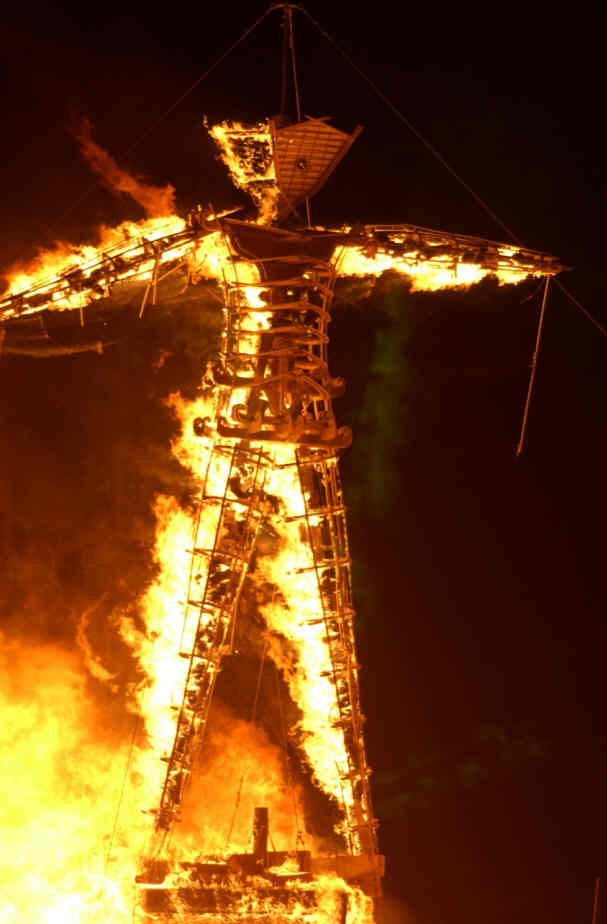
Burning Man, Sacred Space,...and Church?


What does a “counter-cultural” festival like Burning Man have to do with church and Christianity in America? Perhaps more than we might think.

Today I will be picking up some items to include in my survival gear for my attendance and participation in the 2006 Burning Man Festival coming up August 28 – September 4, with the theme Hope & Fear: The Future. I am going with a small group from two churches in northern California, including Fair Oaks Presbyterian Church and Shadowridge Church. The group is attending in order to learn about this interesting subculture, and to consider its ramifications for missions in their local church contexts. This is of interest to me as well, and my attendance also serves as my summer missions project for seminary study. In addition to my reading of academic and popular treatments on the festival, I will write a project paper that brings together my participant observation at the festival, the readings, and other studies I have done in the areas of anthropology of pilgrimage and culture. The paper will sketch the history and development of Burning Man and look at the missiological and ecclesiological implications of the festival.

But back to my original question that I began this post with: What does Burning Man have to do with church and Christianity in America? While it is often characterized by the media as little more than a place for adults to thumb their nose at authority and traditional expressions of Western culture, scholars have recognized the religious significance of the Burning Man experiment in intentional community. Sarah Pike of California State University, Chico has written that this religious significance is
“characterized by powerful ritual, myth and symbol; experiences of transcendence or ritual ecstasy; experiences of personal transformation; a sense of shared community; relationship to deity/divine power, and, perhaps most importantly, sacred space.”
Most importantly, these characteristics take place in “an important cultural and religious site that exemplifies the migration of religious meaning-making activities out of American temples and churches and into other spaces.”

Pike concludes the introductory portion of her essay by stating that, “I want to suggest that popular religious sites like Burning Man festival are essential to an understanding of contemporary issues and future trends in American cultural and religious life.”

I think Pike is right, and my hope is that our experiences and research at Burning Man can bring helpful lessons to those in missional churches and the emerging church. I will post reflections and pictures here at the conclusion of the festival in early September as my schedule permits.

(Citations are from Sarah M. Pike, “The Burning Man Festival: Pre-Apocalypse Party or Post-modern Kingdom of God?,” The Pomegranate 14 (August 2000): 27-28. The essay was reprinted as “Desert Goddesses and Apocalyptic Art: Making Sacred Space at the Burning Man Festival” in Michael Mazur & Kate McCarthy (eds), God in the Details: American Religion in Popular Culture [Routledge, 2001].)

Image source: http://phillips.blogs.com/photos/uncategorized/410_burning_man.jpg. All Burning Man images are the intellectual property of Burning Man LLC.

Thursday, July 27, 2006

Interview with Gretchen Passantino-Coburn: "Why Doesn't Apologetics Work?"


Gretchen Passantino Coburn is a veteran apologist with a long history and body of work. She worked closely with the late Walter Martin and the Christian Research Institute, and has had her own ministry of Answers in Action that she developed with her late husband Bob Passantino. After Bob's passing three years ago the Lord opened up new opportunities for Gretchen, and she is now enjoying newly married life with Pat Coburn. At the 2006 Cornerstone Festival Gretchen presented a series of seminars under the provocative title "Why Doesn't Apologetics Work?" Readers will enjoy the insights of a veteran apologist on this interesting topic.

MoreheadsMusings: Gretchen, please briefly summarize your history of apologetic work for those who may not be aware of your background.

Gretchen: My late husband Bob began as an apologist for skepticism as a teenager, before he became a Christian (and before we met). He was in southern California, the hotbed of the Jesus Movement, and in 1968 or so, he used to research arguments against Christianity, the Bible, and God in the library (although he didn't do homework for school), and then head down to the beach where the "Jesus Freaks" were witnessing to all the LSD hippies near the Huntington Beach Pier. As they would stroll the sand with their cartoon tracts, he would follow with his Robert Ingersoll and Bertrand Russell arguments. So apologetics came naturally to him when he later became a Christian. When we met, I was going to UC Irvine, majoring in Comparative Literature, and working at a Christian bookstore. Bob visited the bookstore and was always interested in the musty, thick, dense theology books, not the screaming testimony and rapture books. That intrigued me, since I had a lot of time on my hands at the store, and had kept my mind occupied by reading those same old books. Conversations and 10% sales discounts led to Bible studies and to witnessing together to anyone who would listen -- including Jehovah's Witnesses and Mormons. That's how we ran across the late Walter Martin and had the blessing of meeting him and volunteering to help him when he was speaking in California. When he first moved to California in 1974, he conducted Bob's and my wedding and then hired me to help him open the Christian Research Institute in California. Concurrently, we joined with some of our Jesus Freak friends and started a lay ministry to Jehovah's Witnesses called Christian Apologetics: Research & Information Service (CARIS).

After our first child was born in 1978, I quite my employment at CRI and focused on motherhood, CARIS, and free lance work for other Christians, including continuing to help Walter Martin with his book projects until his death in 1989. In 1985, Bob and I incorporated Answers In Action to reflect our broader commitment not only to general apologetics, but also to active apologetics; that is, endeavoring to unite the reasons, arguments, and evidence of rational apologetics with the persuasion, relationship, and discipleship of more missions oriented apologetics. For many years we worked together in apologetics. Although many know us for our many books, articles, and other materials (most available on our website, (http://www.answers.org/), we also believed that the heart of our ministry was in relationships. We developed strong mentoring relationships over the years and became known to those in our field for our commitment to helping more visible leaders behind the scenes. We have been blessed over the years to help -- and be helped by -- people like Norman Geisler, Lee Strobel, H. Wayne House, Mark Mittleberg, Greg Koukl, Rick Warren, Bill Hybels, Josh McDowell, Hank Hanegraaff, and so many others. In addition, we always made time for people in personal relationships.

Bob was the master of the phone, sometimes talking to 10-20 people in a day, and long, philosophical conversations with each one. I got very good at cooking dinner for 20 and answering Bible questions at the same time. But it's the behind-the-scenes mentoring and the personal discipleship that always motivated us. Also through the years I was privileged to teach as an adjunct for Biola University and Concordia University, and Bob and I together spoke in many colleges, seminaries, and on hundreds of radio and television programs. Just a few years before Bob died in November of 2003, Dr. Michael Adams and Dr. H. Wayne House of Faith Evangelical Lutheran Seminary approached us about advancing our education. When we started out, there were no schools that offered degrees in apologetics, and the only way to become a professional apologist was to apprentice under one, like we did first with Walter Martin and then with others. One issue that was always important to Bob was that God's Word and the things of the mind are available to anyone, not just to elite academicians. He was never very successful in school and he knew that his success in apologetics, philosophy, and theology was a strong encouragement to others who did not do well in formal school settings. But by the end of the millennium, there were so many good programs available (such as Talbot Theological School's M.A. in Apologetics Program) on the graduate and undergraduate level, that our lack of graduate degrees was needless. So, we worked out a study program for Bob to complete his undergraduate degree and for the two of us to complete Masters of Divinity degrees with an emphasis in apologetics. Since our graduation, I have taught for Faith Seminary as an adjunct here in southern California and have been able to mentor a number of students through the entire program. Every time I get to stand up for one of my graduating students, I am so thankful that the torch is being passed on. Since Bob's death, I have continued to run Answers In Action with the strong support of our Board of Directors and our volunteers. Although I can't manage 20 phone calls a day or all-night philosophical debates, God has graciously prospered the ministry and our ability to reach out in meaningful ways that truly put answers into action. I am expecially excited about the ground-breaking research I am doing to develop a peer mentoring program for law enforcement professionals. I know Bob would be so enthusiastic about this. If we can figure out how to translate the truths of the Christian faith into a practical discipleship program for some of the most cynical, skeptical, action-oriented men and women who encounter the reality of good and evil every single day, then we can reach just about anybody.

On a personal note, in August of 2005 I remarried after God reunited me with the man, Pat Coburn, who had been my first boyfriend when I was a teenager. We had lost complete contact for 34 years, but now united in Christ and in love we're asking God for 34 years more together serving Christ.

MoreheadsMusings: At Cornerstone Festival you recently presented a series of talks on "Why Doesn't ApologeticsWork." Can you summarize your thesis?

Gretchen: If we as apologists are not willing to be self-reflective, objective about our strengths and weaknesses, and enthusiastic about continually adapting what we do to the unique audiences God brings us before, then we will fail at a calling that is second only to the preaching of the gospel. And often people will not listen to the preaching of the gospel until their objections and misunderstandings are dealt with, which is the provenance of apologetics.

MoreheadsMusings: For those familiar with your work this might seem like not only a provocative title, but also a strange topic for you. What influences have led you to this type of thinking?

Gretchen: Never in American Evangelicalism have we had more wealth of arguments, evidence, and reasons for faith, and yet we are having less and less influence in the world around us as we increasingly fail to communicate and persuade a community (both within and without the church) that not only doesn't understand what we're saying, but doesn't even know why they should care. As apologists, we're always quick to have the answers and give the lectures, but I've disciplined myself to spend more time listening, watching, and asking questions with those I hope to minister to than I do "practicing apologetics." That has demonstrated to me over and over that we must continuously evaluate and modify our delivery (not the timeless core of the Word of God) or we will fail in our calling. I hope some of the ideas and questions I raised at Cornerstone will help in that regard.

MoreheadsMusings: It's easy to be misunderstood when speaking on topics in which people invest a lot emotionally. In order to make sure you're not understood, you're not saying we should not engage in rational apologetics and offer good arguments and evidences for the faith. In the interests of clarity, what are you saying?

Gretchen: No, but what I'm saying is that if we apologists don't become at least as critical about ourselves and our own methodology as we do about those we disagree with, we will be failing the Lord who called us to this profession. We are not exempt from human fallibility and sinfulness just because we've always got an answer and an argument. We are as susceptible to cultural bias, ignorance, spiritual elitism, euphemistic language, esoteric vocabulary, social ostracism, and egoism as any televangelist, social gospel proponent, or guru we so smugly denounce. As apologists, we tend to enjoy arguments, approach choices logically, and draw distinctions. Those are neither good nor bad traits in themselves. But when we cling to arguments instead of relationships, or use logic to the exclusion of heartfelt-empathy, or draw a false line on the basis of our preferences rather than the essentials of the gospel, we are wrong and if we continue without heeding God's admonition, we are sinning. Let me give you an example: Someone e-mailed me today and complained that his post on abortion had been unfairly banned by the discussion group moderator because he used the word "evil," and that was deemed "inflammatory." Now as apologists, we immediately think about how we can protest the censorship and force the group to post our comments and face the facts. If his purpose was to demand civil rights for all discussion posts, then I guess that's what he should push for. But I suggested something else. If, instead, his purpose had been to warn people of the dangers of abortion and to encourage them to protect even unborn life, then he should re-word his post to meet the vocabulary standards but still communicate his concern and respect for life. I don't see that as compromise, or diluting the gospel. I see that as strategy.

MoreheadsMusings: Let's talk a little more about the importance of relationships. There is some good evidence in the history of the Christian church about the importance of relationships and community to evangelism, as evidenced in Celtic Christianity for example. There's also good evidence from the social sciences that early Christianity traveled most effectively along social networks. We seem to have forgotten these simple truths in our time. Why do you think that is, and how might those inclined toward a more traditional apologetic incorporate these important elements?

Gretchen: I think part of the reason apologetics is so popular in American Protestant Evangelicalism of the 21st century is because we are largely a culture of words, not of relationships. And yet, it is by relationships that lives are changed. This is incredibly biblical, but incredibly missed by many of us as apologists. In fact, one could have all the reasons, answers, and arguments that Jesus Christ is Lord, but unless we have that relationship with Him by the power of the Holy Spirit, we don't have eternal life! If we would remember this simple core gospel principle in everything we do, we as apologists would be incredibly more effective & far easier to live with! Here's an example. I was speaking on women in church history and after my talk a young missionary asked my advice. She and her friends were involved in church planting in a very religiously conservative area of the Middle East. The men who had converted from Islam to Christianity were adamant that women could not have any visible or teaching position in the church at all. She wanted arguments to convince them that she and her friends, all long-time Christians and graduates of Bible college, could teach Bible studies better than the men who were not only recent converts and not biblically trained, but actually illiterate. She asked an apologetics question that really needed a relationship answer. I asked her to try an experiment. In her next 6 month tour in the Middle East, I asked her to not argue with the men anymore, but to enthusiastically live her life for Christ, and eagerly participate in anything the men would allow her to do. If she were persistently available and Christlike, I was convinced she would have far greater influence for the gospel than if she continued arguing with them.

MoreheadsMusings: As you talk about relationships and building credibility with our hearers I am reminded that your ideas seem to fit well within an overal missional paradigm. That is, the mission of the church in the world is central to the life of the church, and the history of Christian mission in cross-cultural contexts includes a variety of aspects including relationships, cross-cultural communication, and culturally contextualized apologetics. Would you say that your current views on apologetics recognizes its supporting role in a broader context of evangelism and missions?

Gretchen: I don't think my views on apologetics currently are contrary to my views before, and in fact Bob and I had many long discussions on these very issues; and this emphasis is why we never focused on a public platform ministry or devoted most of our time to writing rather than relating. However, I do believe that as our culture has changed and as we have developed a good body of apologetics material and methodology from those of us who are "professional" apologists, we have not only prepared the way to integrate apologetics seamlessly into an overal missions or evangelism approach for lay people throughout the church; I predict that if we as apologists don't recognize that symbiotic relationship and the need for every Christian to incorporate reasons with relationships, we will become largely irrelevant to the church as a whole, the immeasurable value of what we have accomplished will be lost to the church, and we will have unwittingly weakened the church's ability to overcome the world. I would love to see professional apologetics disappear from American Protestant Evangelicalism, not because it has been aborted, but because it has joined with the seed of the gospel to give life to the Body of Christ.

MoreheadsMusings: Is there anything else you'd like to say, particularly to those of a more traditional apologetic orientation?

Gretchen: I don't like to see a schism between the "traditional" and the "missiological" apologists. I think Christians are better at fighting among themselves than any group including sports fans from opposing teams and fanatical Muslim sects. And I think apologists are supreme within the Church for devouring each other. That may seem sensationalistic or extreme, but I think it's true. If we spent just as much time listening to each other as criticizing, working together as being in opposition, enjoying our differing perspectives as condemning our differences, and understanding as arguing, we would be an unstoppable force for the gospel in a dying world.In the last few years, I have spent a lot of time "listening" to apologists of all kinds. (Listening means both literally in conversations and also reading and corresponding in print or electronically.) I have not tried to argue or persuade, but I have tried to listen and understand. Both sides, in my opinion, have at times expressed unhelpful dogmatism, eltism, paranoia, argumentiveness, judgmentalism, and intolerance. If I were to give a running score, I would say those on the traditional end of the spectrum are ahead in that regard, but the missiological end is close behind. Shame on us! There shouldn't be "two sides" -- we should be accommodating enough (not compromising essentials) to provide a united experience of the best apologetics along the spectrum without rancor or envy.I offer myself as a conduit for open, humble, loving communication among any apologists of whatever stripe who would truly like to join us all together to serve Christ.

[After reflections on the few comments posted to this interview I have decided to delete them so as to preserve the spirit within Gretchen's comments.]
New Jesus Traditions and the New Religiosity

Reender Kranenborg, recently retired from Free University of Amsterdam, presented an interesting paper at the CESNUR 2006 International Conference earlier in July. The paper is titled “New Traditions About Jesus and the New Religiosity.” It is a paper that summarizes the new traditions about Jesus that are prevalent in Western culture, and why they are appealing to increasing numbers of people as viable alternatives to the New Testament portrait of Jesus. This article contains ideas that are relevant to those in the contemporary church as well as emerging church and missional church leaders who want to understand the cultural environment of the West.

Kranenborg discusses some of these new traditions, including the Tradition of the Infancy Gospels that purport to tell us of Jesus’ infancy and his relationship with Joseph and Mary; the Tradition of Jesus and Mary Magdalene which includes stories upon which The Holy Blood and the Holy Grail, The Messianic Legacy, and The Da Vinci Code drew; the Tradition of Jesus in India as promoted in Notovitch's book The Life of the Holy Issa, The Aquarian Gospel of Levi Dowling, and the writings of Elizabeth Clare Prophet; the Esoteric Tradition, a very influential tradition which includes elements from a variety of sources such as the Freemasons and Rosicrucians, Blavatsky and Theosophy, and A Course in Miracles. Kranenborg notes that esotericism has been very influential in popular Gnosticsm, or perhaps more accurately neo-Gnosticism, and again mentions Dan Brown and his Da Vinci Code as an example of this. The final major facet of the New Jesus Tradition that Kranenborg cites is the Tradition of Jesus as a Precursor as found in Islam.

Kranenborg then turns his discussion toward consideration as to why these traditions are increasingly popular and appealing. He asks, "Why have these traditions become so authoritative? And: Why do people believe these new traditions and reject the Christian tradition about Jesus?" He provides eight points in response which I will summarize.

1. The biblical information about Jesus is brief and people want to know more. Because of the brevity of information about Jesus, particularly in his early years before his public ministry, people fill this gap with stories of the so-called "lost years"of Jesus in India or Egypt.

2. The New Testament presents a "one-sided" portrait of Jesus, the view of the church. Kranenborg presents the New Testament's view of women as more positive than other first century alternatives, but still largely patriarchal, and thus Dan Brown's "religion of the sacred feminine" has great appeal as an alternative to the traditional Christian portraits of Jesus.

3. People reject the authority of the church and with it, the church's interpretation of Jesus and the gospel. Because of this, alternative Jesus stories, such as The Gospel of Judas, become very attractive.

4. The prevalence of conspiracy theories related to the church in falsifying and modifying the Scriptures and the portrait of Jesus. This idea is found in The Da Vinci Code, and The Gospel of Judas is popular in part because it is considered non-canonical by the church and thus must have something important to tell us about Jesus due to the church's supression of the document.

5. The shift of authority from institution and church Scripture to certain phenomena. Kranenborg cites texts in the esoteric tradition channeled by "higher beings" as more authoritative for many people because it claims to come directly from the source of Jesus himself, mediated by a powerful supernatural experience.

6. The need to experience new things. For many in Western culture, Christianity is considered passe, and the "regular and traditional [spiritual] paths are no longer interesting - they are part of the past and have nothing more to offer."

7. The shift from an emphasis in Western spirituality from the rational to the experiential. As Kranenborg states, "this new religion of experience is much more fascinating than traditional Western Christianity."

8. The individualism of Western culture. Rather than a community orientation in life in general, and particularly in spirituality, Westerners are following a self orientation in spirituality.

Kranenborg then concludes his paper with a brief paragraph that raises the question as to "How do we handle this?" This is a question that the church desperately needs to grapple with. How will we handle the development of these New Jesus Traditions that are held by increasing numbers of people in America and the West? I submit that it will not do to ignore them, and neither should we merely continue to produce books and videos that reassert the traditional picture of the church as understood by the church. While these resources calm the concerns of church members it does nothing to engage those who view the church and its portrait of Jesus with suspicion if not outright dismissal. If we continue to simply reassert the church's portrait of Jesus and the gospel we will continue to preach to the choir where the church's authority is not suspect. What is needed is a new critical cultural and missional engagement with the New Jesus Traditions that takes these alternative narratives seriously and also engages the growing numbers of do-it-yourself spirituality adherents. Neither the contemporary church nor the emerging church can afford to ignore the cultural and religious shifts of the West and the signficance of "alternative" spiritualities in this new milieu.

Image source: http://www.eso-garden.com/cgi-bin/esogarden/images/uploads_bilder/anno_domini_jesus_3.jpg

Wednesday, July 26, 2006

A Modern Parable and “Those We Do Not Speak Of”


M. Night Shyamalan is one of my favorite contemporary filmmakers. I especially appreciate his preference for subtlety in his storytelling, and the symbolism in his films which lends itself to a number of different interpretations.

One of his films that I especially enjoy is The Village (2004). This film appears to present life inside a small village somewhere in the American woods in the nineteenth century. As the story develops it becomes clear that this village has achieved a peaceful co-existence with a race of creatures who live in the woods and who are fearfully referred to by the townspeople as “Those we do not speak of.” Much as the early Israelites refused to speak the Divine name for fear of blasphemy, the people of this village refuse to speak directly of the creatures, or even to allow the color red, said to attract the creatures, to appear inside the boundaries of the village.

The village cannot be understood as a religious group, or a people with any foundational religious convictions. No place of worship or church is found in the village, no Bible or other Scriptures are read, and no scene of prayer accompanies any of the community celebrations such as funerals, meals and weddings. And yet there is something religiously familiar about this village, at least for this viewer. The village is led by a group of elders, and this group appears to function more like a group of church elders than a town council elected through a democratic process. As mentioned above, the group has a form of religious taboo that forbids mentioning the creatures by name. In addition, it is apparent very early on in the film that the people of the village live in constant fear of the outside world, not only of others in “the towns” where evil is present, reminiscent of various fundamentalisms. While it would be unfair to characterize this village as a Christian town, or even a religious group of people, the similarities between them and aspects found in some religious communities makes the comparison possible.

As the storyline develops it becomes necessary for someone to leave the relative safety of the village and to enter the domain of the creatures in order to secure medicine from a nearby town so that the life of a member of the village might be saved. But what about the threat of attack and death at the “hands” of the creatures? The boundaries of the village and the woods had already been breached by some of the townspeople, and a few of the creatures previously entered the village to leave their warnings. How could anyone, no matter how courageous, even consider entering the woods inhabited by the creatures? (For those who haven’t seen the film beware, a plot spoiler is coming.)

In order to alleviate fears and to facilitate a successful attempt at securing medicine, one of the village elders reveals that the creatures don’t exist at all. They were created by the elders in the town as a means of maintaining fear among the village population so that no one would ever want to leave the village and thereby experience the evil and violence of the outside world. The elders make noises in the woods as if they were the creatures, they consume the food offerings tossed into the woods by the village, and at times elders dress up as the creatures and roam the village at night, all of this to maintain the illusion of the creatures and the dangers of leaving the village. In fact, the village isn’t living in the nineteenth century it is in the twentieth, located within an isolated game preserve owned by one of the founding elders.

Other than a film review and a slice of pop culture, what does any of this have to do with the purpose of this blog? Please allow me to connect the dots. I noted above some of the features of the village which permit a parallel between the village and religious groups. I believe one interpretation of the film allows applications that are especially relevant to church communities. There are definite similarities between the people of the village and Christian fundamentalism, as well as some aspects of evangelicalism. This is particularly the case in the fear of the creatures and the outside world. This parallels fears that many conservative Christians have about the possibility of contamination and compromise through engagement with culture. Better to stay safely in the village of the church subculture rather than risk danger from entering the woods of the world.

With these thoughts in mind the lessons Christian’s might take away from Shyamalan’s film can be the dangers of cultural isolation as a form of escape, and the inevitability of culture catching up with you. In the first scene of the film we see the townspeople grieving over the loss of a village member to death as a casket is buried. The village may have been created as a means of escaping many of the evils of the outside world, but ultimately there really is no place where paradise can be recreated. Eventually death finds us all, and while we may be able to temporarily escape some of the evils from the world in our self-created Christian subcultures, we cannot escape the evil within ourselves and our communities. We forget that evil is found in Christians and the church too. It would seem that the creatures “we do not speak of” may not so much be referenced euphemestically out of taboo, but rather because the monsters are us. Perhaps then this film might function as a modern parable for Christians as we envision Jesus sitting down and saying, "A certain group of people lived in a village.."

Image source: http://img.timeinc.net/ew/dynamic/imgs/040419/16389__village_l.jpg

Communicational Heretics

I have mentioned previously my interest in looking at aspects of cross-cultural missions and its applicability to church, evangelism, and missions in the Western and North American contexts. Of particular interest is the cordial debate in missions and missiological circles as to the appropriate degree of contextualization as it relates to Muslim cultures.

One of the debates is over the question as to what extent it is appropriate for Muslim converts to Christ should stay within Muslim culture to worship and express their faith (known as C5 or C6 contextualization, or sometimes referred to as “insider movements”).

One of the concerns raised over insider movements, whether in Muslim, Buddhist, Hindu or any context, is the fear of syncretism, the inappropriate amalgamation of aspects of Christianity with other religious elements. In an interesting article titled “Pursuing Faith, Not Religion: The Liberating Quest for Contextualization” from Mission Frontiers (September-October 2005), Dr. Charles Kraft, a missiologist at Fuller, touches on this fear in one section of the article. He writes:

There are, however, at least two roads to syncretism: an approach that is too nativistic and an approach that is too dominated by foreignness. With respect to the latter, it is easy to miss the fact that Western Christianity is quite syncretistic when it is very intellectualized, organized according to foreign patterns, weak on the Holy Spirit and spiritual power, strong on Western forms of communication (e.g., preaching) and Western worship patterns and imposed on non-Western peoples as if it were scriptural. It is often easier to conclude that a form of Christian expression is syncretistic when it looks too much like the receiving culture than when it looks “normal,” that is, Western.

But Western patterns are often farther from the Bible than non-Western patterns. And the amount of miscommunication of what the gospel really is can be great when people get the impression that ours is a religion rather than a faith and that, therefore, foreign forms are a requirement. To give that impression is surely syncretistic and heretical. I call this “communicational heresy.”

If we stop to reflect on this discussion in overseas mission contexts and to apply it to our own situation there are many questions we need to ask ourselves, and if we are wiling to reflect carefully, much that can be learned.

What does it mean to consider Christianity as a faith and not a religion? How might our American forms of Christianity which we take for granted, be foreign to increasing numbers of subcultures in our communities? What would it look like if we created new cultural forms of the faith for these various subcultures rather than attempted to transplant them in our Western church forms? And perhaps most painfully, might it be that our refusal to consider these questions means that in our fear of syncretism and heresy we have already practiced syncretism, and functioned as heretics, commucational heretics?

Image source: http://www.heretic-in-extremis.com/sitebuilder/images/INEXTREMISHALF-456x456.jpg

Monday, July 24, 2006

Grave Robbing and "Cult"ural Assumptions


In the Nurel list Dr. Steven Hayes, a missiologist in South Africa, posted a story on the corpse of a boy that was stolen in Florida. The story was reported by the Associated Press and in The St. Petersburg Times. The fascinating aspect of the story is not so much the tragedy that the corpse of a boy who passed away in the 1970s was stolen, but that Tampa law enforcement commented on the case speculating that "We are just leaning toward it being cult related or involving Santeria or some voodoo because we don't have any other reasonable explanation." The article continues by stating that, "This is a loaded statement, one worth considering carefully. It offers an example of how religion in America can be defined starkly along lines ofwho is and who is not accepted as part of the cultural mainstream."

Two other sections of the article are worth citing. The first follows immediately from the sentence quoted above, and the next comes from its conclusion:

No evidence of anything "cult related" was found at the scene of the robbery, nor does either religion (Santeria or Voodoo) ritually engage in such criminal action. Their being named, however, speaks to the power of popular conceptions, shaped in no small part by a history of horror movies in which race fear is an underlying dynamic.

Thus, the publicly voiced suspicion of "Santeria or some voodoo" expresses a great deal about fear of the (religious) other in American culture. Two reprehensible acts happened in Tampa: A body was stolen from its tomb, and the police further marginalized these religious groups.


At the risk of being further labeled a "cult apologist" by some conservative evangelicals, I must state that I agree with this article's assessment, and I find it troubling. The general public is often quick to blame certain religious and spiritual groups for acts for which it cannot find a "reasonable explanation," and sadly, evangelicals often follow suit. (See a previous blog post on Santeria and the work of Miguel de la Torre that touched on misunderstandings and misepresentations.)

In addition to Santeria and voodoo we portray other new religions in problematic fashion. Consider the recent post at the Tall Skinny Kiwi blog concerning the animation segment of the 1980s Godmakers film as "Mormon theology in 6 minutes." As I commented in response, the use of animation to portray some of the theology and sacred history of the LDS is questionable at best. While animation is respected as a serious art form and means of communication in some cultures, in the U.S. it tends to be associated with children's entertainment, and would seem to be a culturally inappropriate medium for communicating the sacred for LDS.

Perhaps these two examples indicate that we still have a long way to go as American evangelicals in accurately and empathetically understanding and describing "religious others" in our pluralistic environment. Surely missional Christians will feel a responsibility to do better.

Thursday, July 20, 2006

The Bible in the Global South: Important Voices for Missional and Emerging Churches

I have touched on the work of Philip Jenkins in the past on this blog as it relates to his discussion of the shift in Christendom from the global North to the South. The cultural and theological implications of this were also part of my Cornerstone yoU seminars. Jenkins recently made me aware of an article he has online reprinted from The Christianity Century, titled "Liberating word: The power of the Bible in the global South." In the article Jenkins touches on areas that should be of interest to Christians in any part of the globe, but are particularly important to those in the global North who are involved in missional churches and emerging churches. I have included some interesting quotes below.

Fifty years ago, Americans might have dismissed the conservatism of Christians in the global South as arising from a lack of theological sophistication, and in any case regarded these views as strictly marginal to the concerns of the Christian heartlands of North America and Western Europe. Put crudely, why would the "Christian world" have cared what Africans thought? Yet today, as the center of gravity of the Christian world moves ever southward, the conservative traditions prevailing in the global South matter ever more. To adapt a phrase from missions scholar Lamin Sanneh: Whose reading-whose Christianity-is normal now? And whose will be in 50 years?

Of course, Christian doctrine has never been decided by majority vote, and neither has the prevailing interpretation of the Bible. Numbers are not everything. But overwhelming numerical majorities surely carry some weight. Let us imagine a (probable) near-future world in which Christian numbers are strongly concentrated in the global South, where the clergy and scholars of the world's most populous churches accept interpretations of the Bible more conservative than those normally prevailing in American mainline denominations. In such a world, surely, southern traditions of Bible reading must be seen as the Christian norm. The culture-specific interpretations of North Americans and Europeans will no longer be regarded as "real theology" while the rest of the world produces its curious provincial variants-"African theology," "Asian theology" and so on. We will know that the transition is under way when publishers start offering studies of "North American theologies."


...
Only when we see global South Christianity on its own terms - as opposed to asking how it can contribute to our own debates- can we see how the emerging churches are formulating their own responses to social and religious questions, and how these issues are often viewed through a biblical lens. And often these responses do not fit well into our conventional ideological packages.

...
For a North American Christian, it can be a surprising and humbling experience to try to understand how parts of the Bible might be read elsewhere in the world. To do so, we need to think communally rather than individually. We must also abandon familiar distinctions between secular and supernatural dimensions. And often we must adjust our attitudes to the relationship between Old and New Testaments.

Jenkins is Professor of History and religious Studies at Pennsylvania State University. His new book, The New Faces of Christianity: Believing the Bible in the Global South, will be published in September 2006 by Oxford University Press.

Saturday, July 15, 2006

The West and the Rest: Where Does Their Rage Come From?


In my previous post I summarized my presentations at the recent Cornerstone Festival in the Imaginarium venue. In this post I will summarize my seminars in the Cornerstone YoU venue. My series in this venue brought a cross-cultural perspective to the anger of the non-Western (majority) world at the West in a series titled "The West and the Rest: Where Does Their Rage Come From?" I made it clear from the outset that I was attempting to present the insights of intercultural studies and related disciplines to this topic rather than a perspective that was either politically Right or Left, Conservative or Liberal, Republican or Democrat. Although it is impossible for anyone to be completely objective (we all bring our presuppositions and biases to any and all subject matter), I was attempting to look at broad international tensions (that include but are not limited to the global war on terrorism) from the perspective of culture.

In my first session I noted that the major difficulty we have is grasping any other sense of cultural awareness (let alone acceptance) simply because our individual cultural experience is taken for granted as the way things are and the way things should be. Culture is like the air we breathe in that we take it for granted unless we experience cultural otherness. Evangelicals often then compound the problem by "baptizing" their American and Western cultural values as biblical and Christian when the situation may have more to do with culture than theology.

In order to help my audience step outside of their cultural boxes I had them go through two cross-cultural exercises, both taken from chapters in Richard A. Schweder's Why Do Men Barbecue? Recipes for Cultural Psychology (Harvard University Press, 2003). The first exercise came in the form of sleep order arrangements where audience members were given a family of a given size with two parents and multiple children but with differing dwelling sizes ranging from two to four rooms. Participants were asked to divide the family sleep arrangements based upon these differing room arrangements. This exercise reveals that Europeans and North Americans tend to value the "autonomous couple" sleeping together and independently of the children whenever possible, whereas other cultures, such as those in Asia, tend to value the parents sleeping separately and with individual children. In fact, Asian cultures tend to view the Western sleep order pattern as psychologically damaging to children and aberrant, whereas Westerners wonder whether the Asian pattern (particularly if replicated in the West) does not hint of child abuse.

The second exercise involved a look at female circumcision, sometimes called female genital mutilation, that is practiced in a number of cultures, particularly African and Muslim cultures. I summarized the negative case frequently presented against it usually presented by European and North American physicians and human rights advocatates, and then shared the contrasting medical, psychological, and experiential evidence. If we listen to the multicultural voices of women, some 80 to 200 million African women participate in this practice, and some have shared their displeasure with it. However, the vast majority of African women who undergo the procedure do not regard it as maiming, mutilation or oppression by men or Islam. Their concept of body image and sexuality causes them to affirm the practice. From their cultural perspective the “natural” state of the female sexual organs is repulsive and unclean prior to this procedure, whereas after the procedure they are associated with cleanliness, beauty, and adulthood.

My point is utilizing these exercises was not to change anyone's desires in the area of sleep order arrangements or female circumanycision. Instead, my point was to use these provocative examples as a means of helping Westerners to become more aware of your cultural assumptions. The second example illustrates that our own assumptions and perceptions of beauty and disfigurement are assumed to be universal and transcendental. Differing cultures have very different ideas as to these and other practices. Consider how routinely we accept male circumcision and other forms of bodily enhancement surgery (breast implants) which those in the Third World would consider mutilation. So while we might think and say “Yuck!” in response to the thought of certain sleep order arrangements, or female circumcision, someone from another culture might look at our cultural practices and say, “Yuck, what kind of barbarians are those who don’t circumcise their genitals!”

My second session sought to build on the ability to check cultural assumptions as a means of creating understanding of non-Western rage and violence. (Understanding in the form of mental comprehension of cultural reasoning is not to be confused with condoning terrorism.) I part company with many conservatives at this point in that I believe understanding the root causes of the rage are important if we want to move beyond responses to the symptoms of terrorism in order to address their root cultural causes.

I began by setting the cultural stage and noted the retribalization of large swaths of humankind based upon ethnicity, nationality, and religion. I then introduced the concepts of Jihad as a metaphor for an anti-Western, anti-universalist struggle, and McWorld as a metaphor for rampant consumerism taken from Benjam Barber's book Jihad vs. McWorld. In the case of Jihad vs. McWorld we find one group of cultures pursuing a politics of identity, the other a politics of economic profit. From the non-Western perspective, Jihad might be considered a response to colonialism and imperialism and their economic children, capitalism and modernity. While this might be a bittler pill for Westerners to swallow, as Barber writes, Jihad is not only McWorld’s adversary, it is its bastard child.

As we reflect further on our cultural assumptions we might also consider our notions of terrorists as "enemies of freedom," as they have been labeled by Western leaders, and those who also stand against “the universal values of the human spirit” (meaning, presumably, not only freedom, but also democracy and the consumerist aspects of Western culture). Such thinking reflects American notions of “common sense.” We have to be careful here in our cultural assumptions of common sense. Common sense may be common, and it may make sense, but maybe not! Some of our cultural presuppositions (like the primacy of individualism and privacy) are not genuinely common at all. The common values shared (to differing degrees) by Western societies generally are sharply at odds with those of the non-Western cultures that confront them.

My next session interacted with the writing of Meic Pearse in his book Why the Rest Hates he West: Understanding the Roots of Global Rage. While most Americans, particularly our political leaders, view America as the great agent of freedom and democracy around the world, many times the non-Western world, particularly those in Muslim countries, view us as great Barbarian Juggernauts steamrolling over other cultures. Why these differing perceptions?

As Pearse notes, Westerners are often perceived by non-Westerners as rich, technologically sophisticated, economically and politically dominant, morally contemptible barbarians. Why barbarians? Among a variety of reasons, Pearse cites despising tradition, the ancestors and the dead, religion, cultural shallowness and triviality, sexual shamelessness, loose adherence to family and tribe, and an absence of honor. In the non-West, shocking as it will be to American evangelicals, Western values (often equated by evangelicals with Christian values) are onsidered antivalues, and Western culture anticulture, exported under the guise of consumerism. As one Iranian leader put it, “When you see some people here dressed in American-style clothes, you are seeing the bullets of the West.”

The point is that seeming justifiable economic, political and military actions from the Western side of the fence look very different from a non-Western (majority) point of view. Our talk of human rights and free trade appears to be self-seeking. You may not agree with the non-Western preceptions, but you do have to grapple with it.

My final session shifted gears to look at the implications for cultural clash between Western evangelicals with the shift in growth and vitality in Christendom from the Northern Hemisphere to the Southern, a topic I have touched on in previous posts while discussing the work of Philip Jenkins.

I concluded this series with a summary, and by noting that for non-Westerners, our cultural ignorance, both of our own culture and non-Western cultures, and our assumptions of cultural superiority and imposition of Western culture on the Two Thirds world, results in us perpetuating our history of cultural imperialism. And then, curiously, we wonder why we’re hated.

For those who would like a further exploration of these topics:

Benjamin R. Barber, Jihad vs. McWorld (Ballantine Books, 1995)

Philip Jenkins, The Next Christendom: The Coming of Global Christianity (Oxford University Pres, 2002)

Meic Pearse, Why the Rest Hates the West: Understanding the Roots of Global Rage (IVP, 2004)

Richard A. Schweder, Why Do Men Barbecue? (Harvard University Press, 2003)

Image from Benjamin R. Barber, Jihad vs. McWorld: How Globalism and Tribalism are Reshaping the World (New York: Ballantine Books, 1996) modified cover photo http://www.lclark.edu/~eyoung/Trans/Images/jihad%20vs.%20mcworld.jpg

Wednesday, July 12, 2006

Imaginarium, Cornerstone and Days of the Dead


As I have mentioned previously, I recently returned from Cornerstone Festival where I was privileged to participate in two seminar venues as a speaker. I will be posting some summary reflections here, and today I will begin with some thoughts on Imaginarium and their 2006 theme of "Days of the Dead."

A couple of years ago I was asked to speak in the Imaginarium on the topic of anime, popular culture, and spirituality, an area of great interest to me as part of the overlap between theology, spirituality and popular culture. Earlier this year I participated in a series of email exchanges and discussions with Mike Hertenstein who's creativity, along with Dave Canfield, results in the Imaginarium program each year. (See Mike's post-Imginarium report here.) The 2006 theme sought to engage aspects of differing cultures as they grapple with death through festivals, symbolism, ritual, and popular cultural elements as well, such as film and literature. My meager contribution to this year's intellectual and artistic synthesis was a three-part cross-cultural look at North American Halloween and the Mexican Dia de los Muertos or the Day of the Dead.

In the first session I traced the historical and cultural origins and development of Halloween, from its earliest antecedents in Pagan Samhain as an agricultural and mythical festival, to the influence of Catholic All Souls' and All Saints' Day, to its continued development in North America as a form of public pranking and significance in courtship rituals expressions in the eighteenth and nineteenth centuries. As Halloween continued to develop in response to the cultural and subcultural contexts of America, it eventually became influenced by popular culture, particularly in the 1970s through the horror film genre. Today it is increasingly popular, and functions as a means for children and adults alike to engage in costuming, identity exploration, and social inversion, existing largely as a secularized and consumer driven pop culture phenomenon far removed from any religious or spiritual aspects of previous Pagan influences.

My second session noted that the Mexican Day of the Dead is very different. This is a deeply religious celebration with some similarities to Halloween in the form of costuming, street requests for sweets and foods, and engagement with issues related to death, but the differences far outweigh the similarities. Celebrations include the making of sweets and special foods (such as "Bread of the Dead" and sugar skulls), the creation of family altars for the dead, and visits to grave sites. For Mexicans the Day of the Day is a marker of ethnic identity which encompasses festival, symbol, and ritual as a means for families and communities to both mock death and embrace it as a reality of life while also facilitating the continuing bond between the living and deceased ancestors.


My third session brought a three-part concluding analysis. This included noting that many evangelical and fundamentalist Christian portrayals of Halloween focus on the Pagan historical influences through Samhain while ignoring other influences, and a process of cultural development and modification in the holiday over time. In addition, I noted that conservative Christians also demonstrate faulty reasoning in their analysis of the holiday with simplistic formulas such as "Pagan influence = occult = off limits," or "horror film pop culture influence = occult = off limits." As to the first formula, not everything that comes from Pagan cultures should be dismissed as negative (in this case the Christian devil is too big, God too small, and Pagans too evil). In the second formula, it is inappropriate to dismiss a broad genre with sweeping labels. In both of these formulas some conservative Christians are quick to dismiss Halloween as "occultic" demonstrating a serious lack of understanding of both Western esotericism, Pagan cultures, and popular culture as well. For these and other reasons I believe the evangelical and fundamentalist critique of Halloween often misses the mark.

The third session also offered a contrast of Halloween and the Day of the Dead in North American and Mexican cultures. I noted that in America the Halloween celebration functions on a superficial level in the culture in ways that entertain aspects of popular culture from an individualistic perspective as participants engage in costuming and identity play. But the secular Halloween celebration really does not deeply and meaningfully engage death. By contrast, the Mexican Day of the Dead provides a religious festival for individuals and the culture to engage the reality of death and the continued connection of the living and the dead through a rich reservoir of symbol and ritual. It would seem that North Americans can learn a lot from our neighbors to the South in terms of cultural festivals.

A highlight of the Imaginarium was an evening celebration of Cornerstone's version of the Day of the Dead. Authentic sugar skulls from Mexico were passed out to participants, along with pens and labels, and people were given the opportunity to write the name of deceased loved ones and friends on them before placing them on the ofrenda or altar as a way of memorializing and expressing our continued connection with the dead. When this event was planned there was no way to know what the response would be, but as this portion of the night continued more and more people came forward to remember their loved ones through this ritual. Some were deeply touched emotionally, demonstrating a serious shortcoming in the American way of dealing with death (including the way we respond in our churches), and the value of learning from the festivals and rituals from of cultures.

I was privileged to be able to be a part of this year's Imaginarium. While a few brethren of the ultra-conservative variety found it necessary to pass out tracts decrying the Imaginarium's Days of the Dead theme, and a few also found it necessary to engage in a "mission trip" to Cornerstone, these folks were the minority, and their perspective and efforts demonstrate three things. First, as Lint Hatcher writes in his booklet on Halloween such folks are obviously missing the "spooky gene" which enables some of us to entertain a robust Christian faith while also enjoying aspects of Halloween and horror fandom. (I don't have the "Nascar gene" or the "country music gene" anymore than others have the "spooky gene," so perhaps we should appreciate our pecular genetic makeup and diversity rather than pointing fingers of disgust and sounding the alarms of heresy.) Second, while concern over evil is commendable an undue focus on such things ends up crossing the line from sound discernment to zealotry and boundary maintenance. Third, one of the reasons why Imaginarium explored this theme was to explore how evangelicals are missing out on important aspects of what it means to be human. In our knee-jerk Reformation reaction against ritual and symbolism we are missing important aspects of expression, not to mention a lot of fun. In the process we end up missing out on participating in the fullest dimensions of the human experience, and we deny the full implications of the incarnation. The Word came in the flesh to live among us and to participate in culture, including its ritual and symbolism. Evangelical overemphasis on the rational and the textual ends up denying the fulness of the incarnation that also embraces the imagination.

Image sources: http://www.faustosgallery.com/deaders/paperskulls/02b.jpg and http://www.azcentral.com/ent/dead/images/lacatrina.jpg

Subscribe to this blog

For those of you who may not glance at the right hand column of this blog frequently, over the last several weeks I have added several features to make it easier for readers to keep in touch with new posts. In addition to using the various blog feed services such as Bloglines, those who are not quite so tech or blog savvy can sign up to receive new posts via email through Feedblitz. Simply enter your email address in the space provided above the Feedblitz button on the right, and click, and you will receive new postings in your email inbox.

Tuesday, July 11, 2006

On Gnosticism and Evangelical Spirituality


The Next Wave e-zine has an interesting article by Steve Lewis titled "On Becoming Post-Gnostic." The article represents some refreshing and honest self-criticism for the Emerging Church. Lewis wonders whether the frequent notion that EC advocates "get it" in terms of what needs to be done by the church in postmodernity whereas other expressions of the church do not, might be a form of evangelical neo-Gnosticism. Lewis writes:
However, to be honest, I've also observed (in myself and others) a kind of smugness within the emerging church circles. While it is true that we have been awakened to a lot of the broken ways of thinking that modernity and mainstream evangelicalism have brought about, I believe we need to be careful here. When I have conversations with emerging types about the state of the church in North America, it seems that we tend to fancy ourselves as those who have figured stuff out to the degree that we've arrived at some higher state of spiritual awareness. Of course, we'd never state it in those terms, but I have to wonder if there's not some of that going on just below the surface. Is that not a gnostic way of thinking?
This criticism of the EC, and questioning as whether this represents a form of Gnosticism might also be asked about other segments of evangelicalism. I was reminded of this during one of my recent seminars at Cornerstone Festival when a question came from the audience that articulated a spiritual vs. cultural sphere for Christian "battle" and ministry. Although I did not have time to respond as I should have, I spoke with author David Dark who was also in the audience, and we shared our mutual concern for this kind of Gnostic spiritual vs. material dichotomy. Coming from a broader perspective beyond the EC, and writing about apocalyptic in its biblical sense of an epiphany, unvealing or revelation, Dark writes in his book Everyday Apocalypse: The Sacred Revealed in Radiohead, The Simpsons and Other Pop Culture Icons (Brazos Press, 2002):
Our ability to recognize apocalyptic is, in our day, often most hindered by the popular, best-selling misunderstandings of biblical witness. Confusing the death-dealing forces that enslave, exploit, and crucify (what our biblical translations sometimes render "the world") for the created world itself, such so-called "apocalyptic" is a negation of this-worldly experience. It tends to view the physical as only fit for burning. In a kind of Gnostic-style propaganda, creation is deemed a sort of waiting room, irredeemable and best discarded. Confusing redemption for escape, real injustice - political and personal - goes mostly unengaged, and the actual, everyday world gets left behind. (page 11)
While some evangelical theological systems lend themselves more to such Gnostic-style views than others, it is interesting to me that in all the evangelical fuming over neo-Gnostic interest in the Gospel of Judas and The Da Vinci Code, we seem to have missed our own Gnostic tendencies. While we rightly respond to those outside the church, perhaps its time to look more closely within our own communities. If we do the result might be not only corrected theologies, but greater missional and cultural engagement in our own backyards.

Image source: www.johannine.org/images/sophia_icon.jpg

Monday, July 03, 2006

Spirituality, Pop Culture, and Anime


Philip Johnson recently made a post on "Spirituality Aspects of Anime," based upon an article in the journal Culture and Religion. The article that Philip is interacting with was written by Jin Kyu Park and Philip's post echos one I made on this blog previously in commenting on Park's work.

The interface between popular culture and spirituality in the West is a fascinating area of study with important implications for evangelicalism. This is especially the case in looking at spiritual influences in Japan, not only in Japanese culture, but also in its exports as they are brought into American culture through the increasing popularity of anime (Japanese animation), and Japanese horror films. The significance of the latter was recognized by the UK Research Network for Theology Religion and Popular Culture earlier this year when they issued a call for papers that would interact with the cultural significance of the Japanese horror film Ringu (1998).

Those interested in exploring Park's thesis outside of his journal article can download another version of this presented at the Intercultural Communication Division of the International Communication Association in 2003.

Those interested in resources on theology, spirituality and popular culture will benefit from exploring Dr. Gordon Lynch's website. Lynch is lecturer in Religion and Culture in the Department of Theology and Religion at Birmingham University in the UK, and is the author of Understanding Theology and Popular Culture (Oxford: Blackwell, 2005).

Image source: http://www.desktop-designz.com/wallpapers/anime/1/images/035.jpg.

Theistic Satanists and Satanic Panic

My friend and colleague, John Smulo, pastor of LifeSong Church in Elk Grove, California, and fellow contributor to Sacred Tribes journal and the Lausanne issue group on postmodern and alternative spiritualities in the West recently made me aware of an online article of interest. The article is by Diane Verna, a theistic Satanist, who wrote the piece titled "Why it behooves Pagans and occultists to oppose a Satanic panic." The article mentions favorably the work of Smulo, Philip Johnson, and myself in the following paragraph:
Among conservative Christian evangelists and apologists, a non-panicky attitude toward Wicca is likely to reflect a non-panicky attitude toward Satanism too. For example, in Wiccans and Christians: some mutual challenges by Philip S. Johnson, the section False witness? briefly mentions a few Satanic-conspiracy scaremongers and the debunking thereof. Johnson's article is on a Christian website which also has an unusually good collection of links on Satanism. A few of the articles listed on that Satanism links page are by John Smulo, an Australian Baptist minister who has debunked common Christian misconceptions about Satanism and is now working to debunk common Christian misconceptions about Wicca. Likewise John Morehead, a Southern Baptist minister here in the U.S.A., has written the article Giving the
Devil More than His Due: Supernatural Sensationalism and the Need for Discernment
, debunking some Christians' slanders against a northern California Pagan bookstore while at the same time debunking some anti-Satanist claims.
I am glad to hear that a Satanist appreciates the careful work of some evangelicals as they approach a topic more prone to sensationalism than accuracy in description and analysis.

Monday, June 26, 2006

Evangelical-LDS Dialogue: If We Don't Continue What's the Alternative?

Dialogue is taking place between evangelicals and Latter-day Saints in a number of venues. Scholars from these religious communities have been gathering on an annual basis for a number of years, Greg Johnson and Bob Millet have engaged in many public dialogues, Biola University and Azusa Pacific University students have been dialoguing with students from Brigham Young University, and of course informal dialogues continue among individual evangelicals and Mormons. While individual dialogues take place in our neighborhoods and workplaces they don't seem to raise much concern. But the more formal dialogues mentioned above are viewed with suspicion and fear by members of both communities. Concerns and distrust have been expressed from both camps, so much so that these dialogues remain a fragile process, threatened to the point of extinction with the application of appropriate pressures from either side. But I'd like to suggest that these dialogues need to continue, hopefully expanded, and provide a few reasons why.

First, let me point out that I am advocating responsible dialogue, that which clearly articulates the views of both religious communities without compromise, but which is also done in ways which are respectful and civil. Critics of the dialogue process are concerned about the appropriate cautions and safeguards being built into this process, and this is a helpful reminder that dialogue can be reduced to forms that ignore the very real differences between evangelicals and Latter-day Saints. None of my colleagues support such a problematic form of dialogue, and hopefully this will help alleviate some of the fears out there.

Second, I'd like to see these dialogues expanded. I believe the venues mentioned above are important and should continue, but beyond these I'd like to see entire evangelical church congregations and LDS wards get together. These would not be done with theological agendas for proselytizing, but as social gatherings that bring together people who mutually reflect the image of God and who need to spend more time talking to each other rather than merely about each other. Perspectives on matters of faith would naturally arise during these gatherings, but they would not be focal point for the interactions. I can testify to the value of such efforts. My involvement with my LDS neighbors at neighborhood barbecues has resulted in a number of rewarding experiences for all of us. They have built relationships based upon understanding and trust that at times has included the respectful discussion of spiritual things. What if these small gatherings were expanded beyond individual neighbors meeting here and there and which involved whole churches and wards?

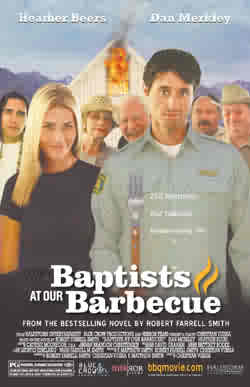
My wife and I recently had the opportunity to watch the wonderful LDS film Baptists at Our Barbecue. The film did a wonderful job at presenting a comical look at the fears (sometimes bordering on paranoia) that both Mormons and evangelicals feel living in close proximity. But it also portrayed the courage that a few people had to put together a community event that brought these two subcultures together. Perhaps what these filmmakers envisioned in entertainment can become reality through the courageous efforts of like-minded evangelicals and Mormons.

Third, I recognize that real fear exists among representatives of both communities, and we certainly shouldn't gloss over the risks involved in interreligious and intercultural engagement, but we should not let the challenges overshadow the opportunities and the benefits. While both religious communities might be fearful of such prospects in terms of potential loss of members to "the other side," the reality is that interreligious dialogue results in a loss of ignorance and fear, and a strenghtening of committment to one's own faith rather than large scale faith defections. It would appear that there is more to be gained than to be lost in dialogical exhanges between our faith communities.

Fourth and finally, should our dialogues discontinue, or should they be stopped by those concerned about this process, what is the alternative? Will we return to the options of the past in terms of ignoring each other, or perhaps more commonly, will we resume our attacks on each other? We have been lobbing doctrinal and worldview handgrenades at each other through the course of our overlapping histories, and I wonder how anxious we are to continue this process. It seems that we either find a way to work together through the challenges and difficulties of the dialogical process in various venues or we return to the ways of the past that really didn't benefit either community.

The world is growing increasingly smaller, and it is more and more common for people of diverse religious backgrounds to live and work in close proximity to each other. Our continued dialogue in spite of our concerns and fears provides us with a helpful tool that makes our world and our neighborhoods better places to live. I urge members of both religious communities, evangelicals and Mormons alike, to pursue the path of dialogue with the resulting fruits of understanding, trust, and relationships, rather than the path of silence with its fruits of ignorance, stereotypes, and distrust.

Photo source credits: http://sergecar.club.fr and http://www.ldsfilm.com.

Thursday, June 22, 2006

Emerging Church and Critical Issues: Part 4

Following is the fourth and final from "Baptists and the Emerging Church: some critical issues," by Simeon Payne and Philip Johnson from Mosaic. Copyright Mosaic, Payne & Johnson.

Critical Crosscurrents
The EC is correct in its assessment that the western Church will be institutionally finished within the next generation unless some major changes take place. However we believe that EC thinkers need to become more critically discerning about our era. EC writers tend to uncritically lump all of modernity together, and do not properly describe postmodernity. What Christians think postmodernity is, and what it actually is, are sometimes two very different things.

Another critical problem is that leading EC writers have largely ignored the tremendous influence of consumer religions and failed to make the essential linkages between postmodernity, New Age and DIY spiritualities. We find this omission particularly odd since EC writers are emphatic that they are on the cutting-edge in missional outreach in postmodernity. Here we urge all Christians to become far savvier in their critical understanding of society.

Ultimately, this involves reversing the great twentieth century uneasiness that evangelicals have had regarding Christ being for, against, above, or critically with culture - and also addressing the evangelical uneasiness with natural theology and critical interaction with secular academics. We have to find and develop a middle position between blind acceptance of culture on one extreme, and pure escapism on the other.

We commend the EC for its creativity, but we caution against romanticising parts of church history. We also would like to encourage the EC to move way beyond a focus on chic worship, and to do what its Church Growth parents were unable to do: focus on living as a missional Church every day, not just Sunday.

We also need critical reflections about psychological issues relating to faith development. Just as churches need to honestly articulate their theological convictions and how this connects with some key questions of identity, we also encourage churches to critically reflect on what sort of psychological zone they operate in, and realistically to whom they are capable of ministering.

We have already said that it is dishonest to lump all EC together. Yes, there are some faddish aspects that one can detect in the "soft end" of EC. However, it is unfruitful to dwell on the trivial particularly since this does not represent the whole picture. Similarly, it is not good enough for some naysayers to suggest that anything associated with the tag of "Emerging" is heretical, or that the true test of evangelical orthodoxy is whether you oppose EC. A polarising of views into opposing camps will lead to unnecessary alienation and sideline the need for serious reflective dialogue. The burden remains on critics to go beyond finding theological faults, and if in the final analysis EC is proven to have lost its moorings altogether, critics must construct a viable alternative model.

Evangelical pastors also need a reality check. It is easy to overlook that some of today‚s most admired leaders in the Church Growth networks pursue entrepreneurial models and franchise products designed to cure your congregation‚s declining numbers. If the EC is accused of reflecting the consumerist spirit, the same could also be said of many churches. So before yanking the speck out of the EC eyes, it may first of all be necessary to pluck the logs out of our own.

So what will become of the EC? In the first instance the EC has to face a historic and sociological reality that no religious movement can remain leaderless or without structure indefinitely. For its own good the EC now needs a degree of structure, otherwise it has no positive future.

It also has to plot what it wants to be its lasting legacy. There are two options. The first is that the EC follows the same social dynamics of the civil rights or women's movements. It functions by agitating for rapid changes in existing churches. If through their missional experiments the EC can create new model congregations that effectively reach inside postmodernity, and in positive dialogue help to reshape opinions for existing churches, then mainstream Protestantism could successfully absorb their insights and examples and chart a new positive course for the postmodern era. Then, once the EC had achieved its objectives, it could plateau and subside as a movement.

The other option is for the EC to intentionally form new congregations that would develop into yet more denominations, ultimately exacerbating the Protestant decline. If this new strand were unable to develop a mature, theologically orthodox foundation, it also runs a real risk of creating heresy or theologically becoming a cult. For this reason we strongly urge both the EC and the existing Church to proactively communicate so that this fragmentation can be avoided.

Our preferred option is that the EC will remain within existing denominational structures. Our strong plea is that generous, and intentional, space be made for the EC to be a welcomed part of our Baptist family. If this is not done it will simply and dangerously fragment evangelical Christianity further, and accelerate the decline of western Christianity. If the existing Baptist churches can cultivate the grace to dialogue and to mutually grow together with the EC, then God will surely bless that generous spirit.

May we close with a positive comment? We believe Baptists are well placed to positively gain from the EC. Our independent spirit, non-institutional leanings, congregational government, Spirit-led fluidity, and our radical Anabaptist heritage all offer positive bridges to build upon. The question is, will we positively engage with the EC and have we the courageous vision to see that this needs to be done? We strongly encourage NSW Baptists to actively engage those in our midst who resonate with the ideals and longings of the EC.

Simeon Payne (s.payne@uws.edu.au) is the Baptist Chaplain at UWS, and Philip Johnson (philip21360@yahoo.com.au) is an adjunct lecturer at Morling College and independent scholar. Both are members and writers in the Lausanne Committee subgroup (www.lop45.org) that is looking at Alternative Spirituality in the West.

Emerging Church and Critical Issues: Part 3

Following is the third installment from "Baptists and the Emerging Church: some critical issues," by Simeon Payne and Philip Johnson from Mosaic. Copyright Mosaic, Payne & Johnson.

Comparing EC and New Age
Now there are quite a few parallels between the dynamics of New Age and EC. Like New Age, the EC has (so far) produced an informal leaderless movement of individuals who positively celebrate postmodernity. The EC perceives itself as responding to postmodern culture with the gospel. However, it is also clear sociologically that the EC has arisen from both Protestantism and postmodernity. It manifests a strong spirit of individuality that is common to both. EC adherents mix-and-match things across all Christian traditions, just as New Agers freely combine practices from many religions. As New Agers reject modernity for its rationalism, so too the EC claims that the churches have elevated the intellect at the expense of a practical spirituality. They point to the heavy emphasis on text-based forms of communication in church, and contrast it with the way most people now communicate in audio-visual computerised formats. Just as New Agers wanted to reinvent a spiritual society, the EC should be commended for wanting to create new forms of church that are missional and spiritually relational.

The EC also reflects evangelicalism‚s free spirited attitude. Sociologically, Protestantism's strength has been the decentralised market spirit but it has been too uncritical in recognising how closely allied this is with the spirit of the times. In this era of late-capitalism, there is simultaneously a fragmentation of all social structures and very rapid globalisation of ideas. Seen in this light, the seemingly radical independence of the EC and its highly non-structured nature is really no surprise as it is taking Protestantism to its natural conclusion.

There is a "soft end" where some people call themselves EC because they identify with pop trends in clothes, music and gadgets. They seem to imagine that holding a service using candles, light liturgy and a Celtic labyrinth makes one EC. Others superficially mix and match Christian sources without reflecting on their original theological contexts. Again, just as New Agers romanticised the pre-Christian past, so we have observed some of those in the EC romanticising about the Celtic church and projecting back onto it an ideal kind of church they wish existed today. This "soft end" is very prone to faddishness and is very easy for critics to dismiss.

However, at the opposite end of the spectrum there are some very creative and clever people who are serious about being missional in postmodernity. From the "hard core" EC networks, the church is being offered encouraging words about new urban experiments in missions. In light of their missional experiences, they are posing important questions about postmodernity, faith, and worship, which need to be openly and honestly discussed throughout evangelical churches. Even if EC did not exist, the issues they have raised would still have to be faced.

There is another dimension to the EC that demands our reflection. Alan Jamieson, a Baptist minister from New Zealand, has identified many "post-Church" groups in his country and ours. These are not groups of heretics, back-sliders or immature Christians. The opposite is the case. These groups consist of people who have grown through and beyond Evangelical, Charismatic and Pentecostal groups. He uses the psychological paradigm of Fowler's Stages of Faith, arguing that some Christians psychologically move beyond the rigid, inflexible and constraining format that many churches offer. Many of these people have found a home in the loose connection of the EC. It is critical that the reader understands that what distinguishes these groups from the established or mainline Churches is not theology or function, but their perspective on structure and sociological understanding of what their Church is about.

We wish to add one more element to Jamieson's work. With our own ministry to people within Alternative Spirituality, we have witnessed a number who have come to a saving relationship with Christ, but have floundered to find a church that can accept, understand or augment their journey. Although they are new to Christianity, their psychological faith zone is beyond that which the bulk of churches operate. These people have tended to gravitate towards the EC.

Tomorrow: Critical Crosscurrents - Part 4

Emerging Church and Critical Issues: Part 2

Following is the second installment from "Baptists and the Emerging Church: some critical issues," by Simeon Payne and Philip Johnson from Mosaic. Copyright Mosaic, Payne & Johnson.


Social Change and New Spiritualities
Let's get our bearings straight about societal changes. Firstly, sociologists argue that we live in the age of "he self". Life in the dotcom, 24/7 world is shaped with expectations about work, leisure and relationships that leaves little space for enduring commitments to communal or institutional activities like church. There is little trust in public or corporate entities and decreasing notions of the "common good".

Increasingly many now feel that modern institutions have failed us, and so you have to look inside yourself for truth and values. Over the past twenty years, religion has gone from being a corporate experience to being primarily focused in the individual. It has gone from focusing on doctrine to being focused on what you do. The individual goes within to discover meaning. The shift is from the passive acceptance of what a pastor declares is truth, to do-it-yourself (DIY) spirituality. It is less concerned with reading a sacred text, and much more about experiencing things. It celebrates the self in popular culture but critiques modernity‚s sceptical denial of spirituality.

Sociologists use the term consumer religions when describing the way people now approach spiritual matters. People now shop for spirituality in the same way they would look for a new car or pair of shoes. The emphasis is no longer on product loyalty, nor the empirical facts about the product itself. The emphasis is on how it feels to me at the time. It is the consumer who defines truth ˆ not the retailer. Gone is the era of the authoritative religious leader. It is the consumer who sets the agenda.

Secondly, this is an era of mix and match spirituality. In the spiritual supermarket, you can access a never-ending array of experiences or beliefs. Because there is little "product" loyalty, one is free to sample whatever they might desire; and very often this mix-and-match process removes things from their original context. What matters is what "works" for you. This has led to consumer fads about crystals, angels and the Cabala. There is also a tendency to romanticise the past and to project back into it what the seeker is looking for today. One can take a bit from the east, a bit from the pre-Christian pagan past and top it all off with a bit of indigenous spirituality. As DIY spirituality is consumer driven it is an eclectic leaderless social phenomena.

Within these alternate spiritualities, we have discerned a broad spectrum of positions. There is a distinct "soft end" of the spectrum, which is very consumerist and faddish and pandered to with chic books and trinkets. But there is also a distinct "hard core" - those who are very savvy about the consumerist nature of spirituality and in fact despise its commercialisation. The hard core yearn for depth and integrity to their spirituality.

Tomorrow: Part 3 - Comparing EC and New Age

The Emerging Church: Some Critical Issues

My friends and colleagues, Simeon Payne and Philip Johnson in Australia, recently wrote an article for Mosaic Vol. 8, No. 2 (Winter 2006), a publication for Baptist churches in that country. The article is titled "Baptists and the Emerging Church: some critical issues." I am reproducing this article in installments in order to share their thinking in the hopes of facilitating dialogue between leaders in the emerging church and other forms of church in the West. The article is copyrighted by Payne, Johnson and Mosaic. A copy of this article is available in PDF file by request.

Mosaic article: Part 1

Through the establishment of the Emerging Church socio-spiritual dynamics and New Age spirituality are being mirrored sociologically. What role does the Emerging Church play in our Baptist Churches?

Are there any Christians out there who have not come across material, or had a conversation with someone about the Emerging Church? If you browse the Internet and Christian bookshops, the Emerging Church (EC) is the "in" topic. Subscribers to the EC seem more at home in postmodern culture than they do inside traditional churches. They sense a huge gap between a church in serious decline and postmodern culture, and feel strongly that there must be other legitimate ways of worshipping, expressing faith and relating to the community.

Passionate polemics, either for or against the EC, are now very common. In some circles, sympathy for or against the movement is held up as a new mark of Christian or evangelical orthodoxy. Yet the EC is very diverse, and a big mistake is to over-generalise about the movement and lump all EC sympathisers together. This discussion is neither a defence of nor a polemic against the EC. We are not debating their theology, which Don Carson and others have already done. Here we reserve our judgement on the fairness and accuracy of these critics.

We belong to a missional network that centres on reaching seekers in new religions, New Age and Alternative Spiritualities. We have learned a lot about society and missions, and therefore feel we have something fresh to say in this debate. Instead of focusing on the EC theologically, here we are looking at it from the social sciences. Using this approach, we believe we have uncovered a new set of critical issues that have largely been excluded from the conversations generated by the EC.

This is our thesis: the socio-spiritual dynamics that surfaced in mainstream society in the 1980s with New Age spirituality are now being mirrored sociologically inside the church through EC. Please note we are not saying that the EC teaches New Age doctrines or that it is New Age in disguise. The EC and New Age are theologically poles apart. The parallels we draw concern their social phenomena: What New Age was for secular society, the EC is to Protestantism. Both the EC and New Age have arisen as reactions to very broad societal changes and cultural influences. Nothing occurs in a vacuum, and the EC is very much a product of, and not just a response, to broader societal changes. If we can compare the two movements sociologically, there is much to be learned.

Tomorrow: Part 2 - Social Change and the New Spiritualities