Friday, May 26, 2006

Of Pentacles and Tombstones

I am a member of several Yahoo groups related to religious studies and mission to new religions and alternative spiritualities. One of the groups, NUREL, recently included a post in the form of a story about a controversy in Reno, Nevada. The Associated Press is reporting that the family of an American soldier killed in Afghanistan is trying to get the Department of Veteran Affairs to approve the placement of a Wiccan pentagram on the tombstone of the fallen soldier. The family says that the pentagram would be the appropriate symbol for the young man who practiced this form of spirituality.

While Nevada officials work to speed up the probable approval of this request, the AP story states:
The Veterans Affairs' National Cemetery Administration allows only approved emblems of religious beliefs on government headstones. Over the years, it has approved more than 30, including symbols for theTenrikyo Church, United Moravian Church and Sikhs. There's also an emblem for atheists - but none for
Wiccans.

This news story reminds me of the firestorm of controversy that erupted a few years ago when it became known that an Army Base was permitting Wiccan ceremonies to be conducted on the military facility. There was a minor public uproar, including complaints from many evangelicals who felt that somehow the government should be in the position of disapproving certain spiritualities such as Wicca.

In light of the controversy in Reno, and as we remember our fallen war dead and other lost loved ones, Christians in religiously plural America might be thinking about the practical aspects of our theology of religions, and remember that freedom of religion means all religions, even ones evangelicals find distasteful. That seems to me to be the Christian thing to do.

Have Western Evangelicals Become the New Judaizers?

This week I received the latest edition of Missiology journal, Vol. 34, no. 2 (April 2006). This issue is devoted to discussion of issues surrounding the shift in Christianity’s growth from the Northern to Southern Hemispheres, with decline in Western Europe and North America and growth in Africa, Asia, and Latin America. This shift has been recognized for some time by the missions community, and has been explored by a number of authors, including Philip Jenkins in his book The Next Christendom, the subject of a few previous posts and an interview with the author on this blog.

One of the articles in this issue discusses the missiological implications of the southern shift (“The Changing Face of Mission: Implications for the Southern Shift in Christianity,” by Mark Lang, pp. 164-177). In a sub-section of the article titled “Blessed Reflex,” the author discusses the revitalization of the early Jewish church that came with the growth and strength of the Gentile church. He then discusses the possibility of the Western church being revitalized and renewed by interaction with southern Christianity’s mission and theologizing, unencumbered by the Enlightenment and other Western cultural assumptions. Lang writes:
Missionaries are being sent from vibrant southern churches to the North bringing renewal and revitalizing northern churches. Coming from contexts unaffected by an Enlightenment worldview, many are able to naturally connect and communicate with the post-Christian post-modern world, where in contrast, the Western church often struggles to do so. In fact there is the danger for Western Christians, that in their quest to maintain orthodoxy, they may find themselves unwittingly defending the plausibility structures of the Enlightenment rather than defending Christianity, guarding a cultural form of Christian Enlightenment. (p. 175)
In light of my own cultural and missional studies and experience in the West I find this statement interesting. As I considered its ramifications it dawned on me that evangelicals might have unwittingly become the new Judaizers. Let me briefly explain.

One of the groups that surface polemically in the New Testament, such as in the Pauline epistles like Galatians, have been labeled the Judaizers. Scholars believe that this was a group of Jewish converts to Christianity who believed that it was also necessary to not only accept the gospel, but also to keep the law of Moses. Their error arose because of a their connection of the gospel and Christian identity with aspects of Jewish culture. In the process of this connection the gospel itself, and the unity of Jew and Gentile in one united community in Christ was undermined.

With the syncretism of the Western church with aspects of modernity and Enlightenment presuppositions I believe that we may indeed by guarding and promoting a particular cultural expression of Western Christianity as the universal and orthodox expression of the faith. This may be happening on an even grander scale among those ministries that evangelize adherents of new spiritualities in the West, where the tendency is to extract them from their subculture and to reinculturate them in the evangelical subculture, rather than presenting the gospel contextually in their cultural context and permitting the development of indigenous expressions of the faith in new cultural forms. (If this is an accurate assement it would indeed be ironic in that such ministries frequently cite Galatians and other texts addressing the Judaizers in refuting many new religions.) If this indeed the case then the Western church can learn a lot from the southern church, and my hope is that we in the West can exercise the humility and teachability necessary to learn and adapt to new roles, theologies, and ways of being in the twenty-first century.

Monday, May 22, 2006

Apologetics as Love and Relevant Communication

Some of my interactions with those who have sent along comments to recent posts made me think of John Stackhouse, author of Humble Apologetics (Oxford University Press, 2002). Salt Lake Seminary is working to secure his teaching in the upcoming fall semester as part of the intercultural studies program, and I look forward to benefitting from his instruction.

Quotes from his book on apologetics provide evangelicals with pause for reflection. The first addresses the areas of the purpose of apologetics and the attitudes of the apologist (p. 141):
Apologetics must alway look like God's love at work...Apologetics is not, primarily, about me. I can read apologetics in order to strengthen and sophisticate my faith, yes. I can engage in apologetics that can benefit me in various ways. But I ought to be commending the faith to my neighbor primarily for her benefit, to the glory of God. I ought not to be engaging in apologetic conversation out of some need of my own, whether a need to save face, or show up an enemy, or congratulate myself on my fervor. Apologetics, again, is a form of Christian speech, and as such it is always and only to offer a gift to the recipient - not aggrandize the speaker. Fundamentally, then, apologetic is about winning the friend, not the argument.

The second collection of quotes addresses adapting apologetic approaches for diverse audiences (pp. 142-3):
With love for God and love for our neighbor guiding and motivating us, therefore, when it comes to apologetics we will take each audience seriously on its own terms. We will not, that is, present apologetics to discharge a duty to our own satisfaction and then depart. In particular, we will not devise an apologetic that impresses us, but an apologetic that meets the needs of the particular audience we are addressing...Many Christians, and particularly those in the evangelical tradition to which I belong, are typically better at speaking, at proclamation, than at these two necessary skills: asking questions and listening to answers. Yet we must begin by asking questions. Who am I dealing with? What are their questions, their cognitive style or styles, their concerns, and their criteria for deciding about religious matters? Before I rush in with my package of stirring apologetic arguments, I need to ask just what my audience cares about, and how they will likely hear and respond to what I have to say.

I wonder if more evangelicals took these words to heart and modified their thinking and action as result, then would not the complexion of many apologetic and countercult ministries have to change dramatically?

Wednesday, May 17, 2006

Alister McGrath on Postmodern Apologetics

My friend and ministry colleague Philip Johnson recently made me aware of an article by Alister McGrath on the necessity of apologetics in postmodernity titled "To Capture the Imagination of Our Culture: Reflections on Christian Apologetics," that appears in Anvil, volume 17, number 1 (2006), pp 5-15. Philip discusses this article as it relates to the emerging church movement's emphasis on embodied apologetics at his Circle of Pneuma blog. If by an "embodied apologetic" the emerging church refers to the need for greater emphasis on incarnating in postmodern subcultures and engaging in acts of service and hospitality, then I am all for it, provided this is done in connection with other forms of mission and apologetic as well. The emerging church needs to resist the false dichotomy of "embodied apologetic" vs. "rational apologetic."

But before evangelical apologists shout a hearty "Amen!" they need to remember that apologetics within postmodernity needs to be done very differently than in a modernist context. Apologetics, like missions, must be contextually appropriate and relevant to a culture. Evangelical apologists' penchant for modernist apologetic approaches need to be revisited in light of social and cultural shifts. Readers might be interested in a popular article I wrote on that touched on this area in "A Fresh Agenda for Apologetics in the Twenty-First Century."

Emerging church participants and apologists alike are encouraged to click on the link above to Circle of Pneuma for Johnson's comments on this issue, and to secure this issue of Anvil.

Monday, May 15, 2006

Da Vinci Code Film and Evangelical Responses: Boundary Maintenance to Missional Engagement?

A few years ago when I was participating in a short-term mission trip in Australia, I came across an issue of What is Enlightenment? magazine in a New Spirituality bookstore that caught my attention. The cover featured an illustration of an older male figure with long hair and a long flowing beard, a traditional representation of the God of Christian theism, sitting fretfully at a computer keyboard with mouse in hand. The cover story that accompanied the illustration was titled "can God handle the 21st century?" Of course the answer to this question is "yes," just as God has "handled" all the previous centuries of human existence, but I believe the question posed in the article's title should be altered to reflect a more serious question for Christians in the West. The real question is: can the church handle the 21st century? I'm not so sure this question can be answered in the affirmitive. Uni-dimensional evangelical responses to a pop culture phenomenon illustrate my thinking.

On May 19 The Da Vinci Code movie will premiere in the U.S. The movie is, of course, an adaptation of the best-selling novel by Dan Brown. It is directed by Ron Howard and stars Tom Hanks. The combination of a story loved by millions who purchased the book, and an Academy Award winning director and actor suggests that this film will be a blockbuster.

Evangelicals have been responding to concerns ab0ut the Da Vinci Code since the book was first published. With the film ready to debut, evangelicals are cranking up their responses to the movie as well. Some of the responses by evangelicals have been well done, providing a reasoned consideration of the church's traditional understandings of the Bible, the life of Jesus, and the history of the church. Of course, the church does have a responsibility to respond to the historical and theological inaccuracies within Brown's fictionalized novel. Nevertheless, thus far Christian groups seem largely (or solely) focused on defensive reactions to issues of theology and history, while ignoring equally significant cultural aspects of Brown's novel.

For examples of the types of evangelical responses, Tyndale House Publishers is organizing a "Da Vinci didn't convince me" marketing campaign for churches, while the Josh McDowell Ministry has included "Da Vinci packs" in their Beyond Belief campaign. Again, the church does need to understand its history and theology in light of the counter-claims of Da Vinci Code, but in the process we're assuming the church will be heard outside of its walls when we engage the culture, and we're ignoring another imporant angle for cultural engagement. In light of America's post-Christendom and post-modern culture, the church must engage culture in different ways and address the specfic concerns of that culture. Christendom culture approaches will not work in a post-Christendom environment. In addition, not only should we be thinking about what the church will say to the culture, but what is the culture's interest in Da Vinci Code saying back to the church? The Da Vinci Code raises several interesting isues for the church's critical self-reflection:

Concepts of the Divine (masculine and feminine imagery, particularly with concerns over patriarchy).

Christ (emphasizing his humanity as well as his deity, where the church may overemphasize one at the expense of the other).

Gnosticism (the church's denunciation of "New Age" in the 1980s and beyond did little to address the West's continuing fascination with various forms of Gnosticism and neo-Gnosticism).

Women (gender roles in church and society).

Sexuality and the body (moving beyond Puritanical concepts).

Conspiracy theories (why they continue to grip our imagination).

Church (as authority structure, and its relationship to popular culture).
The church in the West must discover ways in which to move beyond mere confrontation in order to embrace missional engagement with the culture that is self-critical, positive, proactive, and holisitic, addressing not only theology and history but contemporary culture as well. If we continue to merely respond defensively, outside the church as well as within, we will perpetuate our continuing marginalization and isolation. Can we move beyond confrontational approaches to popular culture and our propensity to preach to the choir to seize the opportunity presented by this new movie? I'm afraid I'm not very optimistic.

Wednesday, May 10, 2006

Symbol Wars: Cautions and Considerations for Evangelical Approaches

As I mentioned in my last post, I recently completed the Cross-Cultural Hermeneutics course at Salt Lake Theological Seminary, and in our last session one of the topics we discussed was symbolic anthropology, specifically the work of Victor Turner. I had read some of Turner previously, and read other anthropological commentary on his perspectives, while completing my work on a project for this course, and I immediately recognized the implications of symbolic anthropology for not only my project, but for evangelical engagement with LDS culture as well.

In this post I will briefly summarize some of the thinking from Turner's symbolic anthropology (at the risk of oversimplification), and will then apply it to a clash of symbols in popular culture, and will conclude with consideration of the ramifications of all of this for ministry among the religions. I beg the reader's patience with the initial academic discussion of anthropology.

Symbolic anthropology, especially as presented via the work of Victor Turner, understands culture as composed of symbols which sustain society. Turner's work obviously includes both a methodology of studying the symbols as well as a theory of the symbol. In terms of theory, every culture may be thought of as made up of both signs and symbols. Signs (also called referential symbols) have a one-to-one relation between the signifier and the signified and the connection between the two is arbitrary. The meaning is referential. We master our world by signs.

Symbols, on the other hand (also called condensation symbols) fuse affect and value. That is, they have both affective and moral poles associated with them. Primacy is on feeling and willing, not on referential thought. Because of this emphasis on the affective, symbols have mobilization efficacy. If it is said that we master our world by signs, then we master ourselves by symbols.

We might also note that given the strong connection of the affective or feeling to symbols, individuals and cultures often attach a strong sense of individual and corporate identity to them. The significance of symbols to a culture, the importance of the deep affective dimension of symbols, and how this plays out in cross-cultural interaction, can be illustrated through an example from popular culture.

It is not possible to drive along America's roadways for long without encountering the Christian fish symbol on car bumpers. The fish has long been a historic symbol of the Christian faith stretching back to the early centuries of the religion. As an expression of their identification with Christ and their faith, contemporary Christians created various expressions of this ancient symbol and proudly displayed them on their car bumpers. However, it did not take long for another American subculture, atheism and agnosticism, to recognize the significance of the fish symbol for the Christian community, and they responded with a modification of the symbol. The addition of "Darwin" and feet to the symbol provide an evolutionary twist that is included as a means of both establishing atheist cultural identity while also mocking both Christianity and individual Christians through the use of symbol.


Not surprisingly, when the conservative Christian community noticed that their symbolism was being appropriated and mocked, this did not lead to their interest in exploring the secular worldview and the rejection of Christianity. Instead, Christians responded with a further modification of the symbolism wherein the Christian fish was depicted as carnivorous and devouring the atheist evolving fish symbol. In this development of the symbolism, Christians responded defensively to the attack on their symbol, which was interpreted as an attack on the essence of the sacred in their culture, Christ himself, as well as Christianity and individual Christians.

There are at least a few things we might take away from a consideration of symbols and their place in culture, as well as the popular culture example of symbol wars.

1. Symbols are significant to a culture as an embodiment of the sacred or the highly valued.
2. Individual and community identity is attached to symbols and their expression.
3. The manipulation of symbols by cultural others leads to perceptions of threat to individual and community identity, and attack on the culture.
4. A defensive reaction may follow from attack on cultural symbols.

Given the strong connection between a culture, identity, and the affective and symbolism, it is not surprising to expect a negative reaction when a given culture perceives that its symbolism is being attacked by a cultural other. For this reason missionaries would be ill advised to engage Hindus during their life-cycle initiations (samskaras) pilgrimage, or Muslims during the hajj. The presence of cultural outsiders at places associated with a symbolic sense of the sacred would provoke a strong negative reaction by the culture, thus alienating the missionary from the participants of the culture making effective communication difficult if not impossible. The insights of symbolic anthropology in dialogue with missiology teaches us that there are appropriate and inappropriate cultural venues in which to engage those we are called to reach.

With these considerations in mind we might this discussion a little more close to home. Scholars have noted several aspects of Mormon culture, including its emphasis on ritual, the significance of death and death conquest, as well as pilgrimage. While we might not normally think of Mormon participation in community celebrations (such as Pioneer Day), pageants (such as the Mormon Miracle Pageant at Manti), and temple visits as pilgrimage, Douglas Davies has stated that, "Mormon spirituality cannot be interpreted without some idiom of pilgrimage" and that "the Mormon practice of temple visiting" is legitimately understood as an aspect of pilgrimage.

Other aspects of Mormon culture are worth considering, including the connection between Mormon identity and ideology of place connected to sacred geography, temples serving as a social symbol, and pilgrimage as a social context where Mormons participate in a narrative rehearsal of the collective sacred.

If we connect the dots of our discussion, including the significance of symbols to culture, and the defensive reaction of a culture when its symbolism is attacked (or the mere perception of threat exists), we might reflect once again as to whether outreach at Mormon temples is culturally appropriate. In light of the preceding discussion the answer must be a resounding "no." Just as evangelicals were not motivated to consider a secular worldview when one of its sacred symbols was attacked, but instead reacted defensively, Mormons are not motivated to consider a traditional Christian worldview when their cultural symbol is attacked by the presence of evangelicals as cultural outsiders. I submit that while evangelicals have the best intentions in their outreach programs at various expressions of Mormon pilgrimage, and worthy goals of education and evangelism, ignoring the symbolism of Mormon culture results in not only a widening of the divide between our subcultures, but also deepens their commitment to their worldview in response to perceptions of attack. While evangelicals may disagree with this assessment, they will have to carefully consider symbolic anthropology and its ramifications for ministry before immediately dismissing this thesis.

Tuesday, May 09, 2006

Worldview Approach to Culture: Assumptions, Shortcomings and Benefits

Last Friday and Saturday I participated in the final classes of the Cross-Cultural Hermeneutics course at the seminary, led by Robert Priest of Trinity. One item of discussion was the worldview approach to culture. Evangelicals tend to utilize this particular approach to culture in general, as well as various new religions and world religions as well (consider Jim Sire's book The Universe Next Door as an example). What follows are notes from Priest on the topic.

Priest noted that a worldview approach to culture is affirmed by a minority of anthropologists, but is used by a majority of missiologists and evangelicals who think about culture. The worldview approach to culture assumes that the order observable in culture is primarily cognitive and rational; that such order is related to basic philosophical categories; that such worldview order is deep, implicit, assumed, and largely unconscious; and it assumes a direction of causality in which cognitive order provided by worldview determines other things. Worldview is the base, the first cause, the primary root.

Priest continues by describing the worldview perspective on persons whereby it assumes they have a strong drive for rational order and consistency, and also assumes that humans act rationally, given their cognitive assumptions.

Moving to a theoretical critique, Priest notes that many times culture is shaped by other forms of order, other organizing principles than that of cognitive order. He also states that even the cognitive order which is there is grounded in and shaped by metaphor, symbol and story rather than by abstract rational thought. He continued by noting that human action and speech is often less rational and less rationally determined than is often thought.

In terms of methodological problems, Priest noted that worldview analysis tends to be removed from lived reality. It is often abstract and distant from the data. Other approaches are more closely tied to the data and the method of engaging data. He notes the problem of etic (outsider's perspective) as the starting point, and the propensity to privilege the intellectual's explanations and justifications as the correct ones.

In terms of missiological problems with the worldview approach to culture, Priest states that the language of worldview frames things in philosophical terms, as a question of truth or error. If every cultural difference is thought to be the result of a worldview difference, then every cultural difference invites people who think they have the right worldview to enter into judgment.

Priest concluded this discussion by stating that worldview analysis is valuable if:

1. Worldview is treated as one kind of order, not the only kind of order.
2. If direction of causality is understood to move in more than one direction. It is one contributor to action, not the only or necessarily the primary contributor in any given situation. Much of culture is not contingently dependent on a particular worldview.
3. If it is studied by sophisticated anthropologist with profound knowledge of culture at multiple levels. (It results from multiple research steps beginning with empirical.)
4. If it includes a judicious mix of emic (insider) and etic (outsider) perspectives.
5. It is especially important in context where systematic efforts at rational order are pursued by members of the society.

As I reflected on this discussion I noted the importance of its application to both missional expressions of church in Western culture, as well as to engagement with the cultures of new religions and alternative spiritualities. Evangelicals can benefit from considerations of worldview, but we must also recognize its limitations, and balance it with other considerations in order to arrive at a full orbed understanding of the culture's we seek to engage.

Monday, May 01, 2006

Brueggemann on emerging church

ReligionLink recently disseminated a piece on the emerging church. The brief resource written as an aid for religion writers included a list of contacts that could be approached for further comment on this phenomenon. One of the scholars listed caught my attention when I saw the name of Old Testament scholar Walter Brueggemann. Dr. Brueggemann is described by ReligionLink as “an appreciative observer of the emergent conversation. Brueggemann is professor emeritus from Columbia Theological Seminary in Decatur, GA. He is also the author of a number of books including An Introduction to the Old Testament: The Canon and Christian Imagination, The Prophetic Imagination, Texts Under Negotiation: The Bible and Postmodern Imagination, and Deep Memory, Exuberant Hope: Contested Truth in a Post-Christian World.

I found an appreciation for the emerging church by a noted Old Testament scholar of great interest and I gave him a call to discuss it. We spoke briefly, and Dr. Brueggemann told me that his introduction to the emerging church came by way of a phone conversation and later lunch with Brian McLaren. While Brueggemann does not claim to have an in-depth knowledge of the complex and diverse movement of the emerging church, he said that he is appreciative of its desires to seriously engage the culture, and he appreciates its social and missional activities. Brueggemann also shared concerns about evangelicals who condemn the entire movement as heresy.

I was glad to see that a respected scholar was open to a different expression and experimentation with church forms and ways of being in the West. Perhaps others might consider such openness, or at least be more willing to withhold judgment against the movement, and pause before raising red flags relative to missional Christians who include emerging church links on their blogs.

Sunday, April 30, 2006

Cornerstone Festival 2006: Attend if you can!

It will be my pleasure to participate in my fourth Cornerstone Festival this July 4-8 in Bushnell, IL. This year I am privileged to present seminars in two tracks, including Cornerstone You and the Imaginarium. Both sets of presentations look at differing issues from the perspective of intercultural studies. My series in the Cornerstone You venue looks cross-culturally at the rage directed at the West by the Majority World:

“The West and the Rest: Where Does Their Rage Come From?”
Americans scratch their heads at the constant protests and expressions of hatred against our country around the world. In reality, our lack of cultural appreciation and perspective causes us to misunderstand other cultures and their rage, but also to misunderstand the Scriptures and the Christian faith.

This year’s Imaginarium will be looking at various Day of the Dead celebrations in differing cultural contexts, and analyzing it from differing cultural expressions. My contribution to this fascinating topic is the following seminar series:

"Incarnation Means Becoming Human: Body, Soul & Imagination"
Image, myth, symbol and ceremony are the bread and butter of the Imaginarium, a fare people respond to as if they'd been starved. Often, they have been - by a Modern culture that prizes abstraction over incarnation. Missionaries worry about syncretism - mixing with non-Christian cultural forms - but have rarely scrutinized Modernity's conquest of the faith. Yet recent developments in missiology parallel the Imaginarium's journey in seeking a more sophisticated approach to culture. This seminar surveys those overlapping trails, and serves as the theoretical counterpart to our evening series: "Death Takes a Holiday: Celebrations of All Saints, Souls, & Bodies."

I am really looking forward to the perspective I will contribute to these topics and many of the other seminars as well. This may be the best overall year for the Imaginarium yet.

Most intriguing is a seminar series by Gretchen Passantino Coburn. I was fortunate to meet Gretchen, and her late husband Bob, during a previous Cornerstone event. We developed a relationship that continues to this day. During the course of our discussions I discovered a similar perspective on many issues of theology, apologetics, and missional approaches. Gretchen will also be speaking in the same venues as I am, and one of her sessions in Cornerstone You will be a joint Q&A between the two of us. Gretchen’s series in this venue captures the direction she has been moving in her thinking over the last few years:

“Why Doesn't Apologetics Work?”
Even seasoned apologists like Gretchen Passantino Coburn agree that most people adopt false beliefs and join aberrant groups for reasons other than intellectual, yet a wide spectrum of Christian leaders continue to focus on education and knowledge as the keys to right belief and practice. How do we resolve this paradox?

I know that Gretchen has been rethinking apologetics, theology, and mission in recent years. It will be interesting to hear her presentations and to see where her thinking is at the present time. Perhaps this veteran apologist and past co-worker with the late Walter Martin has moved to the incarnational mission side of the coin alongside this blogger.

If you can attend this year's C'Stone Fest, I wholeheartedly recommend it. And if you attend one of my seminars stop on by and say "hello."

Tuesday, April 25, 2006

Diverse Faiths in our Neighborhoods: What Does the Lord Require of Us?

In a Yahoo discussion group Amos Yong of Regent College stimulated my thinking about an aspect of the encounter between evangelicals and adherents of other religions. He touched on implications from Jesus’ teachings from the parable of the Good Samaritan, as well Matt. 25 where Jesus states that how we respond to those in need reflect our reception (or denial) of him. Yong wondered how our treatment of the “religious other” might also be included in this passage of Scripture.

I found this perspective of great interest. Evangelicals spend a lot of time considering the soteriological destiny of those in other religions, defining orthodoxy in relation to heresy, and formulating evangelistic and mission strategies in this regard. But we spend little time reflecting on what God is doing in the Christian as they interact with those of other faiths. We are rightly concerned about a number of issues in the interfaith encounter, but we may be neglecting one of the most important issues in the process.

As I continue to consider the importance of this issue I was fortunate recently to come across an organization called Faith to Faith in the United Kingdom. An Internet search turned up this Christian consultancy which addresses the issue raised above as it also attempts to formulate a balanced Christian perspective in light of religious pluralism in the U.K., an approach similar to that of my own Neighboring Faiths Project in the U.S.

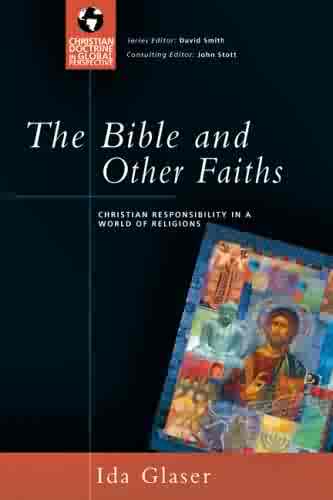
Faith to Faith was directed in the past by Ida Glaser, who is now senior teaching and research fellow for the Edinburgh Centre for Muslim-Christian Studies. She is the author of a wonderful book I am now reading (one of several!) titled The Bible and Other Faiths: Christian Responsibility in a World of Religions (IVP, 2005). The book is part of a series on Christian Doctrine in Global Perspective, with John Stott serving as the Consulting Editor. This book is extremely helpful in that it not only provides a global perspective on the question of religious pluralism, but also moves beyond traditional Christian approaches to the topic in order for Christians to reflect on what the Lord requires of us in the interreligious encounter. A brief excerpt from the first chapter provides a hint of the treat this book provides:
In August 2001 I led a seminar for teachers from theological colleges in Uganda. We were thinking about how and why they taught Islam. The key question, I suggested to them, is “How should we as Christians live in relation to Muslims? What does God want of us?” We looked at the Sermon on the Mount, at the great commandment of Matthew 22:39 and at the Great Commission of Matthew 28:18-20. Then we read Micah 6:8: “He has showed you, O human being, what is good. And what does the Lord require of you? To act justly and to love mercy and to walk humbly with your God” (author’s translation).

Then I asked, “How are we getting along? Are we living like that in relation to Muslims? What stops us?”

The answers came immediately: “Muslims say that Jesus is not the Son of God. They criticize the Bible. They won’t let us preach. They are setting up lots of new mosques. They want to take over our town. They are persecuting Christians in Sudan. They won’t eat our food. They are trying to marry our daughters …”

I repeated what they had said, and they got the point. Even if all those things are true, is there anything in Muslims that Christians can blame for their own lack of obedience to God? Nothing in Muslims, Hindus, Sikhs, Buddhists, atheist or even other Christians can stop us from doing what God requires. Only what is in us can do that.
Glasser’s book brings a helpful perspective for Christians living amidst America’s increasing religious diversity and who are concerned not only with sharing the faith across religious cultures, but also with the process of transformation through the Spirit that comes with our yielding to a life of service and love for those from the world’s religions (and new religions) that we live with in our neighborhoods.

Thursday, April 13, 2006

Sacramento, California Trip Summary and Words of Clarification

My family and I are nearing the completion of our trip to Sacramento in the northern California area. Tomorrow is the last day as we have a few more meetings, luncheons, and time with friends.

The ministry experiences here have been encouraging. I presented Bridges to a combined group from two churches, RiverCity Calvary Chapel of South Sacramento, and LifeSong of Elk Grove. The presentation was well received, and several people expressed appreciation for a missional and relational approach to understanding Mormonism and sharing the gospel with Mormon friends.

This trip to California also included meetings with large churches in the greater Sacramento area. Several of them are considering hosting a Bridges presentation, along with the new Grounded program for teens developed by Salt Lake Theological Seminary. We are well on our way to developing an alternative evangelical approach to the LDS temple opening this summer.

In addition, I was able to touch bases with supporting churches, including First Baptist Church of Elk Grove, and Fair Oaks Presbyterian Church, where I gave a summary of our Utah ministry at the monthly missions potluck. We are thankful for the partnerships with these churches and many of their members who's prayers and financial support literally make our ministry possible.

During this visit I also had an opportunity to meet with a ministry colleague who shared concerns about the missional direction that I have taken. Similar concerns were shared with colleagues of mine in Utah while I was away. I'd like to use the opportunity presented by these concerns to clarify issues and provide further food for thought.

1. Missional paradigm. My colleague shared his concerns that the missional paradigm I am involved in was too academic, it could not be understood, and that he was against it. Several thoughts come to mind in response to this concern.

First, what is the missional model to new religions that I and colleagues from around the world are presenting? Very simply, we are suggesting that the cross-cultural missions approaches that are articulated in the New Testament, and continue into the history of Christian missions overseas, should be applied to the new religious movements in the U.S. and the West. This means viewing Mormonism, for example, as a culture rather than as a "cult," and engaging this culture holistically, drawing not only upon apologetic argument, but also cross-cultural missions.

Second, our missional paradigm has been developed academically, and our book, Encountering New Religious Movements (Kregel Academic & Professional, 2004), was designed as a textbook for Christian university students, Bible college students, missiologists, and other Christian scholars, but this does not mean the book should be dismissed by those who do not feel they are academically inclined. We hope to develop these ideas for the "lay" Christian reader in the near future, but I would encourage those who are tempted to dismiss the articulation of our missional thesis in the academy not to return to the anti-intellectualism that marks Christian fundamentalism.

Third, if someone cannot understand our missional paradigm then it cannot be dismissed as inappropriate. Recall the maxim of the necessity to be able to say "I understand" before you can say "I disagree." If countercult personalities do not understand the cross-cultural missions paradigm we are articulating then they have a responsibility to ask questions and to seek clarification and understanding before leveling criticism.

Fourth, we might consider the possibility that the reason why the missional paradigm has been reacted to so negatively by many in the countercult is not because the the thesis has not merit, but because it involves a paradigm shift. Shifting from heresy contrast and refutation to cross-cultural missions is not easy, and the heresy refutation filter for countercultists likely results in a skewed interpretation of the missional paradigm.

2. Critique of countercult philosophy and methodology. My colleague also shared his concerns about my critique of countercult theory and praxis. He feels that it is inappropriate to state that a given methodology is problematic and should not be engaged in, even when it comes to the "street preachers" in Utah. Two thoughts come to mind in response to this concern.

First, the cross-cultural missions paradigm to new religions contains within it an implicit critique of countercult approaches. While my vocal critique of the countercult paradigm has no doubt added fuel to the fire for those who disagree with me, eventually the deep differences between the two approaches would have been evident and would have to be dealt with.

Second, why can't criticism be leveled against different paradigms in the free marketplace of ideas, including the arena of ministry? Theologians and missiologists routinely engage each other and critique each other's work and few cry "foul" in these contexts. I also find it curious that a few countercult critics have recently refused to label even the most extreme street preachers in Utah as inappropriate and out of bounds, and yet these same critics feel comfortable leveling criticism against those of us developing a missional model. It seems that those of us who are arguing for a missional model that takes culture and Scripture seriously are more problematic for the countercult than those who hold up derogatory signs and wipe their buttocks with Mormon temple undergarments.

I would ask the critics of the missional model to give this approach a fair consideration. If you don't understand something, ask one of the proponents and we'll do our best to help you understand. Also keep in mind that our thesis was presented in a book that won a Christianity Today Book of the Year Award in the category of missions/global affairs, and the book and its ideas have been favorably reviewed by missiological journals in the U.S. and the U.K. Other academic periodicals have begun to consider the thesis as well, and in the recent issue of Bibliotheca Sacra our book was favorably reviewed. Beyond this, our paradigm has received the support of the Lausanne Committee for World Evangelization, and leading theologians and missiologists as well. There is something credible and exciting here.

But at the end of the day it may be that representatives of our conflicting paradigms must part company. Recall Paul's parting of the ways with Barnabas. One of the great challenges for Christians has always been balancing our diversity with our unity. As the granddaddy of the countercult used to say, let's try to exercise the maturity necessary to "agree to disagree agreeably" even as we wish each other godspeed and pursue our differing pathways.

Thursday, April 06, 2006

Off Next Week to California

My family and I leave tomorrow (Friday) for northern California and the Sacramento area. I will be presenting the Bridges training program to the combined churches of RiverCity Calvary Chapel and LifeSong Church. I will also be speaking on the challenge of Western culture and misisonal church to the college group of Fair Oaks Presbyterian Church Sunday night, and return Tuesday evening to update the church on my missions work in Utah at their monthly missions potluck. Beyond that I will be touching bases with various supporters, both individuals and churches, and I will be touching bases with key churches in order to pursue an Evangelical-LDS dialogue and Bridges training as an alternative to the distribution of literature during the opening of the LDS temple this summer in Rancho Cordova.

Given my travels in California I will not be posting on this blog next week. This means that those who enjoy reflecting on my posts will have to wait for a week, and my critics will have a week off as well which will allow their blood pressure and stress level to lower for a while.

I wish all my readers a wonderful Palm Sunday and Easter celebration.

Monday, April 03, 2006

Mormons as Enemies of God?: Reflections on LDS General Conference

Last Saturday and Sunday the Church of Jesus Christ of Latter-day Saints held its General Conference in Salt Lake City. I had the privilege of participating in Operation Loving Kindness sponsored by the ministry of Standing Together in connection with the conference on Saturday. The purpose of Operation Loving Kindness is for traditional Christians from a variety of area churches to share their love and support with Latter-day Saints as they enter and leave from their participation in General Conference. As the throngs of Mormons walked by we stood near the conference center and wished Mormons a good morning, and shared our love and support for them as individuals and as a people.

One of the fascinating aspects of participation in this event was the variety of responses from Mormons as well as the notorious "street preachers."

The response of Latter-day Saints was varied as one might expect, with some expressing an understandable hesitancy and concern over non-Mormons standing near the facility associated with General Conference. But the vast majority received us warmly and expressed their appreciation for our presence and expressions of kindness. A handful even went so far as to approach us, offer us a handshake, and thank us for our efforts and sentiments.

While the reactions of Latter-day Saints was of interest, the reaction of the street preachers was even more interesting. The handful of preachers were scattered up and down the main street that led to the conference, signs with scripture verses and derogatory slogans held high. They alternated between preaching messages of denunciation at Mormon passers by, and when LDS crowds thinned, they took aim at those of us affiliated with Standing Together, even going so far as to denounce us as heretics and unbelievers. (As an aside, the street preachers assumed they were presenting the gospel that was being rejected by heretics, when in fact no contextualized communication was taking place across the subcultures of evangelicalism and Latter-day Saints. Their sermons amounted to little more than a harangue that had no positive appeal and represented poor communication skills, even for evangelicals who might share aspects of their worldview.) During these dismissive sermons I was able to feel for just a moment some of the rejection and judgmentalism that Latter-day Saints must feel when they are the target of this aggressive form of "evangelism."

My experiences at General Conference came during a week when I also received a few emails from a critic of my blog on the topic of Mormonism. He began our brief exchange by asking whether I believed Mormons were rightly viewed as "enemies of God" which included his citation of Romans 11:25 which refers to ethnic Israel's becoming the enemy of God for the grafting in of the Gentiles into the Kingdom of God. As our exchanges continued it become increasingly evident that this person was looking for any kind of biblical justification for regarding Mormons as enemies of God, and presumably of evangelicals.

I believe the attitudes and behaviors of the street preachers and my email inquirer share a common thread, and that is a tendency to view the Mormon people (and not merely Mormonism) as an evil worthy of our denunciation and condemnation, but precious little else. While Christ surely engaged in moments of condemnation, a quick review of these instances in the New Testament reveals that he reserved such judgments for the religious leaders, not for the common people of various stripes, whether Jew or Samaritan (whom the Jews presumably thought were the enemies of God as well). Perhaps if Christ were to have made his first appearance in our time he would in like manner have given his most stern rebuke to corrupt Christian leaders while extending his mercy and invitation to the Kingdom to those some evangelicals perceive as enemies of God.

At any rate, I find it interesting that when evangelicals engage in acts of kindness and love for Mormons and engage in ways of ministry that challenge the status quo of confrontation, the attack quickly shifts to an expanded collection of targets that also includes fellow evangelicals. While there are certainly divergences of opinions and methodologies among the countercult community (to a limited degree), my experiences with both the countercult and the street preachers leads me to wonder whether they do not inhabit the same spectrum of ministry separated by degrees rather than by kind.

Thursday, March 30, 2006

Kent Bean Doctoral Dissertation on Manti Miracle Pageant

Through my ongoing research on anthropology of pilgrimage as it relates to LDS temple openings and the Manti Miracle Pageant, I was referred to Professor Kent Bean at Snow College in Ephraim, Utah. Dr. Bean wrote his doctoral dissertation, "Policing the Borders of Identity at The Mormon Miracle Pageant," for the Graduate College of Bowling Green State University. Dr. Bean touches on several areas I have discussed in previous posts, including the issues of identity and boundary maintenance, which Bean sees as key activities of engagement among the social actors attending Manti, including Mormons, members of the True and Living Church of Jesus Christ of Saints of the Last Days, and evangelicals. Several aspects of Bean's dissertation are worth highlighting.

Bean's discussion of the social aspects of the Manti pageant are significant. Bean discusses the Manti pageant as "material aspects of public display" which sends a "meta-message" as thousands of Mormons gather to reaffirm their faith and sense of identity. Bean references Mircea Eliade's writing in The Sacred and the Profane (1962) where he asserts "that a people can become what they display." The identification of individuals and of a whole religious community through the act of public display takes on additional signficance when we consider that the presence of others from other religious communities is interpreted as an affront to the boundaries of the Mormon community. Indeed, Bean notes that the presence of members of each religious group serves as a threat to the boundaries of each group:
"Pageants have become one 'battleground' where issues of naming can be discussed and tussled over. Identity claims can be staked out by all those involved: 'I am this; you are that.' 'No, I am this; you are that.' Boundaries are explored in the process and territory is claimed."

In one section of his dissertation, Bean discusses the issue of identity formation and the importance of having an Other against which one can define oneself. He quotes John R. Lewis who notes that societies need enemies, and working against a perceived enemy provides a sense of greater unity for a community. Bean notes that it might be too harsh to conceive of evangelicals and Mormons as enemies, nevertheless, he writes, "Actually, I should not be too hasty in saying they do not consider each other enemies, for certainly some members of each group consider members of the other group to be, quite literally, enemies of righteousness. But the important point is that in the defining of someone as an enemy - indeed, in the manufacture of some Other as an enemy, which is arguably what is happening in instances of counter-Mormon activity and Mormon response - there is group cohesion."

On the issue of the evangelical portrait of Mormonism, Bean writes:
"..Evangelicals read Mormon Scripture mostly, if not completely, divorced from the context of Mormon culture, which gives Mormon Scripture a fuller structure. Evangelicals arrive at the pageant with a textual construction of Mormonism, made from the fabric of sundry Mormon texts (many of which the average Mormon does not read or would only pull down from the shelf as a reference book), and they proclaim it Mormonism. Mormons, living their day-to-day lives, often uneventful but filled with the simple, repetitive joys of family, job, and weekly church attendance, are baffled by the strange thing presented to them by the Evangelicals, and their first instinct is to charge dishonesty."

There are many other highlights and insights in Dr. Bean's dissertation that make it a worthwhile read. He has done us a service in providing another interpretive lens through which to understand the Manti Miracle Pageant. His thinking should be considered before evangelicals put together this summer's short-term "mission trip" to Manti. Are such trips really the result of sound missiological thinking, or are they subconsciously an opportunity to defend evangelical identity against a perceived religious enemy in order to claim their sacred turf as our own?

Wednesday, March 22, 2006

Amos Yong and the Interreligious Encounter

Amos Yong is Associate Professor of Theology at Regent University School of Divinity. He was born and raised in part in Malaysia, and has been a minister with the Assemblies of God since 1987. He is a promising and prolific young scholar who has been applying his academic gifts toward the development of a pneumatological theology of religions in books such as The Spirit Poured Out on All Flesh: Pentecostalism and the Possibility of Global Theology (Baker Academic, 2005), and Beyond the Impasse: Toward a Pneumatological Theology of Religions (Baker Academic, 2003.

Yong is featured in the March 2006 issue of Christianity Today in an article by Roger Olson titled "A Wind that Swirls Everwhere." The article includes a number of interesting statements, including Yong's view that "Dialogue and proclamation are not mutually exclusive but intrinsically connected." Olson puts his work in the category of a theologoumena, theological explorations of new ways of looking at old questions. The article also states that Yong regards the traditional categories of religious pluralism and inclusivism too static and as a result he is looking for an alternative. As the article nears its conclusion, Olson says that, "For Yong, the Spirit should not be limited to the supernatural, so even the porcess of discerning the Spirit's work can be enhanced by sociological and anthropological research."

In a recent exchange with Dr. Yong he made available a copy of an article that will be published in the future in Missiology titled "The Spirit of Hospitality: Pentecostal Perspectives toward a Performative Theology of Interreligious Encounter." The paper is the result of a presentation Yong gave at a meeting of the American Society of Missiology.

The article is worth a subscription to Missiology journal, not only for the merits of its overall thesis, but also the many gems contained within it. For a few examples, Yong states that there is a "need to cultivate a wider range of postures and approaches to the interreligious encounter more appropriate to the demands of a post-9/11 era." The author develops his pneumatological theology of interreligious encounter, and adds additional elements to it. Yong discusses the lessons we can learn about interreligious encounters from the church's expansion into Samaria and the Parable of the Good Samaritan and suggests that Jewish attitudes about the Samaritans parallel Christian attitudes about other religions. The article also discusses the significance of hospitality and table fellowship in a first-century context and suggests that this spirit of hospitality can be helpful for the Christian church in the interreligious encounter and dialogue with adherents of other faiths. At one point Yong states that the theological position he develops in this article "not only allows but also obliges us to cultivate different dispositions toward those in other faiths than those traditionally promoted; not only allows but also requires that we look for dialogical situations and opportunities involving religious others; not only allows but also necessitates our establishing friendships and opening our homes for table fellowship with those of other faiths."

In this blogger's opinion, Amos Yong represents one of the promising evangelical voices working to develop a theology of religions in a religiously plural, post-9/11 environment.

Saturday, March 18, 2006

Robertson, Graham, and Mohler: Islam and the Religions as Demonic

Last Friday evening on The O'Reilly Factor, Bill O'Reilly included a segment on recent statements on Islam by Pat Robertson and Franklin Graham. Both stated in so many words that Islam was a demonic and satanic religion. I expect these kinds of statements from Robertson, but I was a little surprised by Graham.

O'Reilly had Albert Mohler on the program during this segment to comment on the statements by Robertson and Graham. Mohler concurred with their assessment, and stated that it represented the Christian view for 2,000 years (but at least he did it with a broad evangelical smile).

The comments of these evangelical leaders are unfortunate for a variety of reasons. First, they have a view of Islam that fails to consider the complexity and diversity within the religion, such as the disagreement among Muslims over the meaning and place of jihad in Islam. James Beverley has referred to such diversity in Islam as the "two faces" of the religion, one emphasizing a more peaceful interpretation wherein jihad is understood as an inner struggle against evil, and the other interpretation endorsing violent acts against perceived enemies of Islam. This important nuancing is missing from Robertson, Graham, Mohler and other evangelical spokespersons.

Second, the idea that Islam is demonic and satanic represents the Christian view, not only of Islam but of all non-Christian religions, is also unfortunate. While many have dismissed the religions as demonic deceptions, and this may be the majority view among conservative evangelicals, it is not the only view. Other theological concepts have been put forward in developing a theology of religions, such as Justin Martyr's logos spermatikos, the "seed of reason" implanted in the human mind and heart by the Logos; sensus divinitatis, the natural awareness of divinity; and related to this, the imago Dei, a desire for experience with the Transcendent or Ultimate Immanent resulting from the human reflection of the divine nature.


In response to these statements by evangelical leaders I'd like to provide two closing thoughts. First, America's increasing religious pluralism, coupled with the continued culture clash through the war on terrorism, demonstrates the great need for the development of a sound theology of religions. As missiologist David Bosch stated, "the challenge of the religions..is even more important than that of secular ideologies... it is the theologia religionum which is the epitome of mission theology." A well developed theology of religions arrived at by fresh reflection on Scripture, cultures, and the religions is desperately needed if we are to move beyond the polarizing statements of popular evangelical spokespersons.

Second, evangelicals might consider the words of missiologist Henrik Kraemer before uttering their next public statements on Islam that are rebroadcast to an already fractured world where the West is perceived as anti-Islam and anti-Majority World. Kraemer stated that the only real point of contact between the missionary and the people was "the disposition and attitude of the missionary," and that "the way to live up to this rule is to have an untiring and genuine interest in the religion, the ideas, the sentiments, and the institutions" of a people and culture. We fall far short of Kraemer's ideal when we casually dismiss Islam and other religions as demonic.

Thursday, March 16, 2006

Sacramento LDS Temple Opening Summer 2006: Is Apologetic "Outreach" Really the Best Response?

The First Presidency of the Church of Jesus Christ of Latter-day Saints recently announced the Open House and Dedication dates for the Sacramento, California Temple. An open house for hte general public will take place from July 29 through August 26, 2006, excluding Syndays, and a four session dedication will be held on September 3. A cultural celebration is scheduled for September 2.

It didn't take long once this announcement was made for evangelicals in the countercult community to set their plans in motion for an "outreach" during this event. I'd like to share a few thoughts about alternatives to evangelicals in general, and perhaps to a few evangelicals in the countercult community as well where I might still have some credibility.

1. Let's consider the place of the temple to LDS culture. After my experience at the Manti Miracle Pageant last summer, I have been conducting further research on the place of LDS temples within LDS culture from the perspective of anthropology of pilgrimage for a cultural hermenetics class at seminary. My ongoing research has confirmed my initial insights, namely, that visits to temples constitute a form of religious pilgrimage in Mormon culture parallelling religious pilgrimages in other religions, such as Islam, Hinduism, and Christianity. For individual Mormons, participation in such pilgrimages serve an important function, not only spirituallty, but also in terms of reinforcing their individual and collective identity as a part of the Mormon community and culture. With this insight in mind, the presence of evangelicals engaged in "outreach," no matter how well intentioned, is interpreted as an attack both on the sacred symbol of the temple, but also everything it represents, including the history and culture of Mormonism, and the individual Mormon him/herself.

With this insight in our minds, I think we would recognize that not many evangelicals would stand outside the Dome of the Rock to pass out tracts documenting the false nature of Islam in contrast with traditional Christianity. Neither would they stand outside of the Wailing Wall while holding up signs decrying the failure of the Jews to recognize Jesus as Messiah. In these instances evangelicals recognize that such activities are inappropriate in light of the symbolism of the structures and the needless friction with the culture that would result. And yet the cultural courtesies extended to religious groups like Islam and Judaism are curiously misisng in evangelical responses to Mormon sacred sites.

If evangelicals don't find this line of reasoning compelling, put yourself in the shoes of the Latter-day Saint, if only or a moment. How would you feel if you came out from the dedication of your new church or chapel building to find LDS standing on the streets outside your property passing out tracts on the satanic nature of your new building? Would this warm your heart to hear the message of your LDS neighbors? Of course not, you'd be offended, and rightly so, and this is same kind of reaction LDS experience in response to evangelicals at temple openings.

2. I was recently in a small group meeting with a a representative and a few others sympathetic to its approach to Mormonism. I shared my concern about evangelical responses at Manti and LDS temple openings, and that such approaches are needlessly counter-cultural and counter-productive to sound evangelism, and one of the participants in the meeting, Bill McKeever of Mormonism Outreach Ministry, told me that LDS temple openings are not conceived of as evangelistic outreaches, but are more aimed at informing evangelicals and the general public about differences between traditional Christianity and Mormonism. If this is the case, then a few questions arise. First, if the temple responses are more for educational purposes for evangelicals then why are they presented as evangelistic outreaches? Second, since the LDS people rightly bristle at such outreaches, why continue to alienate the very culture we say we want to reach? Why create additional stumbling blocks? And third, if the goal really is to educate evangelicals and the public, aren't there other ways, better ways in which this can be done?

I'd like to try to reason with my fellow evangelicals as the Sacramento temple opening nears. If that doesn't work, I'll try pleading with them. We've simply got to do something different in response to temple openings, both in Sacramento and throughout the United States. I suggest that traditional apologetic approaches must be abandoned, and in there place we must substitute educational events that accomplish the worthy goals we seek. I am working feverishly to create a new paradigm for evangelicals in response to temple openings, one that includes public evangelical-LDS dialogues modeling civility and understanding, followed by Bridges training to help evangelicals understand the Latter-day Saints as a culture rather than as a "cult." It would be wonderful to have evangelicals join me in the development of this new paradigm.

I realize that despite my passionate plea to my evangelical brethren the Sacramento temple "outreach" will likely press ahead as planned. The unfortunate result will be that the "outreach" participants will come away from the event satisfied that they have warned the church and defended the faith, and the Latter-day Saints in Sacramento will come away personally and corporately offended. Perhaps without planning to do so evangelicals will widen the divide between our two religious communities making understanding and real sharing of our spiritual concerns that much more difficult. Folks, let's move beyond our methodological dogmatism. There's a better way, one that is more in keeping with the Spirit and way of Jesus.

Wednesday, March 15, 2006

Dr. Douglas Cowan Interview Part 3: Conclusion


The conclusion of our three-part interview with Dr. Douglas Cowan of Renison College/University of Waterloo on the evangelical countercult movement.

MoreheadsMusings: How would you define propaganda?

Douglas Cowan: The definition that I developed then, and that I hold to now, is:

Propaganda is a systematic, ideologically driven, action-oriented manipulation and dissemination of information, which is intended for a specific target audience, and which is intended to intended to influence the beliefs and behaviour of that audience in manners consonant with the aims of the propagandist.

The particular value of this definition is that it does not rely on subjective characteristics such as “good” or “bad” propaganda, or that what “we” (the good guys) give out is “information” and what “they” (the bad guys) do is propaganda. My analysis is not dependent on whether or not one agrees with the information one is investigating. It also provides a more systematic way of looking at information and information management that is open to empirical investigation. For example, three of the most important components of this definition of propaganda are that it is systematic, that is, it not simply one pamphlet, one lecture, one whatever, but that the information can be tracked and investigated across a coherent body of data. Second, it is a manipulation of information. Some scholars have argued that all information is propaganda, but I disagree. I argue that there is an inherent manipulation in propagandistic discourse that shapes, moulds, and manages the information in ways that support the aims and intentions of the propagandists. To take a couple of simple examples, using the word “cult” to describe a religious movement when one knows the very negative connotations that word carries in our culture is a way of manipulating the information one disseminates. Or, simply inventing information about a group, lying about them, or, at best, only revealing partial truths. The third component that is important to note is that propaganda is not for everyone, it has a specific target audience. You could not use the vast majority of evangelical countercult material on adherents of new religions. The moment you call Mormons satanic, or say that all other religions than one’s own are from the Devil, you’ve pretty much stopped any reasonable chance at dialogue. In broad terms, the most successful propaganda is propaganda aimed at people who are most likely to be sympathetic to it already.

MoreheadsMusings: Evangelical readers who are not sociologists or trained in religious studies, may struggle to understand your argument. Are there any non-technical texts you could recommend for evangelicals to start with in grasping the sociological theories you draw on?

Douglas Cowan: Hmmm, that’s a tough one. Although it is a bit dated, one of the best is Peter Berger’s The Sacred Canopy. For a good introduction to the kind of propaganda analysis that I am talking about, though they take a slightly different approach, would be Edward Herman and Noam Chomsky, The Manufacture of Consent, a very well-known study.

MoreheadsMusings: A member of the countercult movement might casually dismiss the thesis and resulting criticism of the countercult movement in your book, but what positive insights might be gained through critical self-reflection on your book’s ideas?

Douglas Cowan: While the critique that I offer might sting a bit, I do think there are benefits. For example, I alluded earlier to the ease with many countercult arguments can be defeated or dismantled. And I wasn’t exaggerating. It really is a simple matter. By paying attention to some of the criticisms I make in the book, perhaps countercult apologists might come up with arguments that are not so easy to challenge. Also, to go back to what I suggested is the real motivation behind an awful lot of countercult apologetics—reality maintenance for people who already believe they have the only true interpretation of this, that, or the other thing—then I’m not sure they’ll really get much out of this. They are more likely to ignore the critique—which is exactly what has happened. On the other hand, if there are people who are genuinely interested in dialogue with members of new religions, and, to be honest, I’ve met far fewer of those, then the kind of arguments they make could be modified by the critiques I offer. What is important to recognize about that, though, is that dialogue is not monologue, and in countercult discourse the two are often used as though they are synonymous. Real dialogue only occurs when there is (a) an exchange of ideas that occurs on an equal footing, and (b) equal potential for each partner in the dialogue to be changed by the process. This doesn’t mean that an evangelical Christian would convert to Mormonism, for example, though I suppose that’s a possibility. What it means is that the evangelical is as open to changing his or her mind about the LDS church as, hopefully, the Latter-day Saint is to changing perceptions of evangelicalism. There have been some significant and well-reported events of this kind recently, though those have tended to draw trenchant criticism from much of the countercult, so I guess I don’t hold out much hope.

MoreheadsMusings: To the best of your knowledge, have there been any substantial interactions with your thesis by members of the countercult movement?

Douglas Cowan: Only from the good folk at Sacred Tribes. Most others go on and on about how “somebody really needs to take Cowan on,” but to date no one has stepped up. Various people have been huffing and blowing for a couple of years now about writing an in-depth review or refutation, but I haven’t seen anything yet.

MoreheadsMusings: What have been some of the reactions from members of the countercult?

Douglas Cowan: As I pointed out, there has been some huffing and blowing that someone should sit down and really take me to task for what I’ve written. But, to date, no one really has. Mostly, with the exception of the odd mention on email lists, my work has been pretty much ignored by the countercult. One of the more absurd reactions was from a couple of the people I discuss briefly who thought that because they were mentioned in the book I ought to be sending them free copies. Fortunately, that level of response was fairly limited.

MoreheadsMusings: In 2002 you were invited to make a presentation to the annual conference of Evangelical Ministries to New Religions. You wrote a paper after this experience that you presented to the Center for Studies on New Religions. What are your current thoughts on this encounter with the countercult community, and have there been any continuing reactions to your presentation?

Douglas Cowan: What’s interesting about the 2002 EMNR conference is that, though many of the participants dismiss the importance of my work, the presentation I made there was still being talked about three years later. I would be surprised if very many other presentations have that kind of shelf life. I had though that the EMNR might organize an author-meets-critics roundtable for one of their conferences—something I suspect would be quite a draw. I understand, though, that that suggestion was soundly rejected. Too bad, I’d certainly be willing to do it.

MoreheadsMusings: Some of the countercult characterizations of your thesis we have heard include the notion that all apologetic activity is propaganda, and that you are advocating some form of epistemic relativism. Would you consider these accurate representations of your thesis? If not, what do such characterizations indicate about the countercult understanding of your thesis?

Douglas Cowan: I’ve heard that, too. Also that I’m “postmodern,” which, in a very soft way, I suppose that I am, in that I reject overarching metanarratives as adequate explanations for human history, society, and behaviour. In terms of “epistemic relativism,” I don’t know that I’m advocating anything so much as (a) pointing out that epistemologies are relative; if they weren’t, there would be a much narrower range of beliefs available and evident, even within Christianity. (b) Rather than advocating a particular position, I also calling attention to the logical shortcomings of the apologetic system that currently characterizes much of the evangelical countercult movement, and asking how often very intelligent people can hold to epistemological positions that are so patently tenuous.

In terms of what this indicates about their understanding of my thesis, I feel a bit like one of the religious groups they target. There has been very little attempt to understand what I’ve written, but no shortage of commentary that what I’ve written is wrong, ill-informed, and so forth. Perhaps if a more affordable paperback is released, more people will be able to interact with the material, and some substantial responses will be offered.

Tuesday, March 14, 2006

Dr. Douglas Cowan Interview: Part 2

Late last week I posted the first installment in a multi-part interview with Dr. Douglas Cowan. Following is the second installment.

MoreheadsMusings: Who is the primary or intended reading audience of your book?

Douglas Cowan: As a dissertation, a dissertation that was twice as long as the published book, by the way, Bearing False Witness? had a very specific purpose and a very limited audience. As a book, on the other hand, it was written primarily for academics in my field—sociologists of religion and religious studies scholars. And, it has been rather favourably reviewed in the American Journal of Sociology, which is nice. But, and this has been hard for some members of the countercult to understand, it was not written with them in mind as the audience. I have had to repeat over and over to many folks, “You are the group I wrote the book about; you’re not the group I wrote the book for.” When I presented some of the research at the 2002 EMNR conference, I found that a lot of people seemed to think that my task, or my goal, was to help them do their countercult work better—which is a fundamental misunderstanding of the work, and not a little characteristic of the ego-centricity of many countercult apologists. That is, if you don’t think like us, and we can’t use what you have, why should we care about what you think? A good example of this was when I wouldn’t disclose my religious beliefs at the conference. There was quite a bit of email traffic about this following the event, and my position was (and remains): if my criticisms have validity, then it shouldn’t matter what my personal religious beliefs are. If they have validity, and I obviously believe that they do, then you can’t use the fact that I’m not an evangelical Christian to dismiss them. I think that an awful lot of the countercult folks actually know this, they simply don’t want to admit it. While they’re very good at dishing out criticism, they’re very poor at receiving it. In fact, I would suggest that these are the two areas in which many members of the evangelical countercult show the least grace: the manner in which they exercise their witness to others, and the manner in which they respond to criticism of that witness.

Unfortunately, when BFW? came out, it came out in a very expensive edition, and I am contemplating a revised edition that would be much more affordable, and which would take into account changes in the countercult, such as the incarnational approach modeled by the folks at Sacred Tribes.

MoreheadsMusings: In your book you rely on a theory called “the sociology of knowledge.” Could you briefly explain the main premises of this view?

Douglas Cowan: Sure. A sociology of knowledge asks some fairly basic questions: how do we come to think the way we do about something? Why do we think particular ways and not others? And how do we keep thinking that way in the face of disconfirming evidence? It is not so much interested in “knowledge as objective Truth,” as it is in “what passes for ‘knowledge’,” to quote Peter Berger and Thomas Luckmann, in a given culture. For example, on what basis do countercult apologists make the claims they do? How do they support their particular vision on the religious traditions they target? What happens when they’re proven wrong about something, or challenged in some very fundamental way about what it is they believe? How do they resolve the “cognitive dissonance” that represents?

Sociologies of knowledge are predicated on the concept of social construction. That is, all knowledge is constructed knowledge, it’s manufactured by communities using the raw materials and conceptual tools those communities have available to them. Obviously, one of the tools for the countercult is the Bible. But, more than that, their often very particular and idiosyncratic interpretation of the Bible. The argument runs that their interpretation is more accurate, more valid, more faithful, and therefore more correct than an interpretation offered by, say, a Jehovah’s Witness or a Oneness Pentecostal. That’s why one of the very common things one finds in countercult literature is the concern to demonstrate facility with the Bible, and the necessary superiority of one’s own interpretation—which is most often done through challenging the interpretations offered by others. What they lose sight of, of course, is that their interpretations are also just that—interpretations—and have no more prima facie validity than those offered by anyone else.

For example, a number of popular countercult authors have come to the conclusion that there cannot be life on any other of the unimaginable number of planets in the universe. Why? Because the Bible doesn’t say that there is, and to paraphrase one such apologist, one would think that God would include such an important detail in the Bible if it were true. Not to put too fine a point on it, this is logically absurd, and monumentally arrogant—and easy to demonstrate in both cases.

However, rather than simply countering the argument, a sociology of knowledge asks, “OK, how did you come to this conclusion, as opposed to another? What is it about your understanding of the Bible that leads you here? And how do you support that conclusion in the face of challenge and disconfirmation?” For example, the Bible says nothing about the Internet, but countercult apologists have wasted no time making good use of it.

What this kind of analysis led me to relatively quickly is that the vast majority of material resources produced by the countercult is not meant for adherents of alternative religions. It is not intended, really, to convert anyone. Rather, by and large, it is meant for evangelical Christians who already share the basic worldview of the countercult apologists, and who want to be confirmed and reinforced in their beliefs. They’re hymn books produced for the choir, not for those they would like to join the choir.

Now, this is not to say that nothing is ever produced for adherents of other religions, or that literature is not designed to assist evangelicals in their interactions with these folks. Of course, there is. But, for the most part, countercult apologetics is about reality maintenance, maintaining and reinforcing the security and the superiority of one’s own evangelical Christian worldview.

MoreheadsMusings: Is the sociology of knowledge generally accepted as a valid approach by sociologists of religion?

Douglas Cowan: Absolutely. And the great thing about it is that there is no community to which its theoretical principles or methodological approaches cannot be applied.

MoreheadsMusings: Why did you decide to apply the sociology of knowledge approach to your analysis of countercult apologetics?

Douglas Cowan: For me, the sociology of knowledge approach addresses the most interesting and significant questions about a group—not so much how and when a group develops, but why it develops when it does and why it evolves in the way that is does. Since I am also interested in the role of the “movement intellectual,” those who claim to speak with a certain measure of authority for different groups and the effect those movement intellectuals have, this allowed me to investigate the ways in which evangelical countercult propaganda has shaped and influenced Christian perceptions of new religious movements. Though I was a member of a very liberal Protestant church in Canada, remember my reaction to reading The God Makers—not that Decker and Hunt were propagandists who should not be believed if their tongues came notarized, but that the religious group they were describing were actually as described. The printed word, especially the word that is published and sold commercially, is an especially powerful tool in our society. The sociology of knowledge allows me to investigate the effects these words have, which is why I chose to concentrate on publicly available works, and then locate them in the analytical framework of propaganda theory

Saturday, March 11, 2006

Interview with Dr. Douglas Cowan: Part 1

Dr. Douglas Cowan is Assistant Professor of Religious Studies and Social Development Studies at Renison College/University of Waterloo, where he specializes in “cults,” sects, and new religious movements, as well as religion on the Internet and religion and film. He is a co-general editor of Religion Online: Finding Faith on the Internet (Routledge, 2004), and (with Jeffrey K. Hadden) Religion on the Internet: Research Prospects and Promises (JAI, 2000). He is the editor-in-chief of the Religious Movements Homepage Project, located at the University of Virginia. Dr. Cowan has also written several books including his most recent, Cyberhenge: Modern Pagans on the Internet (Routledge, 2005).

Perhaps his most controversial book, however, at least among a segment of the evangelical community known as the “countercult movement,” is Bearing False Witness? An Introduction to the Christian Countercult (Praeger, 2003). In the study of new religions and those who respond to them, scholars have examined the secular anticult movement, but few have distinguished between this and the evangelical countercult movement. I and my fellow co-editors of Sacred Tribes believe that Bearing False Witness? presents an important thesis, as well as criticisms of evangelical countercult methodologies worthy of careful consideration. For this reason we are pleased that Dr. Cowan has agreed to participate in this interview. Due to the length of the interview it will be posted here in installments, and the complete interview will be available in a future edition of Sacred Tribes journal.

MoreheadsMusings: Dr. Cowan, thank you for participating in this interview. As we begin, please share some of your background with us. What led you into religious studies from the perspective of sociology of religion?

Douglas Cowan: Thanks for the opportunity. I do appreciate it. As I tell my students, I am something of a mixed bag in terms of my training and experience in Religious Studies. If a colleague has a BA, MA, and PhD in History, for example, and that makes her a purebred, I’m a reasonably well-mannered junkyard dog. I have a Bachelor’s degree in English Literature, a Master of Divinity, for which I specialized in Church History—I wrote my thesis, which became my first book, on The Cloud of Unknowing, a fourteenth-century English mystical text—and I have a PhD in Religious Studies. The benefit of this kind of multidisciplinary preparation is that I tend not to see things through any one particular disciplinary lens. Though I tend to function now as a sociologist of religion, both professionally and intellectually, I still bring a multidisciplinary or interdisciplinary approach to everything that I do.

I am also an ordained minister in the United Church of Canada, and served congregations in southern Alberta for a number of years before going to grad school for my doctorate. I spent two years training as a spiritual director—which was not my calling at all, by the way. Those experiences, as much as anything else, gave me the impetus for grad school by providing me with a topic I was passionate about researching—the evangelical Christian countercult. Since then, as you noted in your introductory material, in addition to the countercult, I have published on conservative reactionary movements in mainline Protestantism, religion on the Internet, and I am currently working on my second book on contemporary Paganism. John, I know you are also particularly interested in another ongoing project: Sacred Terror: Religion and Horror on the Silver Screen. Since I bore easily, I tend to work on a lot of things at the same time.

MoreheadsMusings: How did the countercult community come to your attention as distinguished from the secular anticult movement, and why did you decide to research this movement?

Douglas Cowan: I really wasn’t aware of any of it until I was ordained and settled on my first pastoral charge. I mean, I grew up in the 1960s and 1970s and had been told that there were these dangerous, devious organizations called “cults” out there, but I had no real clue what that meant. Or even if it was true. Though I certainly wouldn’t consider them a “cult,” while I was an undergrad in Victoria, I did once get into a letter-writing campaign with a Jehovah’s Witness, the kind of tedious, minutiae-driven, micro-hair splitting debate you see in countercult apologetics all the time—“Is eimi in John 8:58 present tense or a past participle or a present progressive or whatever, and, more importantly, why what you believe about it makes you a heretic.” That sort of thing. I found it a completely unfulfilling experience, a rather sad chapter in my life, actually. We were speaking different languages, were not going to see eye-to-eye, and that became clear almost immediately. However, several years later, having survived seminary, I figured I’d had all my theological shots and felt relatively immune to whatever the real world had to offer.

In my denomination, new ordinands are “settled” on a pastoral charge. Though you have some input into the decision, the Church essentially decides where you will serve first. When I got the call from the settlement committee, I was at my parents’ home on Vancouver Island.

The chair of the settlement committee called up and said, “We’re thinking of Cardston and Magrath for you,” two small towns in southwestern Alberta, just north of the Montana border.

“OK,” I replied, “I know where it is on a map. Tell me about it.”
“Ummm, well, how do you feel about inter-faith dialogue?”
“Fine... why?”
“Well, there are some Mormons there.”

Cardston, you see, was settled in the late 1880s by Latter-day Saints who were leaving Utah after the passage of the Edmunds and Edmunds-Burke Acts—the anti-polygamy laws—and who were seeking a place where they could practice their religion free from state interference. In fact, the town of Cardston is named for one of Brigham Young’s sons-in-law, Charles Ora Card. In 1923, the Cardston saints dedicated the first LDS temple in Canada, the only one until the Toronto temple was dedicated in 1990. When I moved to Cardston, there were about five thousand people in the town, a little more than four thousand of whom were Latter-day Saints.

And I had the United Church. Since I knew very little about Latter-day Saints, I went to the Christian bookstore in my hometown and asked what they had on Mormonism. “Oh, we have the best book on the market,” the clerk replied, and handed me a copy of Ed Decker and Dave Hunt’s The God Makers. I took it home and read it that afternoon. About three-quarters of the way through, though, I looked up and said, “Mom, they’re sending me to Mars.”

What I discovered when I got to Cardston, of course, is that Latter-day Saints are pretty much like everyone else. In fact, over the years I was there, they were extremely gracious in offering their ward facilities—which were obviously the largest in town—when we had, for example, a funeral that our tiny church could not accommodate. When my first book came out, the one on The Cloud of Unknowing, the owner of the local LDS bookstore was quick to order ten copies—at a significant loss to him, I’m sure! When I left Cardston, the United Church had grown to the point where they were building a new church, and the Latter-day Saints pitched in on a number of occasions to help them do it.

Through all of this, I began to wonder about the disconnect—what as a sociologist of religion I would now call the “cognitive dissonance,” the difference between expectation and experience—between what I read in Decker and Hunt, and what I encountered living in the heart of Mormon Alberta for five years. At one point, I mentioned The God Makers to someone, and he replied, “Oh, that’s just Christian hate literature.”

And I realized he was right. I began looking deeper into the socio-literary iceberg of which The God Makers was only the tip and discovered this whole evangelical subculture dedicated to little more than countering the “cults.” I began to collect material, as much of the literature of the countercult as I could find, thinking it might make an interesting book someday. I collected backsets of Saints Alive in Jesus Newsletter, The Berean Call, Christian Research Journal, and so forth. I haunted used bookstores for anything and everything I could find—which amounted to quite a collection, as everyone who has helped move my library can attest!

When I moved to Calgary in 1994, the University of Calgary was just starting its regularized doctoral program. I approached Irving Hexham, at that time probably the most knowledgeable person in Canada on new religious movements, and asked if he would be willing to supervise my work. He was, and I was admitted in the first intake to the program. I am also the first graduate of that program.

I knew that in my doctoral work I wanted to write about the evangelical countercult, but at first, to put it crudely I was simply interested in “proving them wrong.” As one reviewer of BFW? noted, not infrequently, exposing the “soft underbelly” of countercult polemics is absurdly easy. I mean, so many of the arguments put forth by countercult apologists and polemicists are so obviously flawed, so logically inconsistent, and in not a few cases, so patently falsified, that in many cases it’s a wee bit like dynamiting trout. Interesting the first couple of times you do it, perhaps, but unfulfilling in the long run.

Irving pushed me to explore the topic more deeply, to understand the “why” of the countercult, not just the “what” and the “what’s wrong.” This is not an uncommon experience for beginning graduate students. They think they know what they want to do, until they realize there are so many more interesting questions to be asked. Which is why I moved to an analysis based on propaganda theory and a sociology of knowledge. I moved from trying to “get them” to trying to understand the motivations and the methods, the theological underpinnings and the sociological pressures that drive the countercult engine.