This blog represents an exploration of ideas and issues related to what it means to be a disciple of Jesus in the 21st century Western context of religious pluralism, post-Christendom, and late modernity. Blog posts reflect a practical theology and Christian spirituality that results from the nexus of theology in dialogue with culture.
Thursday, June 21, 2012
Interview by Alternative Religions Educational Network
Monday, May 14, 2012
"Divine Disenchantment" Session Accepted at Sunstone Symposium
Saturday, May 12, 2012
Friday, May 11, 2012
News Items on Mormon-Evangelical Dialogue
First, presumptive Republican presidential nominee Mitt Romney will serve as commencement speaker at Liberty University tomorrow. When the announcement was made it stirred a minor controversy among some students and alumni who took issue with the invitation of a Mormon. CNN's Belief Blog reported on this, and mentioned the Evangelical concerns about Mormonism as a cult, but also those supportive of the invitation:
Mark DeMoss, a Liberty graduate, member of the Board of Trustees and a senior adviser to the Romney campaign, said on Friday, “We have had a Jewish commencement speaker, we have had a Catholic commencement speaker, and so, I think people are certainly entitled to their opinion. Social Media certainly provides an outlet for people’s opinions, but I think it is a great thing for the university.”Neither the invitation nor the controversy are surprising in my view. Jerry Falwell Jr. is friends with Glenn Beck, a nationally known radio talk show host who is a Mormon. This indicates that Falwell is supportive of and involved in Mormon-Evangelical relationships and dialogue. On the other hand the negative reaction is also easy to understand as many Evangelicals continue to understand Mormonism as a cult, and that the best response comes by way of apologetic and boundary maintenance approaches.
The second news item is the new book by Richard Mouw titled Talking with Mormons: An Invitation to Evangelicals (Eerdmans, 2012). The publisher's website describes the book as follows:
For over a decade Fuller Seminary president Richard Mouw has participated in Mormon-evangelical dialogue with a view to developing a better understanding between the two groups. His participation in these discussions has drawn severe criticism and even anger from people who believe such talks are pointless or even dangerous.Unfortunately, Eerdman's website does not include a listing of chapter titles and topics, but a sample is found on their blog
This brief, highly accessible book is his answer. Advocating humility, patience, and a willingness to admit our own shortcomings, Mouw shows why it is necessary to move beyond stark denunciation to a dialogue that allows both parties to express differences and explore common ground. Without papering over significantly divergent perspectives on important issues like the role of prophecy, the nature of God, and the creeds, Mouw points to areas in which Mormon-evangelical dialogue evidences hope for the future. In so doing, he not only informs readers but also models respectful evangelical debate.
An interesting facet of this book is its attempt to commend dialogue with Mormons to an Evangelical audience. Although many segments of Evangelicalism seem more open to dialogue than in the past, this may prove to be a tough sell in other quarters as demonstrated by an article written by Peggy Fletcher Stack in The Salt Lake Tribune where Mouw's book was discussed. Reader comments accompanying the article are not encouraging. I am quoted in the piece, and several negative comments and allegations are made.
Some readers may be interested in my views on a couple of areas where concerns were raised. One was in the area of how my approach at dialogue with Mormons can be "biblical." Please see Bob Robinson's essay where he discusses how dialogue can be both positive and non-compromising, which includes an appeal to the biblical basis for dialogue which supports my thoughts expressed in the article. The other area of concern was how one could move beyond the false prophet/true prophet dichotomy in relation to religious figures like Muhammed and Joseph Smith. In a previous blog post I set forth my ideas in this area by way of reflection on the proposals of others.
Thursday, May 03, 2012
Hunt for charity and sound arguments, not witches
Tuesday, April 17, 2012
Bob Robinson on Jesus and the Religions

My colleague and friend Bob Robinson has a new book out titled Jesus and the Religions: Retrieving a Neglected Example for a Multi-cultural World (Wipf & Stock, 2012). Robinson is Senior Lecturer in Theology at Laidlaw College in Christchurch, New Zealand. He is the author of Christians Meeting Hindus (2004). He is a Research Fellow with the Western Institute for Intercultural Studies, and a part of the Scholars Network for Sacred Tribes Journal, and a Charter Member for the Evangelical Chapter of the Foundation for Religious Diplomacy.
Book Description
How should followers of Christ live in a multi-religious world? This book argues that the example of Jesus has something fresh and helpful to say to those who ponder the question. It takes something old—the example of Jesus—to say something new to our pluralist world. Most of the book examines the meetings of Jesus with Gentiles and Samaritans. These are found in some of the most poignant and dramatic encounters and teaching passages in the Gospels: a synagogue address with near-murderous consequences; the healing of a pagan centurion's servant; the setting free of the afflicted child of a Gentile mother; a moving encounter at a Samaritan well; the unlikely story of a compassionate Samaritan—and more. This is a scholarly but accessible discussion of what it might mean to "have the same attitude of mind that Christ Jesus had" in our contemporary multi-religious world.
Endorsements
—Gerald R. McDermott
Professor of Religion, Roanoke College
Author of Can Evangelicals Learn from World Religions?
"Rereading the gospel story of Jesus in a pluralistic world brings forth treasures old and new: what emerges is the familiar Lord of Christian faith on the one hand, but one who is surprisingly open in his interactions with Samaritans and Gentiles (non-Jews) on the other hand. Bob Robinson leaves no stone unturned in this patient but yet invigorating Christology that shows there is so much more to consider about . . . fresh approaches to people of other faiths today."
—Amos Yong
J. Rodman Williams Professor of Theology, Regent University
Editor with Clifton Clarke of Global Renewal, Religious Pluralism, and the Great Commission (2011)
"How should believers live today in a multifaith world? Dr. Robinson argues convincingly and passionately that Jesus' encounters with Gentiles and Samaritans give a vital example for us today. In a work richly informed by studies of the historical Jesus and the first-century world, by contemporary Christology, and a Christian theology of religions, Dr. Robinson shows that 'the imitation of Christ' can guide Christians in interreligious relations today. . . . Clearly argued and scholarly but highly accessible, this important and welcome contribution is a must for all who are interested in this vital area."
—Paul Trebilco
Professor of New Testament, University of Otago
Author of Self-Designations and Group Identity in the New Testament (2011)
"Since Jesus never met a Buddhist or a Muslim, the people who seek to 'follow Jesus' have sometimes thought that his teaching and example provide no guidance for interaction with adherents of other faiths today. This book, however, demonstrates that Jesus . . . does provide just such an example, one that is invaluable for us today in our spiritually pluralistic world."
—Harvey Cox
Hollis Research Professor of Divinity, Harvard Divinity School
Author of The Future of Faith (2009)
Tuesday, April 10, 2012
Handbook of Hyper-real Religions Released Soon

Handbook of Hyper-real Religions
Edited by Adam Possamai, University of Western Sydney
Today a new trend is clearly discernable, that of ‘hyper-real religions’. These are innovative religions and spiritualities that mix elements of religious traditions with popular culture. If we imagine a spectrum of intensity of the merging of popular culture with religion, we might find, at one end, groups practicing Jediism appropriated from the Star Wars movies, Matrixism from the Matrix trilogy, and neo-pagan rites based on stories from The Lord of the Rings and the Harry Potter series. At the other end of the spectrum, members of mainstream religions, such as Christianity can be influenced or inspired by, for example, The Da Vinci Code. Through various case studies, this book studies the on- and off-line religious/spiritual consumption of these narratives through a social scientific approach.
Readership: All those interested in the intersection of contemporary religion and popular culture, sociology of religion, postmodern religion and consumerism.
Contributors include: Stef Aupers, Eileen Barker, Lauren Bernauer, Douglas E. Cowan, Carol M. Cusack, Markus Davidsen, Martin Geoffroy, Dick Houtman, Danielle Kirby, Massimo Introvigne, Joseph Laycock, Carly Machado, Debbie McCormick, John W. Morehead, Kamaludeen Mohamed Nasir, Alan Nixon, Krzysztof Olechnicki, Adam Possamai, Johan Roeland, Heinz Scheifinger, John Wallis and Benjamin Zeller.
Adam Possamai, Ph.D in Sociology, La Trobe University, is Associate Professor at the
University of Western Sydney, and President of the International Sociological Association’s Research Committee on the sociology of religion. He has published extensively in the sociology of religion, sociological theory and the study of popular culture.
This book will be released soon.
Friday, March 02, 2012
Evangelicals and the Challenge of Relationships and Civility in Religious Engagement
Recently an essay in The Orange County Register by Jim Hinch titled "Rick Warren builds bridge to Muslims" discussed Saddleback Church pastor Rick Warren, and his efforts to develop relationships with Muslims in southern California. An important part of the essay was the mention of criticism that Warren has received from evangelicals, some accusing him of fostering "Chrislam," a heretical syncretism of the two religions. The article notes that Warren has stated publicly that this is not the case.
The pastor in the video clip above likewise received criticism from evangelicals for his actions. These events indicate that evangelicals face a challenge when they move beyond proclamation of their message, and a defensive posture in regards to other religions, particularly Islam. And it's not only a challenge for adults. It's also impacting our youth. Consider the 2011 Barna survey on why young adults are leading the church. Here was issue number 1:
Reason #1 – Churches seem overprotective.Connected to this idea is the possibility that church's are too protective when it comes to exposing evangelical young adults to an understanding of and engagement with those in other religions.
A few of the defining characteristics of today's teens and young adults are their unprecedented access to ideas and worldviews as well as their prodigious consumption of popular culture. As Christians, they express the desire for their faith in Christ to connect to the world they live in. However, much of their experience of Christianity feels stifling, fear-based and risk-averse. One-quarter of 18- to 29-year-olds said “Christians demonize everything outside of the church” (23% indicated this “completely” or “mostly” describes their experience). Other perceptions in this category include “church ignoring the problems of the real world” (22%) and “my church is too concerned that movies, music, and video games are harmful” (18%).
We must recognize that evangelicals are not only called as Jesus followers to value the missio Dei, the evangelistic sharing of their message, but also to be peacemakers, and that it is possible to share the Christian message with conviction and without compromise, while also doing so in respectful and civil ways that value persons of other religious traditions.
Saturday, February 25, 2012
Sacred Tribes Journal 7.1 2012 - Mormon Dialogue and Divine Embodiment
Sacred Tribes Journal 7.1 2012 is now online. Here's the Table of Contents:"Editor's Introduction" - John W. Morehead
"A Thesis Nailed to the Regensburg Door: Some Questions About Stephen Webb's Challenge to the Great Tradition" - Francis J. Beckwith
"Response to Francis J. Beckwith" - Stephen H. Webb
"God is Somebody to Love" - Charles Randall Paul
"Response to Charles Randall Paul" - Stephen H. Webb
"Christ's Atonement and the Gospel of Reconciliation: A Discussion of Relational Implications for Evangelicals and Latter-day Saints" - Melody J. Wachsmuth
"Mormon-Evangelical Dialogue - Setting the Ground Rules: A Way Forward" - James Holt
Book Reviews
Joseph Smith, Jesus, and Satanic Opposition: Atonement, Evil and the Mormon Vision by Douglas J. Davies - John W. Morehead
Finding Faith: The Spiritual Quest of the Post-Boomer Generation by Ronald Flory and Donald E. Miller - Darwin K. Glassford
Find the issue here.
Wednesday, February 01, 2012
Interview with Joseph Gelfer on 2012: Decoding the Countercultural Apocalypse

A new interview has been posted with Joseph Gelfer, editor of the new book 2012: Decoding the Countercultural Apocalypse, at Sacred Tribes Journal: http://www.sacredtribesjournal.org/stj/
Following is an excerpt.
Sacred Tribes Journal: Thank you for your willingness to discuss the book. It is a good read, and obviously, a timely one this year. What was your personal interest in 2012 as an alleged doomsday period in Mayan prophecy that led you to pull together this collection of scholars to explore the subject?
Joseph Gelfer: I first came to 2012 after reading Daniel Pinchbeck’s book “Breaking Open the Head” in which the author documents his psychedelically-inspired awakening to a world beyond his previously rationalist and journalistic mindset. I looked Pinchbeck up on the Internet, exchanged a few emails and began to partake in conversations with him and other readers on his discussion forum. References to 2012 can be seen in the earliest threads on the forum, in which Pinchbeck highlights the 2012 predictions of (amongst others) José Argüelles and Terence McKenna. This was all before I was engaged in academic research. At the time I was also doing a bit of writing for what could be described as “new age” magazines: 2012 surfaced in a couple of those articles, and even resulted in a picture of me appearing in a 13 moon synchronometer, which is a device used to map Argüelles’ Dreamspell calendar onto our Gregorian calendar. After I began my PhD exploring masculine spirituality, I remained interested in 2012, but began to view it via a more analytical lens. It was about this time that Robert Sitler published his article “The 2012 Phenomenon: New Age Appropriation of an Ancient Mayan Calendar,” which catalyzed thinking about 2012 in the scholarly domain as not only a subject for Mayanists, but also one for cultural and religious studies. Then something odd happened. I was living at the time in New Zealand’s South Island, and discovered that Argüelles had also moved from the US to the other side of the island, so I began to speculate about the role that Australasia might play as the 2012 narrative unfolded, and developed a research agenda around this speculation. Shortly after, I moved to Victoria in Australia, and discovered that Argüelles had made a similar move. Of course, this is a handy coincidence, but when I eventually met Argüelles in Mexico a couple of years later and told him this story, he saw it as a string of synchronicities that were “meant” to happen. Who am I to argue?
Sunday, January 22, 2012
Stephen Webb on Mormon Dialogue and Alternative Rules of the Game

An excerpt from Stephen Webb's Jesus Christ, Eternal God (Oxford University Press, 2011):
Bluntly put, Mormons do not play by the rules of the Nicene Creed. Their theological arguments can look like a form of cheating when, in reality, they are trying to change the way the game is played. Mormonism is like an alternative reality come toWebb offers these thoughts in his chapter on Mormonism in light of his overall thesis concerning divine embodiment. But in addition, he also raises them in light of dialogue between traditional Christianity and Mormonism. So my addition to his questions would be, "What would dialogue between Evangelicals and Mormons be different if Evangelicals allowed the 'rules of the game' to change so that we discussed not only items that fit within the dialogical framework of creedal Christendom, but also the very different framework of Mormonism?"
life—a counterfactual history of post-Nicene developments of pre-Nicene theology, the ultimate “what if ” theological parlor game. ... Mormonism invites creedal Christians into a world where everything is slightly but significantly skewed from what they are used to. It is as if you are hearing stories you had never heard before about someone you love and thought you knew perfectly well. Better put, it is as if you had discovered another branch of your family that you did not know existed. For most non-Mormon Christians (I will call them traditional or creedal Christians in this chapter), suspicion of Mormonism runs so high that taking Mormonism seriously requires something like an intellectual if not spiritual conversion. Indeed, part of the problem is that conflict between estranged relatives can be more heated than arguments among strangers. Only a movement so close to traditional Christianity could incite such strong feelings.
An attempt at exploring this will be pursued in the upcoming issue of Sacred Tribes Journal where Catholic scholar Frank Beckwith, and Mormon scholar Charles Randall Paul, contribute essays that interact with Webb's thesis on divine embodiment and the contributionof Mormon theology in this regard.
Friday, January 13, 2012
Why Mormons Leave
John Dehlin of Mormon Stories Podcast has created a new website and Facebook page titled and devoted to the subject of "Why Mormons Leave." In his description of the rationale behind and purpose of this project, Dehlin writes:
I just wanted to let you know that Mormon Stories Podcast and Mormon Stories Podcast Community are embarking on a new initiative to build greater empathy and support for people who choose to leave the LDS church. We think it's going to be important.I applaud this worthwhile new project and hope that it helps bring understanding and empathy for those making the journey out of Mormonism. Although Why Mormons Leave is done from within Mormon culture, it is an approach in keeping with that of our Transitions resource produced by those outside of by sympathetic to Mormon culture.
Saturday, December 17, 2011
At the Crossroads, Again: Mormon & Methodist Encounters in the 19th and 21st Centuries
The Foundation for Religious Diplomacy is very pleased to announce the second conference hosted by the Mormon Chapter on February 24-5 in Washington DC. The event will be hosted by Wesley Theological Seminary and will be entitled "At the Crossroads, Again: Mormon & Methodist Encounters in the 19th and 21st Centuries." The conference is designed to bring practitioners and scholars from both traditions into a conversation to build understanding, trust, and friendship. Attached you will find the conference announcement with further details. Wehope your schedule allows you to attend.Scheduled Participants include:
Frances Adeney, Louisville Presbyterian Theological Seminary
Senator Robert Bennett
David Campbell, University of Notre Dame
Kathleen Flake, Vanderbilt University
Terryl Givens, University of Richmond
Eileen Guenther, Wesley Theological Seminary
Elaine Heath, Southern Methodist University
Matthew Holland, Utah Valley University (President)
David McAllister-Wilson, Wesley Theological Seminary (President)
Warner Woodworth, Brigham Young University
others to be announced
The conference website can be found here.
Links to the 2010 Mormon Engagement with the World Religions Conference
Video Footage
http://religious-diplomacy.org/June2010Conference
Conference Schedule & Information
http://fidweb.org/projects/fid-events/2010/mormonism-and-world-religions
We are also pleased to note that February 2012 will be a banner month for outstanding conferences on Mormonism on the East Coast as more than a few of our FRD Mormon chapter colleagues will be participating in a Columbia University event on Mormonism and politics in early February (http://ircpl.org/2011/event/mormonism-conference). Jana Riess is among the organizers and will be sending more information soon.
Thursday, December 08, 2011
2012: Decoding the Countercultural Apocalypse

2012
Decoding the Countercultural Apocalypse
Edited by: Joseph Gelfer
Description
December 21 2012 is believed to mark the end of the thirteenth B'ak'tun cycle in the Long Count of the Mayan calendar. A growing number of people believe this date to mark the end of the world or, at the very least, the end of the world as we know it: a shift to a new form of global consciousness. 2012: Decoding the Countercultural Apocalypse brings together for the first time a range of scholarly analyses on the 2012 phenomena grounded in various disciplines including religious studies, anthropology, Mayan studies, cultural studies and the social sciences.
2012: Decoding the Countercultural Apocalypse will show readers how much of the 2012 phenomenon is based on the historical record, and how much is contemporary fiction. It will reveal to readers the landscape of the modern apocalyptic imagination, the economics of the spiritual marketplace, the commodification of countercultural values, and the cult of celebrity. This collection brings much-needed academic rigour and documentation to a subject of rapidly increasing interest to diverse religious and other communities in these crucial closing years before we experience what will be either a profound leap in the human story or, less dramatically, just another mark in time.
Contents
Preface
Michael D. Coe, Yale University
1. Introduction
Joseph Gelfer
2. The 2012 Phenomenon: New Uses for an Ancient Mayan Calendar
Robert K. Sitler, Stetson University
3. Maya Prophesies, 2012 and the Problematic Nature of Truth
Mark Van Stone, Southwestern College
4. Mayanism Comes of (New) Age
John W. Hoopes, Kansas University
5. The 2012 Milieu: Hybridity, Diversity and Stigmatised Knowledge
Peter Lentini, Monash University
6. Chichén Itzá and Chicken Little: How Pseudosciences Embraced 2012
Kristine Larsen, Central Connecticut State University
7. Roland Emmerich’s 2012: A Simple Truth
Andrea Austin, Wilfrid Laurier University
8. The 2012 Movement, Visionary Arts and Psytrance Culture
Graham St John, University of Regina
9. In a Prophetic Voice: Australasia 2012
Joseph Gelfer
10. Approaching 2012: Modern Misconceptions vs. Reconstructing Ancient Maya Perspectives
John Major Jenkins, independent scholar
Monday, December 05, 2011
Reconfiguring Ecclesiology in Participatory Culture
The more I participate in and study various aspects of contemporary American and Western culture the more I recognize that the church is ill prepared to participate in relevant ways. We need to be asking ourselves why the church is still largely a passive culture, whereas the rest of the society in which we find ourselves is now a participatory culture.This has dawned on me the more I study things like Burning Man Festival, science fiction festivals, and even with the recent viewing of a documentary on George Lucas which referenced thousands of fan films that wanted to make their contribution to the universe and mythology of Star Wars. Think of YouTube pages, blogging, Twitter, personally created playlists on iTunes, and any number of other technologies we draw upon every day. People want to be active participants in the creation of what matters most to them. Yet church worship services involve coming to a building at a time designated by others, standing when you are told to stand, sitting when you are told to sit, singing songs (and in the styles and forms) chosen by others, and hearing a message crafted by others and then being told what to think about it and how to act on it in your own life.
The church in the 21st century American and Western contexts must be thinking about what it means to reconfigure ecclesiology in participatory culture. Where is this on the agenda of the emerging and missional church movements?
Sunday, November 27, 2011
"You're Not a True Muslim:" The Challenge of Religious Understanding and Self-Representation
This clip is from a talk show with Anderson Cooper where he includes those on the reality show All-American Muslim from the TLC channel. This program follows the lives, joys, and struggles of various Muslim families in America.
One of the interesting facets of this clip is the reaction of a woman in the audience to the guests from the show, and their religion. Several thoughts come to mind that relate not only to American's wresting with Islam, but are equally applicable to other minority religions that are also viewed with suspicion.
First, although the Muslims in the television program define themselves in terms of their religious practices and beliefs, the woman in the audience presumes to know more about their religion, and its "true" representation than the adherents do. Allowing self-representation in religion is crucial.
Second, related to the thought above, there is a frequent problem in the Evangelical subculture about the understanding of a given religion as the only true and right way to understand that religion. Any other representation by adherents is held to be inauthentic and deceptive.
Third, from these it follows that we must recognize diversity in religious traditions, and that these traditions change, develop, and evolve over time. Religious adherents disagree among themselves about how to interpret their tradition, so it seems difficult for outsiders to adjudicate as to which expression within a diverse tradition is the only true one.
Fourth and finally, we must be willing to work through the difficult process of listening to the religious other, and then wresting with our preconceptions in a process of dialogue so as to come to grips with religious diversity and complexity in our religiously plural environment. All-American Muslim seems to be the best type of program to help us wrestle with difficult post-9/11 issues.
Monday, November 14, 2011
Vanguard Trailer on Islamophobia
I watched this program a few days ago and was pleasantly surprised at its balanced presentation of post-9/11 concerns for Islamic terrorism in the U.S. and UK, balanced by the equally disturbing Islamophobia in the two countries. Such things make a strong case for the need for good religious dialogue programs, such as my work with the Foundation for Religious Diplomacy.
Friday, November 11, 2011
Transitions Bonus Video Part 1: Notes for Church Planters
Notes for Church Planters from WIIS on Vimeo.
We have finalized the video Bonus Materials for the Transitions project. The first part has been uploaded to Vimeo, which includes thoughts on contextualized church planting in Mormon culture. The second installment will be uploaded next week and will include responses to significant issues for Mormons. Both videos will be part of the Transitions website Preview page.
Monday, November 07, 2011
Guest Essays: Patheos Book Club and Square No More

I contributed a couple of guest essays for various websites today. First was my piece "Mysticism, Paranormal, and the Super-Story," at the Patheos website on religion, which interacts with issues raised by Jeffrey Kripal's book Mutants & Mystics: Science Fiction, Superhero Comics, and the Paranormal (University of Chicago Press, 2011).
The second piece was a guest post on Phil Wyman's blog Square No More. The post is titled "Who are the Cultural Creatives, and Why Should Evangelicals Care?". The post looks at the significant subcultural movement called Cultural Creatives, a label taken from the book on the topic by Paul Ray and Sherry Ruth Anderson (Three Rivers Press, 2001). The people that comprise this movement are found at Transformation Festivals like Burning Man, and I suggest we have much to learn from them.
Thursday, October 13, 2011
Jeffress on Romney and Mormonism: Back to the Future for Evangelicals?

Last week the race for the Republican presidential nomination briefly resembled the shape it took in 2007. Four years ago it was Mike Huckabee who raised concerns about fellow Republican Mitt Romney’s Mormonism. The same sentiments about Romney’s religion were raised again more recently at a Values Voters Summit sponsored by conservative evangelical organizations. Governor Rick Perry was a speaker at this event where he was introduced by Robert Jeffress, Pastor of First Baptist Church in Dallas. Jeffress turned an opportunity for Perry to rally evangelical voters into a national controversy when he used the event to label Mormonism a “cult” and to claim that Romney “is not Christian.”
This is not the first time that evangelical concern over Romney’s Mormonism and allegations of its incompatibility with presidential office has been raised on the national stage. Several months ago Warren Smith made headlines in a piece he wrote for Patheos where he stated that “A Vote for Romney is a Vote for the LDS Church,” a title that echoed that of another evangelical in 2008 who warned then that “a vote for Romney was a vote for Satan.”
In the 1960s Protestant America was concerned about the possibility of a Roman Catholic president in John F. Kennedy. Having navigated that religious hurdle it is clear that other religions are still of great concern, not only for Protestants and other evangelicals, but also many other Americans, particularly when it comes to Mormonism. In a 2007 poll by the Pew Forum 53% of Americans had a favorable view of Mormonism, while 27% viewed the religion negatively. Among Protestants the impressions were slightly more negative, with the positive views at 46%, and the unfavorable ones coming in at 39%. When respondents were asked to summarize Mormonism in a single word, negative ones were offered more than positive, with terms like “polygamy” and “cult” topping the list. These largely negative opinions of Mormonism are all the more striking when they are compared to American opinions about Islam in the same Pew poll. Tellingly, the positive and negative views of Mormonism and Islam are almost identical, even while many in the poll acknowledge they had little awareness of and no personal contact with Mormons or Muslims.
In the wake of the controversy over Pastor Jeffress’ comments about Mormonism we are reminded of the impact of religion on politics, and that many evangelicals have concerns over the religion of presidential candidates, particularly those that find their headquarters in Salt Lake City. But it would be a mistake to think that all of evangelicalism understands the Mormon religion as a cult and seeks to relate to individual Mormons in terms of cultism. Two elements among evangelicals need to be considered, including the mindset of the “younger evangelicals,” as well as those engaged in dialogical approaches.
In 2002 Robert Webber wrote a book titled The Younger Evangelicals: Facing the Challenges of the New World (Baker Books, 2002). In this volume Webber discussed the diversity of Protestant evangelicalism, and developments in this subculture’s religious landscape. He defined “younger evangelicals” to include anyone “who deals thoughtfully with the shift from 20th- to 21st-century culture.” Although Webber had primarily generational mindsets in mind, his definition rightly moves beyond age considerations. These shifts involve different attitudes to theology, culture, and other religions.
Some of these differing attitudes are evident in certain evangelical approaches to Mormonism. In 2002 Salt Lake Theological Seminary produced a resource called Bridges, which framed Mormonism as a religious culture with a unique social identity. Although its producers recognized significant theological differences with Mormonism, they discouraged the use of the term “cult” and the corresponding theological category. More recently, this shift in understanding has continued in evangelical publications such as the book Understanding Your Mormon Neighbor (Zondervan, 2011) by Ross Anderson. In the Introduction, Anderson answers the question “Is Mormonism a Cult?.” After noting the association of cultism with groups like Heaven’s Gate and Jonestown in popular media, Anderson states that, “This kind of labeling leads to a narrow, inaccurate view of the LDS people. I believe that Mormonism is theologically in error, but we don’t need to assign a pejorative label to sustain that claim.” Additional examples could be cited, but these illustrate that a new mindset is present within evangelicalism that includes a willingness to consider Mormonism in less pejorative terms, even where substantial theological disagreement is recognized.
In addition to the “younger evangelicals” and their desire to understand Mormonism more in terms of religious culture than cult, there is also an evangelical move that demonstrates more interest in dialogue than denunciation. A number of examples can be cited in this regard. For several years a group of evangelical scholars have been meeting on an annual basis with their Mormon counterparts. The venues for these meetings differ, but relationships have developed and a deeper understanding of their religions has occurred on both sides of the divide. Such dialogue has also taken place on a grassroots level in various places in Utah where small groups of evangelicals and Mormons have met in homes. These meetings began with shared common stories of personal testimonies of faith, and have then progressed to more difficult and in-depth issues of doctrine and practice.
Beyond these dialogical activities, the Foundation for Religious Diplomacy (FRD) also promises to contribute positively to evangelical and Mormon interactions, as well as to America’s broader interreligious environment. Founded by Charles Randall Paul, a Latter-day Saint, FRD describes its efforts as involving “[i]nterreligious diplomacy [that] builds respect and trust between people of integrity who hold opposing religious or ideological beliefs. The goal is not to resolve inevitable differences but to sustain them in peaceful tension by engaging in dialogue that includes sharing personal testimonies and respectful contestation.” FRD has established chapters within various religious traditions so as to help train those within these traditions in more appropriate and effective forms of dialogue. Recently, the Evangelical Chapter was formed as it seeks to involve evangelicals on academic and grassroots levels in dialogue.
American evangelicals have a long way to go in navigating the challenging waters of American pluralism and post-Christendom. For years it was a given that America’s presidential candidates would bring some kind of traditionally Christian background to office. The presence of candidates like Mitt Romney and Jon Huntsman bring a renewed awareness of the diversity of America’s religious landscape, and the implications for the political sphere. Although many evangelicals still bristle at the idea of president from a religion with a long history of conflict with the religious mainstream, a small and growing movement is present within the evangelical subculture that must also be considered for a complete understanding of this significant facet of America’s religious and political landscape.
Wednesday, October 12, 2011
God's Ghost Busters: When Will Evangelicals Move Beyond Church Lady Approaches to Halloween and the Paranormal?
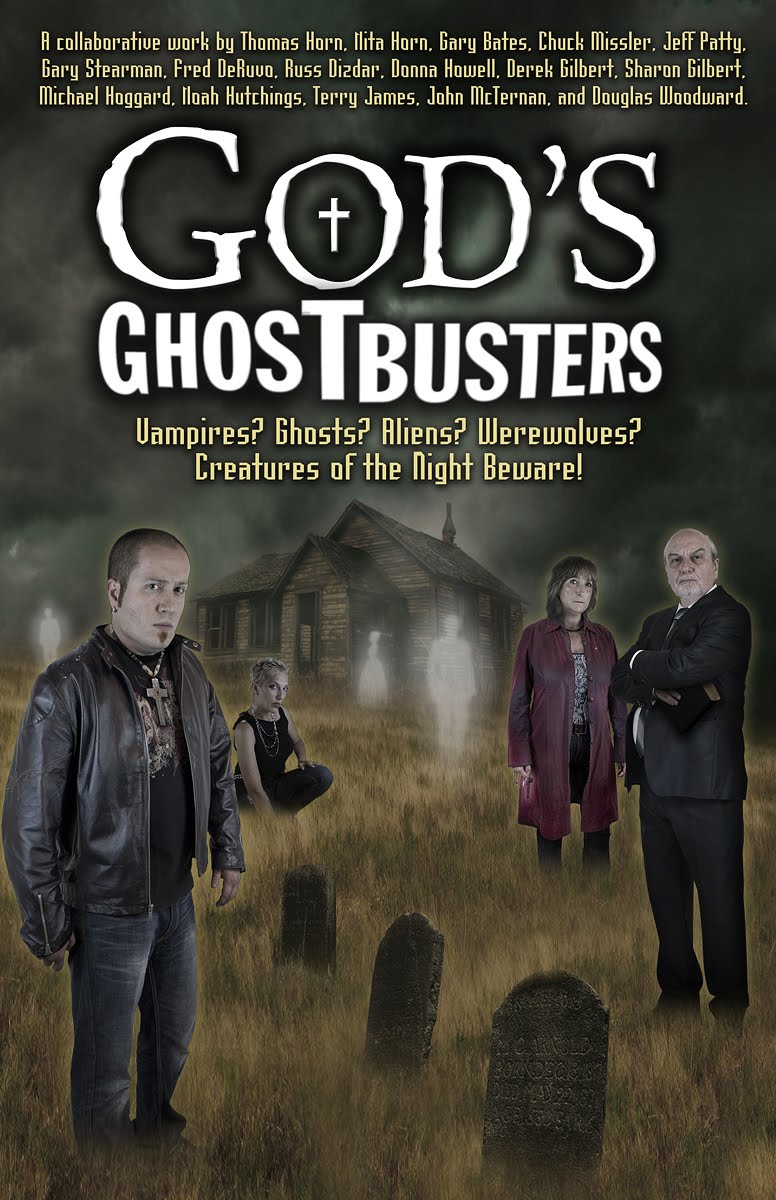
The Halloween season is upon us, and while many are enjoying this time of festive celebration with its ghosts and goblins, not everyone finds pleasure in such things. It is not uncommon for Protestant evangelicals and fundamentalists to express grave concern over the alleged dangers of the holiday itself, as well as the various elements associated with it. Many times books are released touching on evangelical concerns related to this time of year, and thanks to The Wild Hunt I was recently made aware of the 2011 contribution to this evangelical phenomenon.God's Ghostbusters: Vampires? Ghosts? Aliens? Werewolves? Creatures of the Night Beware! (Defender Publishing LLC, 2011) was published last month, just in time for the multi-author contributors of this volume to register their concern about all things horrific. Much can be learned about the perspective and background of this book by considering the product description (with additional insights provided by this YouTube clip):
Recently some 300 exorcists flocked to Poland for a week-long congress to examine the current fashion for vampirism the world-over and the apparent connection between this fascination and a surge in demonic possession.If readers are looking for an analysis of horror in popular culture, as well as various aspects of Western esotericism, and the paranormal, coupled with academic theological analysis, this is not the volume in which such things can be found. (Many of the weaknesses of other evangelical books on this topic apply to this volume as well.) The contributors are obviously out of their depth in addressing the subject matter with competency. A few examples of this include the fact that statistics are provided that cannot be substantiated and which confirms the worst fears of evangelicals regarding certain minority religions. The volume also gives no indication of awareness of sound demographic studies on Paganism, minority religions and identity groups, or the paranormal. It also continues to connect various minority religious traditions, as well as the paranormal, with Satanism, demonstrating a misunderstanding of Satanism, as well as the paranormal and minority religions themselves.
This comes as the world is experiencing an explosion of ancient occultism combined with wicked fascination for ghosts and all things paranormal. In the United States alone, there are now more than two hundred thousand registered witches and as many as 8 million unregistered practitioners of “the craft.” On college and high school campuses, vampires, werewolves, and other “creatures of the night” are esteemed as objects of desire and idolized by young men and women who view them as cult icons of envious mystical power. Church goers are enchanted by the darkness as well. An April 13, 2011 article “Mysticism Infecting Nazarene Beliefs” was preceded only a few days before by a Telegraph article describing how a “surge in Satanism” inside the church has sparked a “rise in demand for exorcists” within traditional religious settings.”
What this volume actually does is tell us more about the contributors, their audience, and the sociophobics of the religious other within the evangelical subculture than it does about Western esotericism, minority religions, or the paranormal. In reflecting on this volume I couldn't help but be reminded of Dana Carvey's Church Lady character on Saturday Night Live. This character makes audiences laugh because of not only the confirmation of stereotypes, but also because of the one-dimensional nature of her concerns about the culture around her where Satan is behind every alleged transgression. In the same way the theological analysis of this volume is thin and simplistic, trotting out a well-worn dualism, with satanic forces seemingly far more powerful and present than the divine.
I hope that one Halloween season evangelicals will demonstrate a willingness to stop bearing false witness against their neighbors involved in various facets of popular occulture, and that they move beyond a response worthy of the Church Lady.
Related posts:
"Interview with the authors of Paranormal America"
"Wicca as America's Third Largest Religion?: Unfortunate Evangelical Sensationalism"
"Summary Thoughts: New Book Generation Hex"
Monday, October 03, 2011
Space.com: Are Aliens Part of God's Plan Too?

Space.com includes an essay with the intriguing title "Are Alien's Part of God's Plan Too?: Finding E.T. Could Change Religion Forever." The essay mentions a gathering of "Christian thinkers" at the 100 Year Starship Symposium that considered the ramifications of intergalactic travel. As one of the participants put it in regards to the theological aspects of the symposium:
In other words, "Did Jesus die for Klingons too?" as philosophy professor Christian Weidemannof Germany's Ruhr-University Bochum titled his talk at a panel on the philosophical and religious considerations of visiting other worlds.
This issue is a pressing one for theologians who interact with contemporary cosmology and astronomy, and it presents challenges not only to assumptions about life on earth and its relation to the divine, but also about soteriology and incarnation.
See the previous post of mine on "An Astrotheology of Extraterrestrial Life" and a presentation by theologian Ted Peters on the issue that relates to this topic.
Sunday, October 02, 2011
Jeet-Kei Leung: Burning Man and Transformational Festivals
The Wild Hunt blog recently posted on the video above: Jason Pitzl-Waters wrote:
The TEDx Youtube channel recently uploaded a talk by Jeet Kei Leung from TEDxVancouver 2010 on transformational festivals. The half-hour presentation focuses on West Coast-oriented festivals and events like Faerieworlds and Burning Man and talks about how these events re-merge spiritual/religious practices with secular festival culture.As Jason offers his commentary on Leung's work he also connects this idea of transformational festivals to Dragon*Con, a fascinating idea which has merit as I've noted in the religious elements in the Star Trek subculture and in my past posts elsewhere (see below) on the similarities between Burning Man Festival and Dragon*Con.
Near the end of Leung's analysis he summarizes some of the key elements in these festivals. His mention of co-creation in participation, and returning a sense of mythos are especially significant for those in Western Christendom with ears to hears the winds of change among the cultural creatives.
I'm glad to see others picking up on the spiritual and religious significance of these events, and I'm looking forward to Leung's book.
See my related posts "Star Trek as a Religious Phenomenon," "Star Trek Conventions as Sacred Pilgrimage," and "Fan Culture Documentaries: Back to Space-Con, and Four Days at Dragon*Con."